
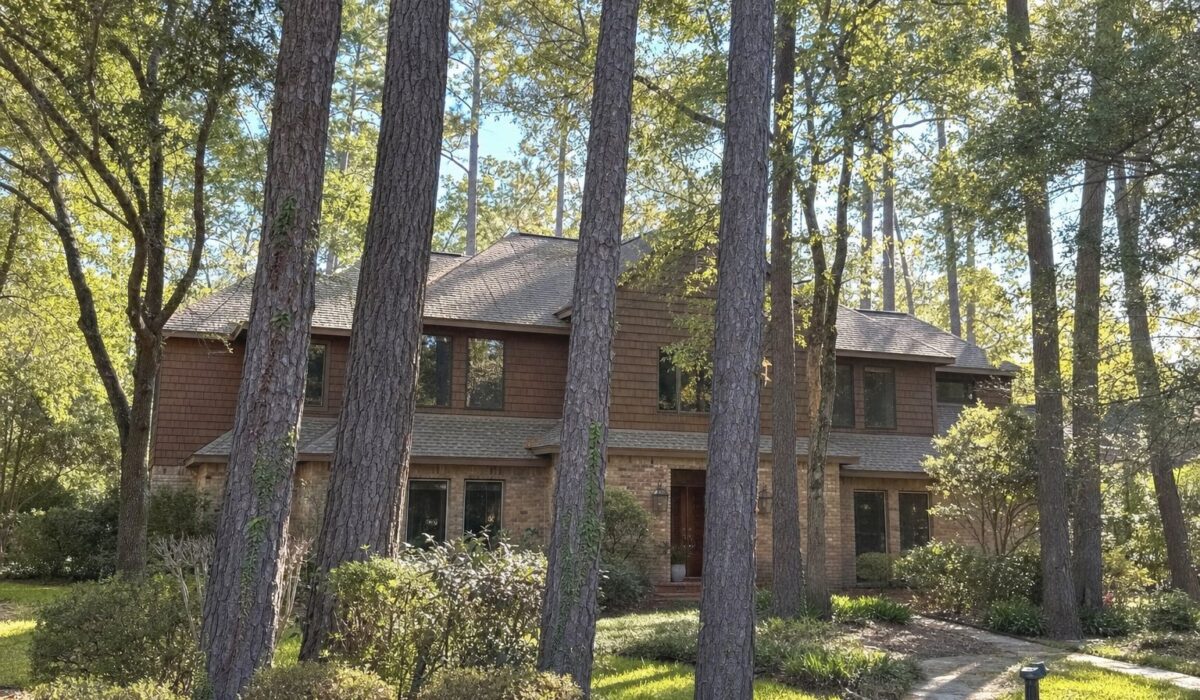
Life under a mature loblolly pine canopy is one of the reasons homeowners choose The Woodlands — the shade, the quiet, the sense of being tucked into East Texas piney woods less than an hour from downtown Houston. The trade-off, which the DC Pines Education Center hears about on almost every service call in ZIPs 77380, 77381, 77382, 77384, and 77389, is what that canopy sheds year-round: long needles, cones, small branches, and pollen landing on the roof, packing into valleys, and drifting into gutters.
This guide covers roof and gutter care under The Woodlands pine canopy: what the township covenants actually require, why standard screen guards fail under pines, and the roof and gutter package the DC Pines Education Center recommends for homes shaded by heavy loblolly cover.
Why The Woodlands roof and gutter lines struggle under pine canopy
The Woodlands was master-planned around its trees, and the numbers still show it. The township’s own preservation rules require a permit for the removal of any live tree six inches in diameter or larger at breast height, which is why so many original loblollies still tower over houses built in the 1980s and 1990s (The Woodlands Township Covenant FAQ). Loblollies drop needles on a rolling schedule with a heavier flush each fall, and mature trees can shed a measurable inch or more of needle litter over a season.
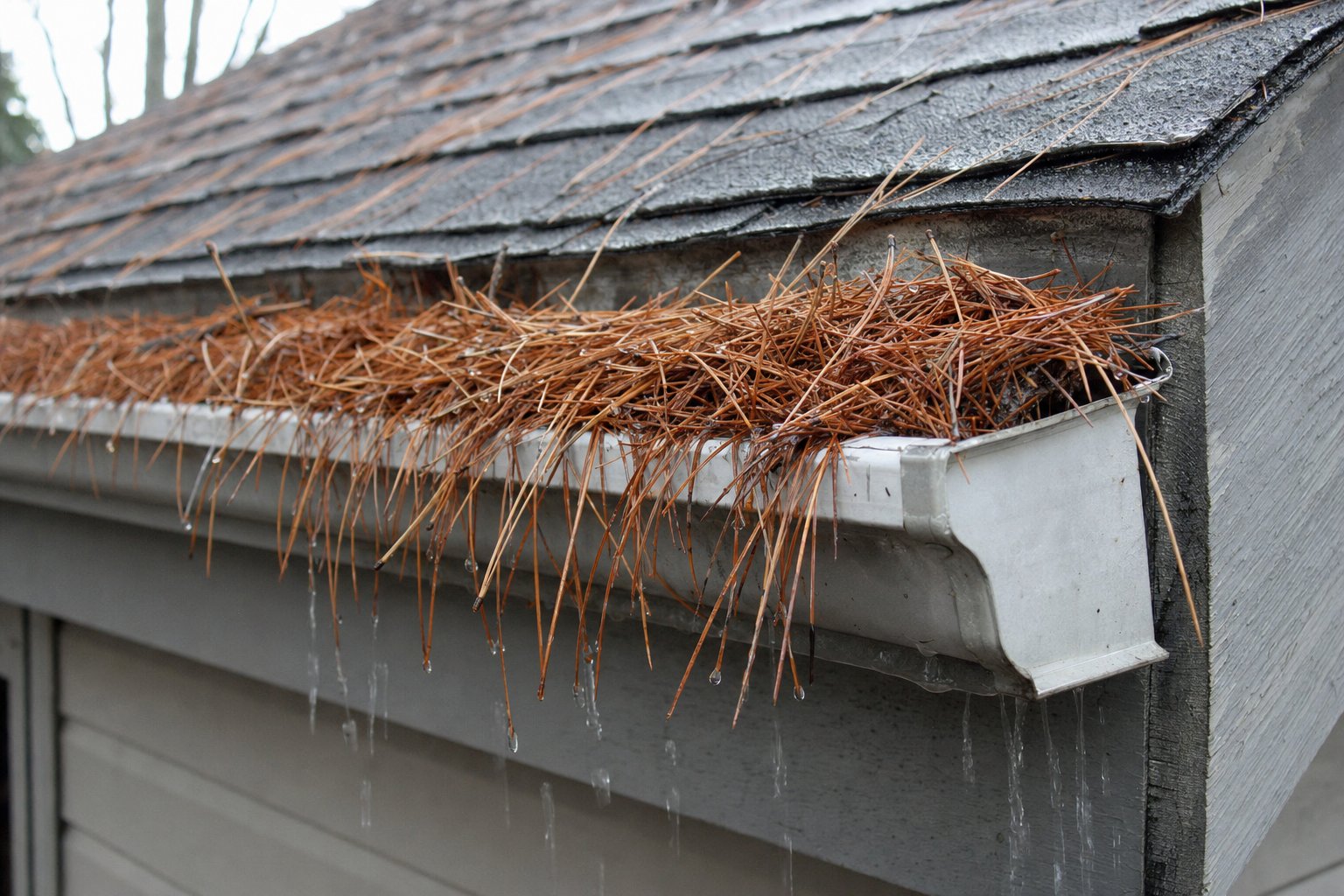
On a Houston-area home without pines, a heavy rain mostly washes debris off the shingles into the gutter. On a Woodlands home, the same rain packs wet needles into the roof valleys, plasters them against the drip edge, and layers them into any open gutter section fast enough that a single afternoon of heavy rain can plug a downspout that was clear the day before.
What the township covenants require
The Woodlands Township Residential Development Standards §3.2 places the maintenance obligation squarely on the homeowner: property must not be allowed to become unsightly, and that explicitly includes roofs and gutters that have accumulated leaves, pine needles, or branches (The Woodlands Residential Development Standards). Covenant Administration inspects neighborhoods and issues formal notices when a roof or gutter line reads as neglected from the street.
The practical read is simple. A Woodlands homeowner does not need to keep the roof spotless, but visible needle mats bridging the valley, needle drapes hanging off the gutter lip, or a downspout dripping brown tannin water down the fascia will get flagged. A regular twice-yearly clearing routine keeps homes well inside the standard.
Why standard gutter guards fail under Woodlands pines
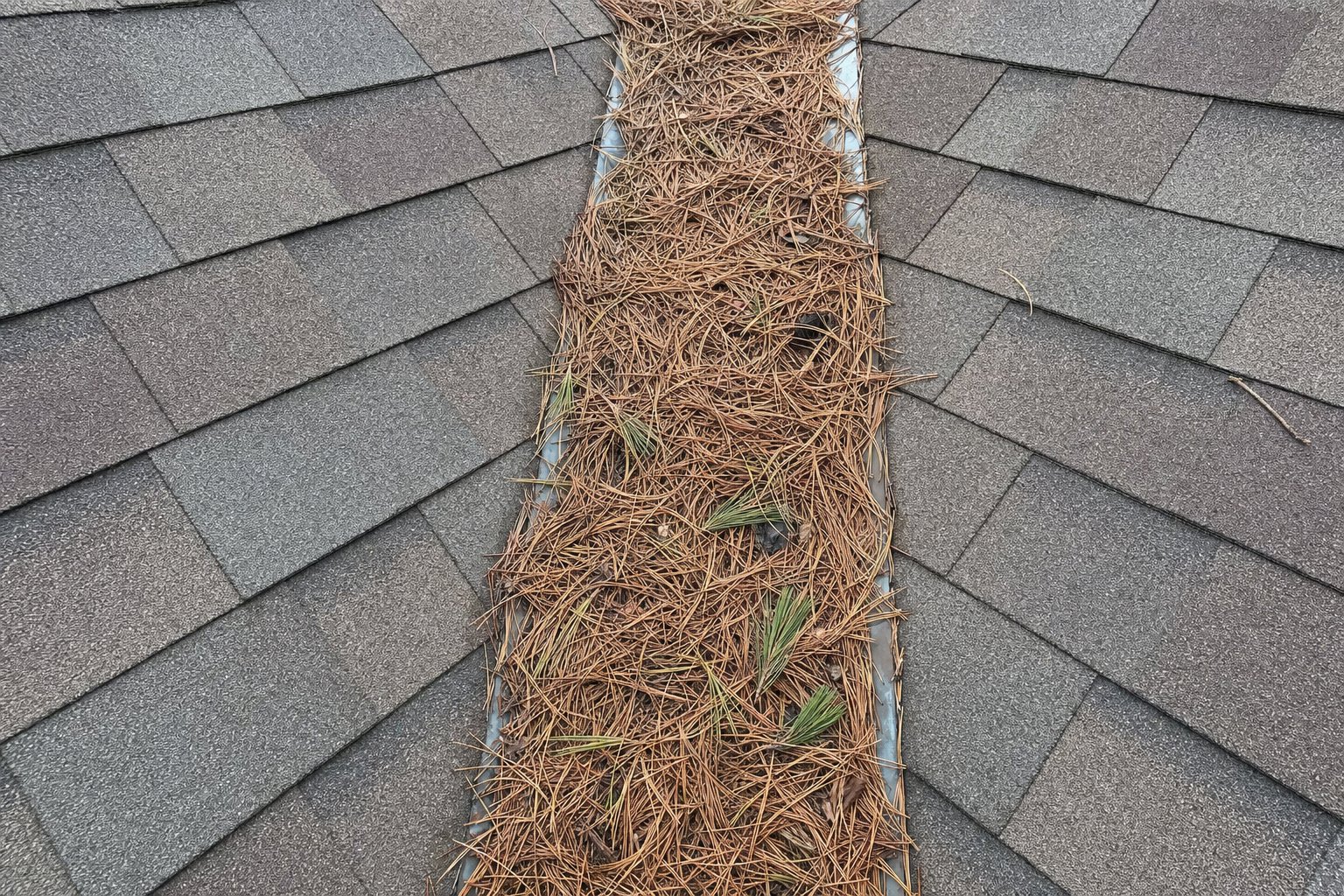
Most gutter guards sold at big-box retailers were designed with hardwood leaves in mind. They stop maple, oak, and sycamore leaves fine — and then fail predictably against a pine.
- Plastic screen and large-opening mesh: Loblolly needles are 6-9 inches long and about 1 millimeter thick. They slip point-first through any opening wider than half a millimeter and form a filter mat inside the gutter.
- Foam inserts: Foam blocks debris on top but soaks up water and pine tannins, and breaks down under UV faster than the gutter itself.
- Reverse-curve guards: The curve becomes a needle catch, and heavy rain overshoots the gutter entirely.
- Slot-style solid covers: Needles wedge into the slots and are almost impossible to clear without pulling the cover off.
The only category that consistently works under mature Woodlands pines is surgical-grade stainless micro-mesh with an opening smaller than the diameter of a pine needle. The mesh sits on a rigid frame flush with the shingles, needles blow or wash off, and water passes through at a published flow rate. DC Pines installs a stainless Z-bend micro-mesh on a factory-formed frame, screwed into the gutter rather than the shingles, with the mesh continuous from end cap to end cap — the version that Woodlands homes actually keep clean season after season.
The 6-inch gutter and downspout question
Most Houston-area homes ship from the builder with 5-inch K-style gutters and 2×3 downspouts. That is fine on a modest single-story home with light canopy — and undersized on many Woodlands homes.
Two conditions push a home toward 6-inch gutters with 3×4 downspouts: roof geometry (steep pitches and long unbroken runs dumping water into a small number of downspouts) and canopy density (heavier organic loading clogs the cross-section faster). Under a mature loblolly canopy, both usually apply. A 3×4 downspout also leaves the splash block gently instead of eroding a trench alongside the foundation, which matters on the sandy soils that swell and shrink with moisture.
Valley protection: the step most homeowners skip
The DC Pines Education Center sees more premature shingle failures on Woodlands homes trace back to neglected valleys than to any other single cause. When a pine needle mat sits in a valley, three things happen in sequence: the mat holds moisture against the shingles for 24-48 hours after every rain, trapped moisture accelerates granule loss, and algae and moss colonize the mat and lift the shingle tabs.
Twice-yearly valley clearing — done from a properly staged ladder, not by walking the valley — takes the mat off before the cycle starts. On heavier-canopy homes, three or four passes per year is the right cadence. It is the cheapest single maintenance step a Woodlands homeowner can take, and it materially extends shingle life. Selective pruning of overhanging branches to 6-10 feet of vertical clearance from the roof surface is a normal arborist service that does not trigger the township’s tree removal permit, since that permit applies only to removal of live trees six inches or larger at breast height.
Roof color approval: what the township expects
The Woodlands Township treats a roof replacement as an exterior change that needs approval through Covenant Administration before work starts, even when the new roof matches the old one. The township’s residential standards call for roof colors that harmonize with the natural landscape: muted tones without a contrasting color pattern, and no glossy finishes. The practical palette is architectural asphalt shingles in weathered wood, driftwood, charcoal, and slate gray.
The most common expensive mistake is ordering shingles before the application is approved. A complete application with the exact shingle name and color, and a physical sample board when staff request one, is the fastest path. Gutters follow the same quiet palette: seamless aluminum in bronze, dark brown, or off-white.
Frequently Asked Questions
How often should gutters be cleaned on a home with heavy canopy?
Two to four times per year is the realistic baseline for Woodlands homes without guards, versus roughly once per year for open-canopy neighborhoods. Micro-mesh guards designed for fine pine debris cut that frequency substantially.
What is the fastest way to get a roof-color application approved?
Submit a complete application through Covenant Administration with a physical shingle sample board attached and a color code that appears on the Township’s compliance list.
Which shingle colors are typically approved in The Woodlands?
Muted shades of brown, gray, and black without a color pattern are the standard. Common tones include weathered wood, driftwood, charcoal, and slate gray. Bright or high-contrast roofs are rarely approved.
The Bottom Line
The Woodlands earned its name honestly, and the maintenance program for a home under those trees is different from the rest of Houston. Township covenants require homeowners to keep the roof and gutter line looking cared for; standard screen guards let pine needles through and are functionally useless under mature loblollies; and a valley left packed with needles is the fastest way to age out a shingle system that should last another decade. A stainless micro-mesh guard package, 6-inch gutters where the geometry calls for them, twice-yearly valley clearing, and 6-10 feet of branch clearance handles all of that quietly. Woodlands homeowners can cross-reference the DC Pines Kingwood tree canopy roof and gutter guide, the Houston downspout sizing guide (2×3 vs. 3×4), and the Houston gutter maintenance guide for the underlying logic that applies across canopy-heavy neighborhoods.
For covenant approval, pine-canopy roofing and gutters, see our roofing page for The Woodlands.
The Woodlands homeowners get a roof + gutter package built for pine canopy.
From valley clearing to micro-mesh guards to 6” upsizing, DC Pines Roofing installs and maintains exteriors that hold up under mature loblolly pines and stay inside township standards.

Jeffrey Ternois
Jeff Ternois is the owner and founder of DC Pines Roofing, a veteran-owned roofing, gutter, and window company in Houston. A former U.S. Army Infantry Captain, he led an infantry platoon in Afghanistan and was awarded the Bronze Star Medal and the Combat Infantryman Badge. After the Army he earned an MBA focused on real estate and learned homebuilding from the studs out before founding DC Pines. DC Pines Education Center guides are published under his direction.