
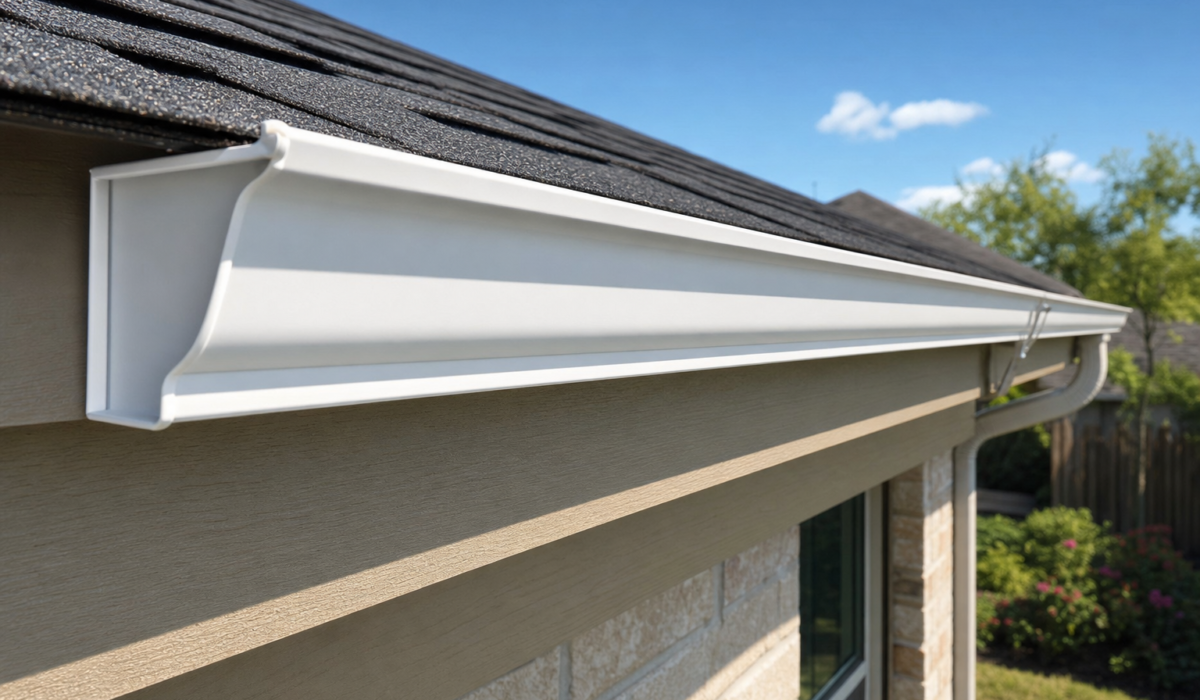
Every seamless aluminum gutter in Houston is held to the house by exactly one thing: the fasteners connecting the back of the trough to the wood fascia behind it. When those fasteners hold, water flows from the roof into the gutter, through the downspout, and away from the foundation. When they fail, the gutter sags, water sheets behind it instead of through it, and the fascia below begins a slow rot cycle that can go unnoticed for years.
Two very different fastening systems are common on Houston homes, and the difference between them is one of the most overlooked details in residential gutter work. This guide covers both systems, how they perform under Houston’s thermal and humidity cycles, and how houston gutter hidden hangers can be identified from the ground. Knowing which system is on the house makes it far easier to catch early failure.
The Two Gutter Fastening Systems on Houston Homes
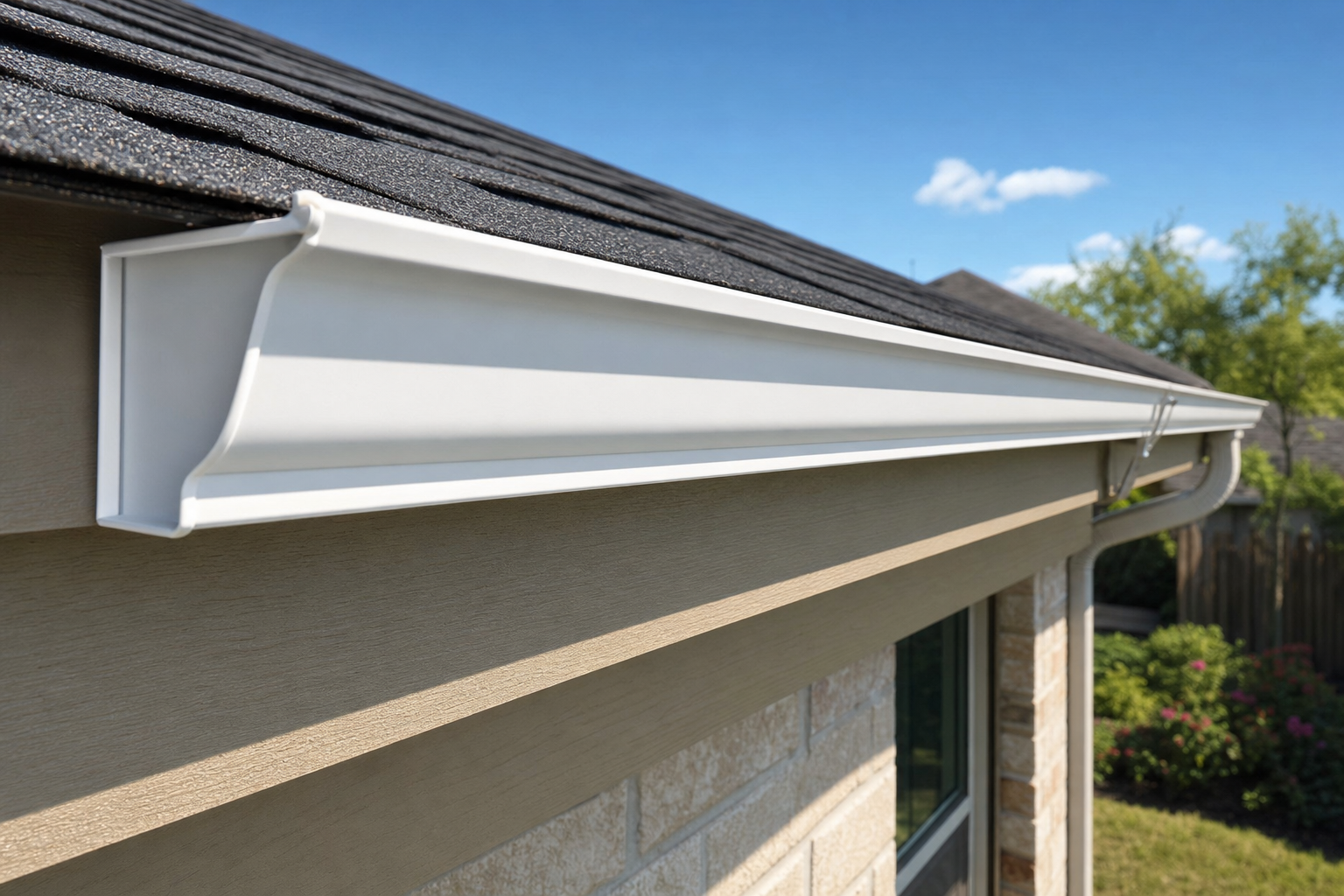
Aluminum K-style gutters — the profile on the vast majority of Houston homes — are attached to the fascia in one of two ways. The older method, spike-and-ferrule, drives a long nail (the spike) through the front lip of the gutter, through a hollow metal sleeve (the ferrule) inside the trough that keeps the gutter from crushing shut, and into the fascia board. The newer standard, the hidden hanger, is a shaped metal clip that hooks onto the front lip of the gutter from inside and screws into the fascia at the back with a hex-head screw.
From the ground, the visual difference is decisive. Spike-and-ferrule systems produce a row of small round nail heads spaced every two to four feet along the front of the gutter. Hidden hanger systems produce a completely smooth gutter face because every fastener is concealed inside the trough. On any given Houston street, both systems are usually present — spike-and-ferrule on homes that have never had a gutter replacement, hidden hangers on any home that has had gutters replaced in the last fifteen to twenty years by a quality installer.
How Hidden Hangers Actually Hold
A hidden hanger works because the fastener thread — not the shank — resists pullout. The bracket clips onto the front bead of the gutter, arches across the trough, and lands on the back wall against the fascia. A stainless-steel hex-head screw drives through that back wall into the fascia. Because the screw is threaded, it grips fresh wood fiber and resists thousands of pounds of pull-out force per fastener.
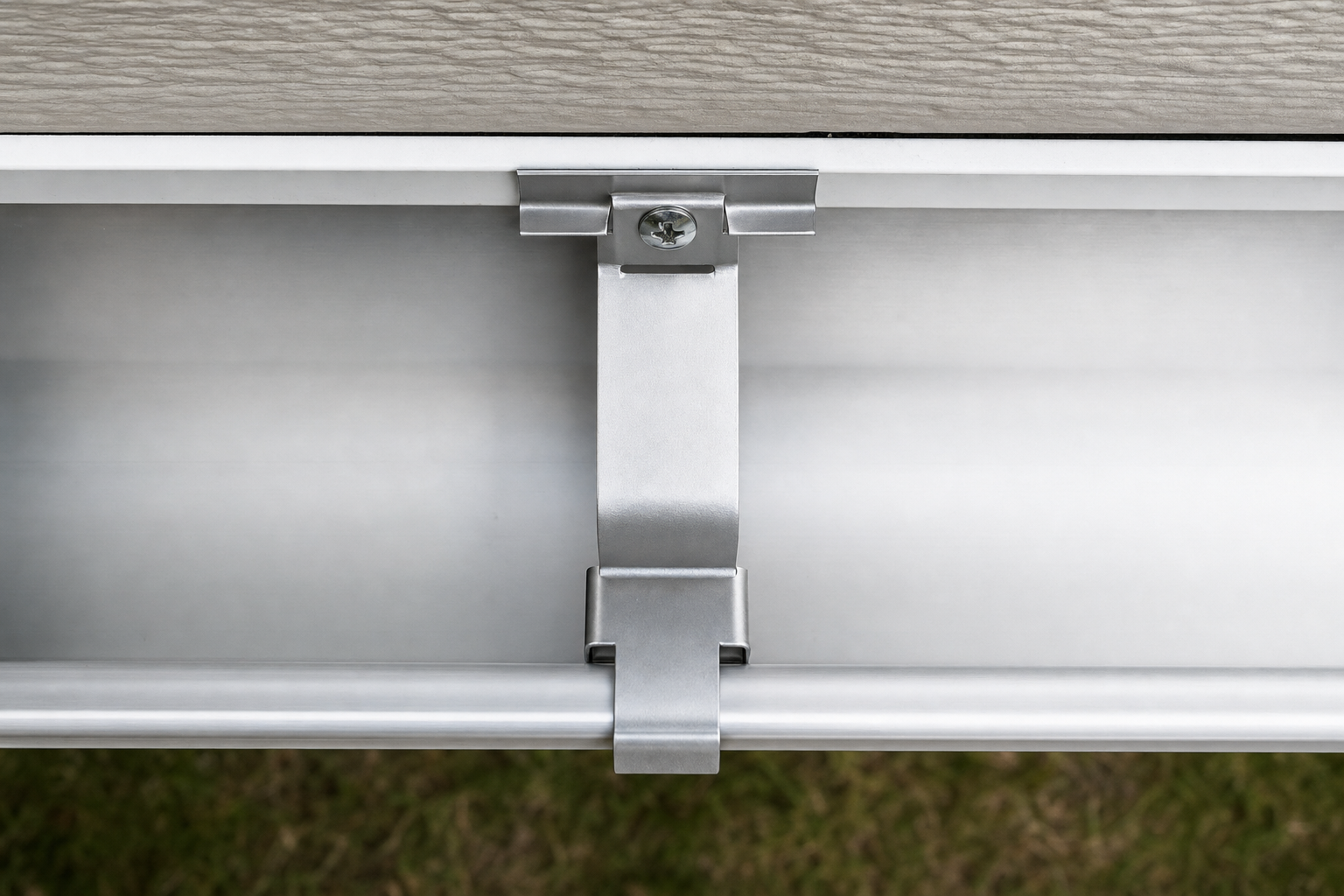
Industry practice for K-style aluminum gutters is one hidden hanger every 24 inches on center along straight runs, tightening to roughly 18 inches near inside corners and valleys where water volume concentrates. Building-science publications reinforce this two-foot spacing as the durable-installation baseline, with stainless steel fasteners specified to resist corrosion from the mildly acidic runoff pine needles and oak tannins produce.
Why Stainless Matters in a Humid Climate
Houston’s humidity and organic-debris runoff make fastener corrosion a real long-term variable. A hidden hanger secured with a coated deck screw or plain galvanized screw holds short-term but can lose head strength within a decade as the coating breaks down. Stainless-steel hex-head screws add about a dollar per fastener and effectively remove corrosion from the failure equation.
Why Spike-and-Ferrule Systems Loosen
Spike-and-ferrule fastening was the residential standard for decades and is functional on the day it is installed. The problem is what happens over the years that follow. A gutter spike is a smooth-shank nail; it has no threads and holds against pullout only through the friction of wood fibers pressing against a smooth shaft. Every time the aluminum gutter heats up in the Houston sun, it expands; every night or summer storm, it contracts.
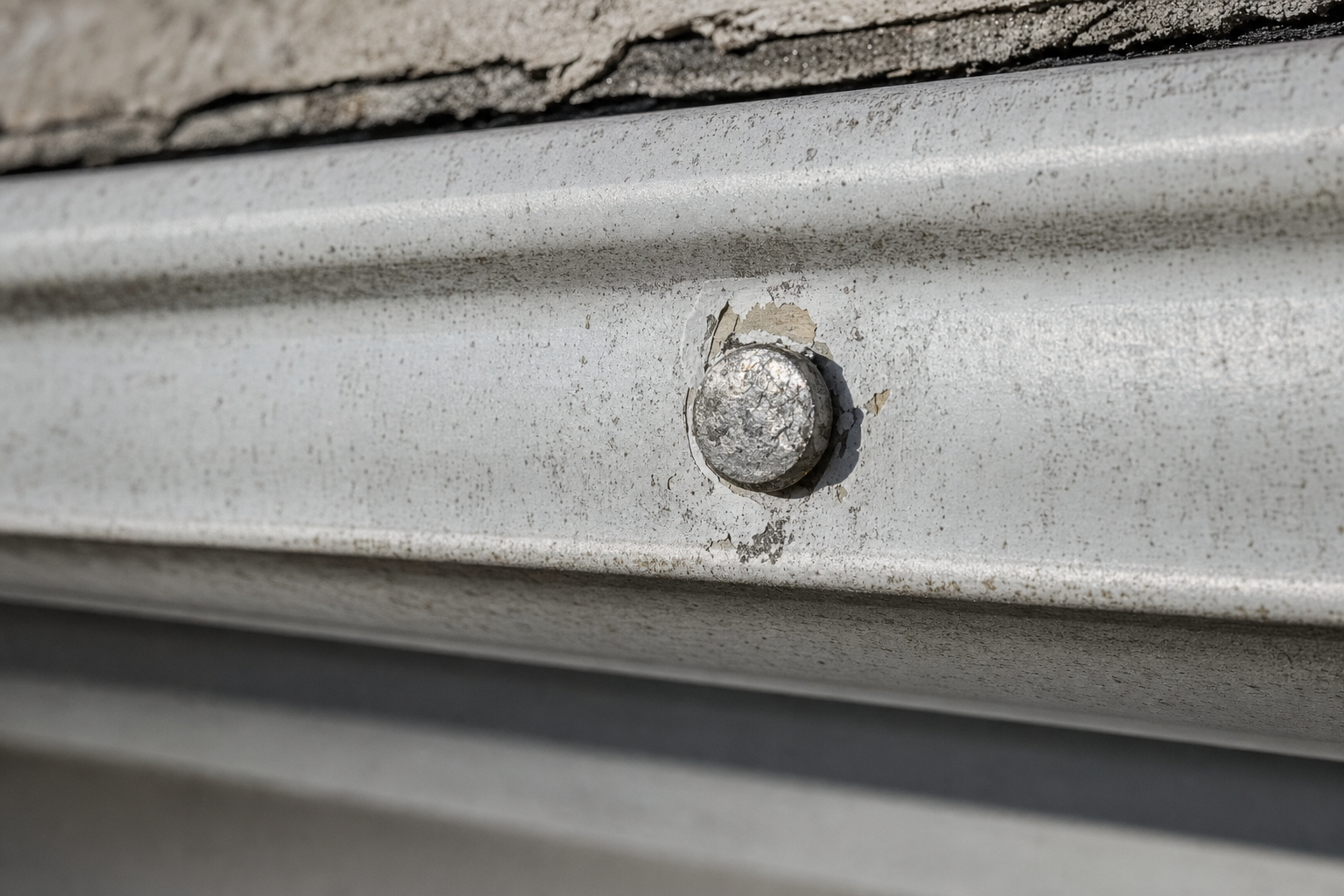
Because aluminum expands about twice as much as wood per degree of temperature change, the ferrule slides minutely against the spike shank over thousands of daily cycles. Each cycle enlarges the hole in the fascia by a fraction of a millimeter. The spike backs out — sometimes visibly proud of the gutter face — and the gutter sags between fastening points. Houston’s long thermal cycling season, roughly March through October, accelerates this compared to milder climates.
The Re-Nail Trap
Tapping protruding spikes back in with a hammer buys a few months, not a repair. The hole the spikes re-seat into is already enlarged. Within one or two seasons the spikes back out again, often further than before. The durable path is to replace the spike-and-ferrule system with hidden hangers screwed into fresh fascia wood, or at minimum to replace each spike with a threaded gutter screw that bites into new wood grain.
How Fastener Failure Turns Into Fascia Rot
Gutter fastener failure rarely stays a gutter problem for long. Once the back of a gutter tips outward — even by an eighth of an inch — the seal between the gutter apron or drip edge and the back of the gutter no longer directs water into the trough. Roof runoff sheets between the gutter and fascia, saturating the wood and paint film that seals it.
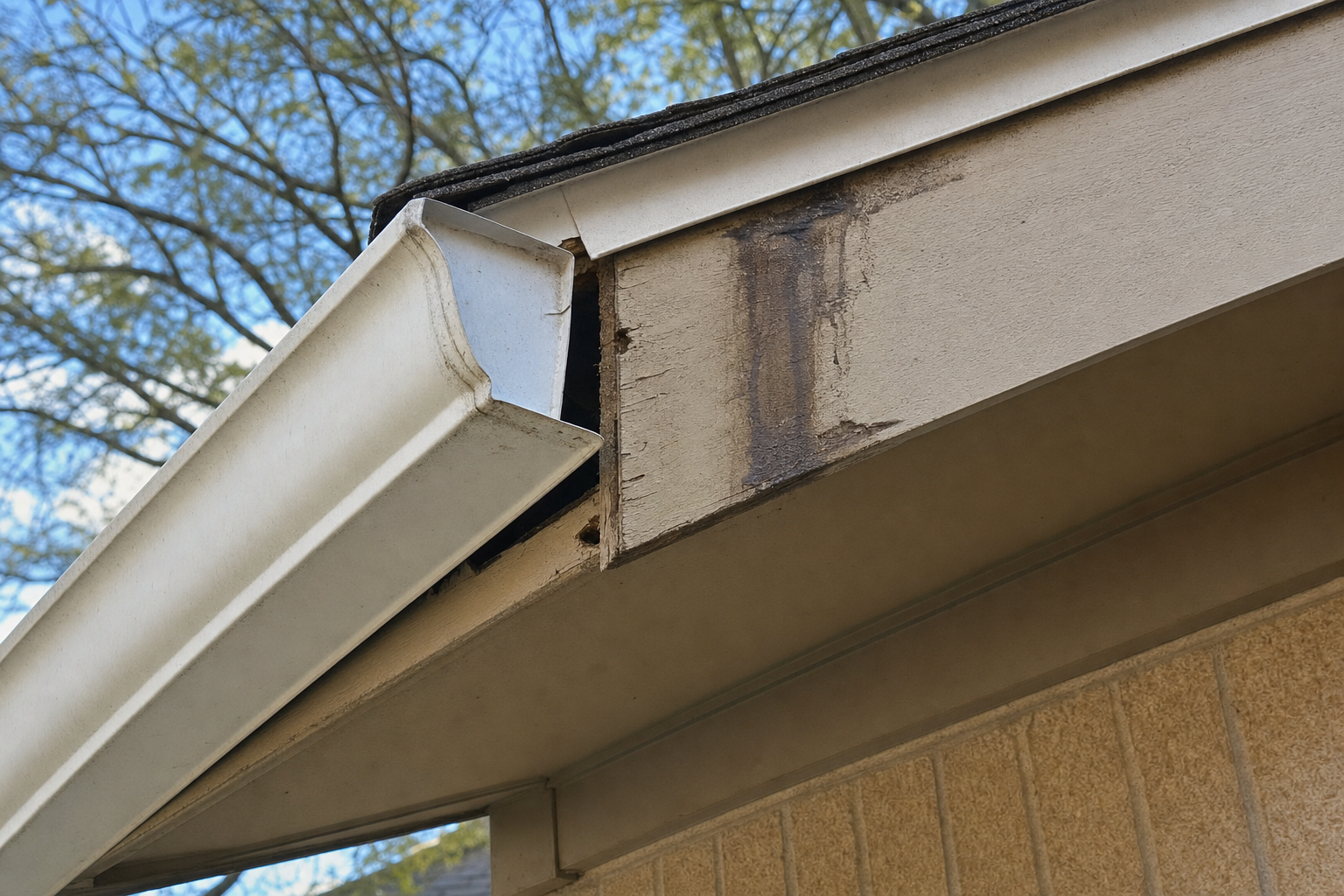
Houston’s rainy season keeps that fascia wet long enough for the paint film to blister and peel, exposing primer and wood grain to repeated wetting. Wood-decay fungi become active above roughly 20 percent wood moisture — a threshold a fascia board behind a leaking gutter easily hits during summer thunderstorms. Once decay starts, the wood loses structural strength, holds fasteners more poorly, and failure accelerates. The U.S. Department of Energy notes that maintaining a continuous water-shedding roof-to-wall detail is one of the highest-return items on the residential envelope.
The Ground-Level Inspection
Three things are visible from the ground without any equipment. First, look along each gutter run for sagging — the gutter line should be straight or run at a slight pitch toward the downspout. Any dip, wave, or belly means at least one fastener has released. Second, look for dark streaks on the fascia below joints and end caps; those are moisture running behind the gutter. Third, on spike-and-ferrule installations, look for nail heads standing proud of the gutter face.
What to Ask for in a Houston Gutter Replacement
When gutter replacement becomes the answer, the fastening specification is often the smallest line item on the bid and the biggest determinant of how long the gutters last. A durable Houston gutter installation should specify hidden hangers, 24-inch on-center spacing along straights, tighter spacing at valleys and inside corners, and stainless-steel hex-head screws into the fascia. If the fascia itself is compromised behind the old gutter, replacement fascia should be included in the scope.
Two additional details worth asking about: whether the installer verifies that the roof drip edge or gutter apron laps over the back of the new gutter (so runoff has no path behind it), and whether downspout outlets avoid concentrated flow at inside corners.
The Bottom Line
The fastener holding a Houston gutter to the fascia is a small piece of hardware doing a large job. A gutter face with visible nail heads is a spike-and-ferrule system on a slow loosening clock in Houston’s thermal cycling; a smooth gutter face is a hidden-hanger system that, if screwed with stainless hex-head fasteners at 24 inches on center, is engineered to outlast the paint on the fascia behind it. Homeowners who can identify which system is on their house and know the visible warning signs are positioned to catch problems years before the fascia becomes the next line item.
For more Houston gutter background, the DC Pines Education Center’s guide to downspout drainage, notes on Kingwood tree-canopy debris, and 5-inch versus 6-inch sizing explainer pair well with this hardware discussion.
Ready to Look at What’s Holding Up Your Gutters?
DC Pines installs seamless K-style gutters in Houston with hidden hangers on 24-inch centers and stainless hex-head fasteners, and inspects fascia condition before every replacement.