
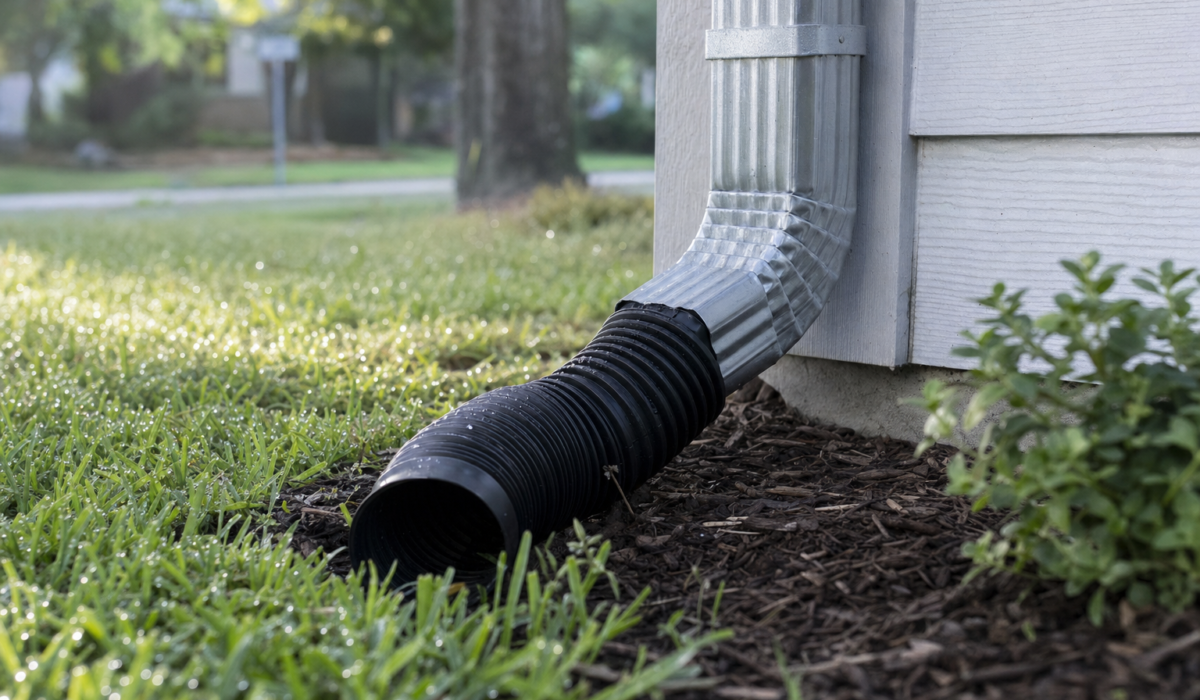
A gutter system that catches every drop of Houston rain still fails if the water it delivers has nowhere sensible to go. Houston downspout extension drainage is the part of the roof-to-ground system most homeowners never think about — until foundation soil starts eroding, a flowerbed turns to soup, or a wet stain climbs the brick above the slab. This guide walks through the three practical options a Houston homeowner has for moving downspout water off the house and away from the foundation, and when each one is worth the money.
The choice is not academic. Houston sits on expansive clay soils that swell in the wet season and shrink in the dry season, and repeated saturation right at the foundation is one of the fastest ways to move a slab. The right drainage detail at every downspout is cheap compared to any of the repairs a missing detail eventually causes.
Option 1: The Flexible Downspout Extension
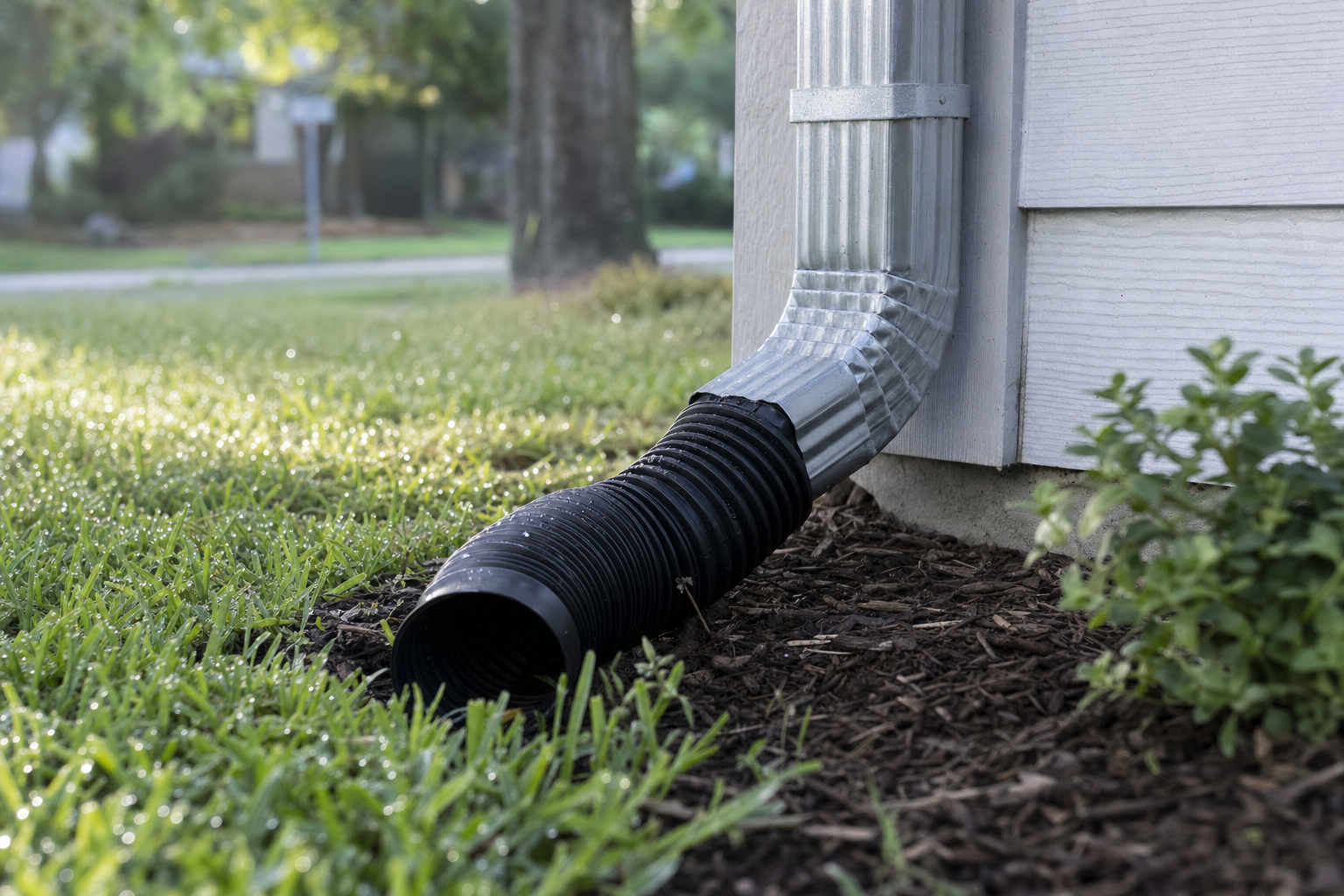
The black corrugated flex extension is the least expensive and most common Houston drainage detail. A stub of 3×4 or 2×3 rectangular downspout connects to a flexible corrugated tube that lies on the ground and carries water four to eight feet out into the lawn or a mulch bed.
The pros are real: low cost (usually under thirty dollars in materials per downspout), no permits, no digging, easy to remove for mowing. The cons are equally real: the tube is a trip hazard, it kinks under a lawnmower tire, ultraviolet light degrades it in a couple of Houston summers, and it dumps a concentrated jet of water at a single point that can erode a mulch bed or wear a bare channel in the grass over time.
Where a flex extension works
Flex extensions are the right call on the side of the house where the lawn slopes clearly away from the foundation, where the discharge point is not on a walkway, and where a homeowner does not mind lifting the tube to mow. On many single-story Houston homes with a shallow-pitch roof and modest gutter loads, that describes most of the downspouts on the property.
Where a flex extension is not enough
If the lawn slopes back toward the house, if the downspout is on a shaded elevation where the ground stays saturated, or if the discharge point crosses a walkway or patio, a flex extension is a stopgap. In those spots, the water needs to be carried below grade to a place that can actually accept it.
Option 2: The Underground Drain to a Daylight Outlet
An underground drain is a buried pipe — usually 4-inch smooth-wall PVC or corrugated HDPE — that receives the downspout discharge, carries it below the lawn surface, and exits (“daylights”) somewhere on the property where the water can safely spread out. On a Houston lot with any meaningful grade, this is the highest-performing drainage detail available.
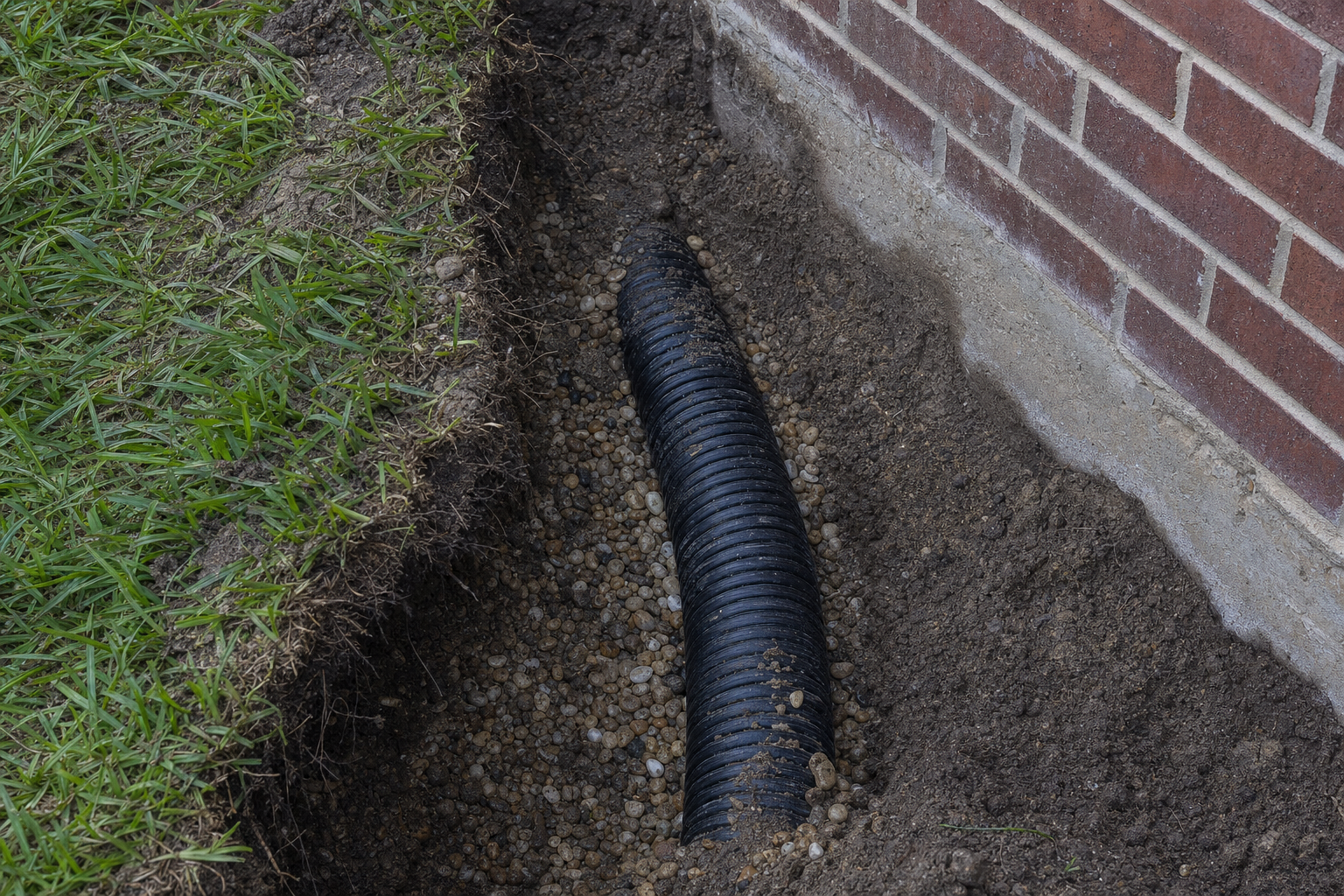
The pros: nothing on the surface to trip over or mow around, no ultraviolet degradation, a concentrated discharge point at the end of the run rather than at every downspout, and — with smooth-wall pipe — service intervals measured in years, not months. The cons: it costs several hundred dollars per run installed, requires digging (call 811 first for locate services), and needs a proper slope of at least one-quarter inch per foot toward the daylight outlet or it will hold water and silt up.
Two details separate a well-installed underground drain from a headache. First, smooth-wall pipe outperforms corrugated flex for interior friction and self-cleaning. Second, cleanouts at every direction change — a capped vertical stub sticking up flush with the lawn — turn a five-year clog into a fifteen-minute rinse instead of a shovel-and-replace job.
Option 3: The Pop-Up Emitter
When a Houston lot is essentially flat and there is no place to daylight an underground drain, the pop-up emitter is the workaround. It is a green plastic cap installed flush with the lawn at the end of the buried line, spring-loaded to lift under water pressure and close when the flow stops. Water discharges into the lawn, spreads out, and infiltrates over a few minutes.
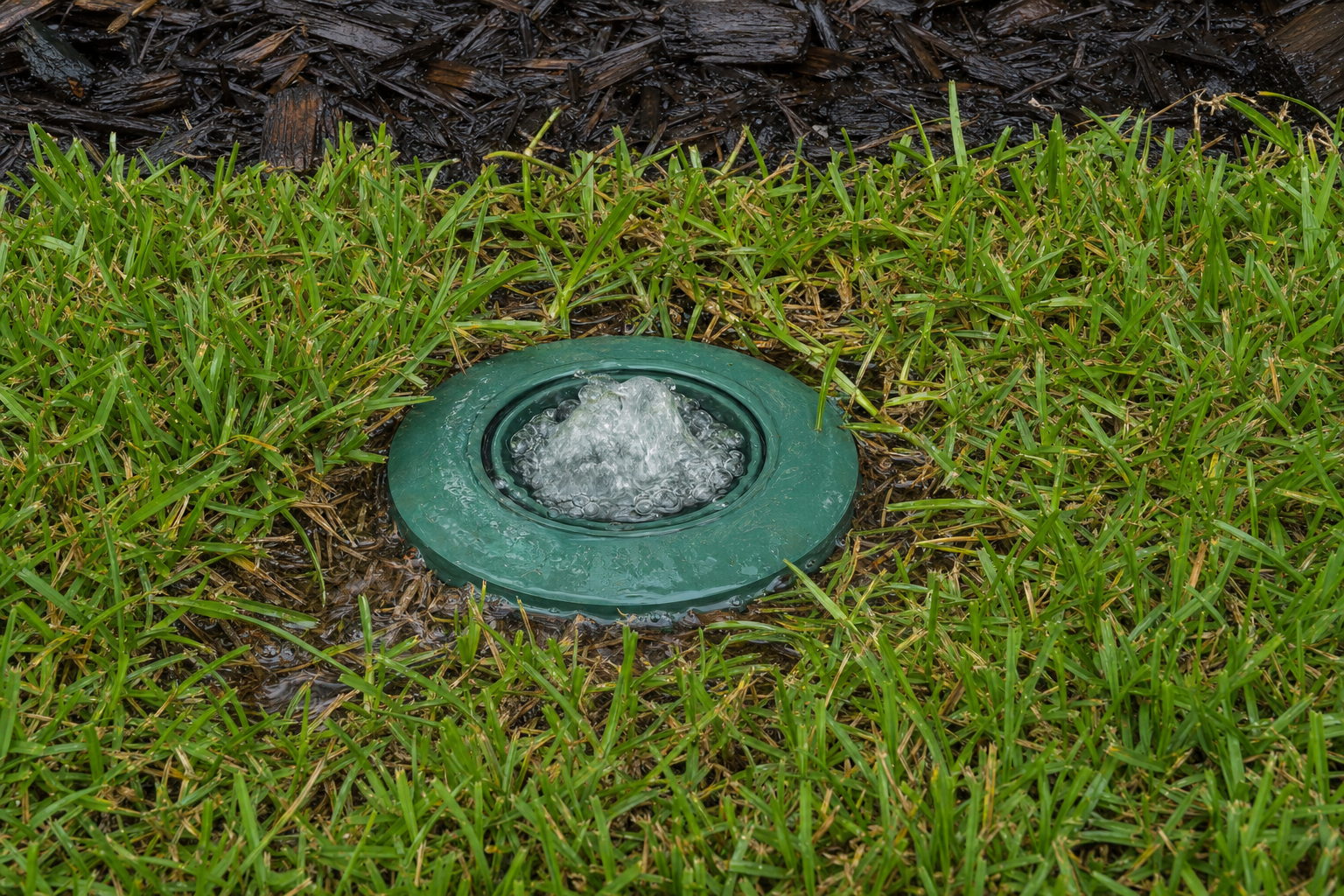
The pop-up emitter works well when three conditions are met: the emitter is installed at the highest point of a gently sloping lawn (not a low spot), the buried line has enough slope to keep silt moving to the outlet, and a leaf-filter basket at the downspout inlet keeps organic debris out of the system. When any of those three conditions is missed — especially the low-spot mistake — the emitter reverses direction during heavy rain and becomes a water inlet rather than an outlet.
A homeowner in a flat Houston subdivision should not skip the emitter over concerns about clogging. A properly installed emitter with a leaf-filter basket at the downspout head is a durable, low-maintenance detail. The choice to skip it is usually a choice to move water back toward the foundation instead — which is the exact problem the emitter is solving.
What Damage Looks Like When Drainage Is Missing
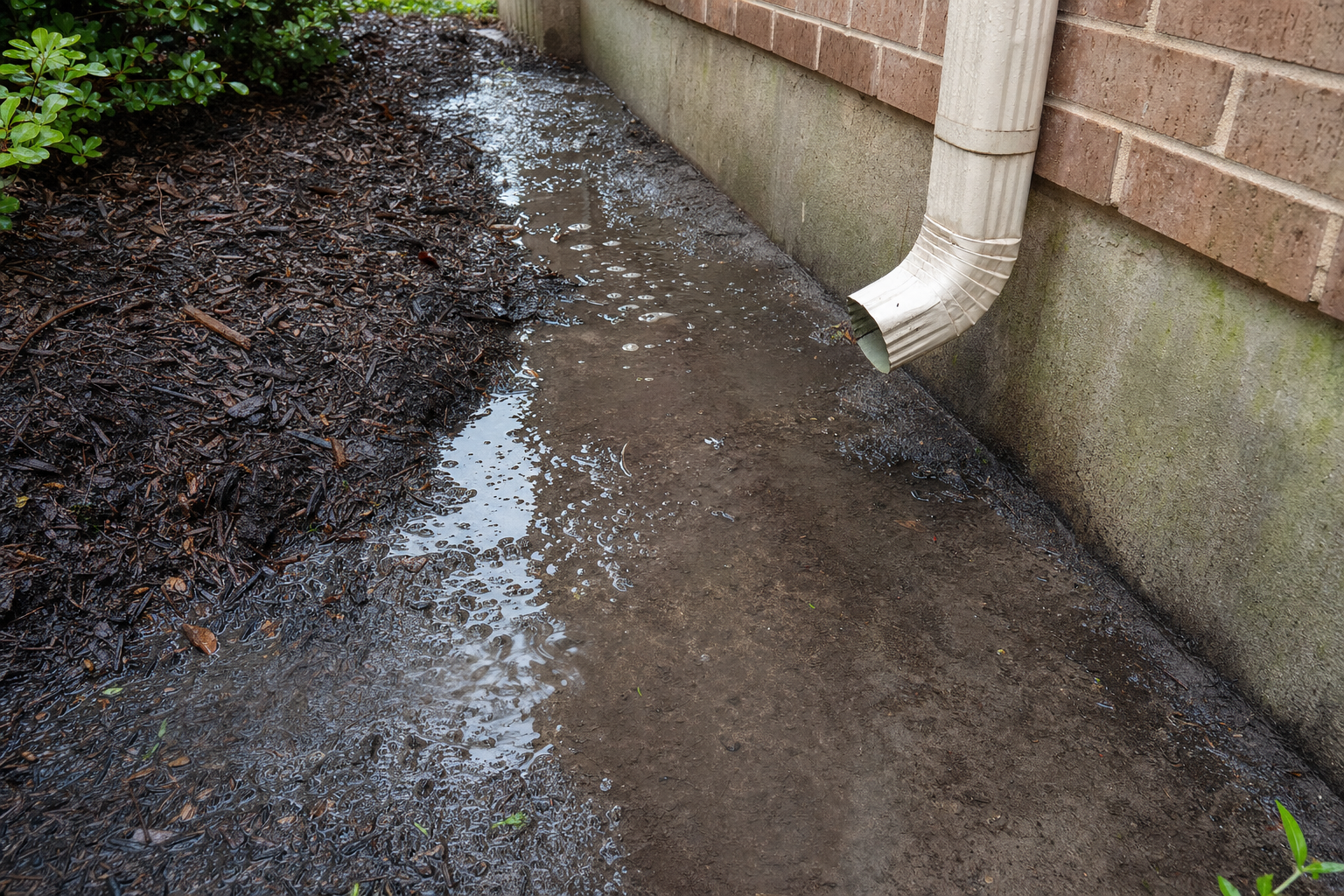
The visible symptoms of missing downspout drainage are easy to spot once a homeowner knows what to look for. A vertical mud line on the brick or siding above the slab shows where splashback has been depositing soil for months. A shallow trench carved through mulch or bare soil traces the water path away from the downspout. Mildew or dark biological staining on the low course of siding on shaded elevations is a moisture readout. Efflorescence — a white mineral crust on brick — signals repeated saturation of the masonry.
The invisible symptoms are more expensive. Repeated saturation of expansive clay soil right at the foundation causes the soil to swell and contract on a much shorter cycle than the surrounding lot, which is one of the mechanisms Houston foundation contractors point to when a slab moves. Wet mulch beds against the foundation also invite subterranean termites, which pass moisture inspections by mud tubes climbing the exposed slab edge.
Related Reading from the DC Pines Education Center
For related gutter and drainage detail work, see the difference between gutter apron and drip edge and how each protects the fascia line, the Houston gutter sizing and downspout capacity guide, and the gutter-guard buying guide for live oak and pine debris.
The Bottom Line for Houston Homeowners
Every downspout on a Houston home needs a plan for where its water goes. On the easy elevations, a flex extension solves it for thirty dollars. On the harder elevations — shaded sides, back-sloped lawns, walkway-adjacent spots — an underground drain to a daylight outlet or a properly installed pop-up emitter is the right investment. According to the HUD Office of Lead Hazard Control and Healthy Homes, moisture control at the foundation is one of the seven principles of a healthy home; downspout drainage is where that principle either happens or does not.
Need better downspout drainage on a Houston home?
DC Pines Roofing designs and installs gutter systems, underground drains, and pop-up emitters across greater Houston — sized for the real Houston rainfall, not a national average.