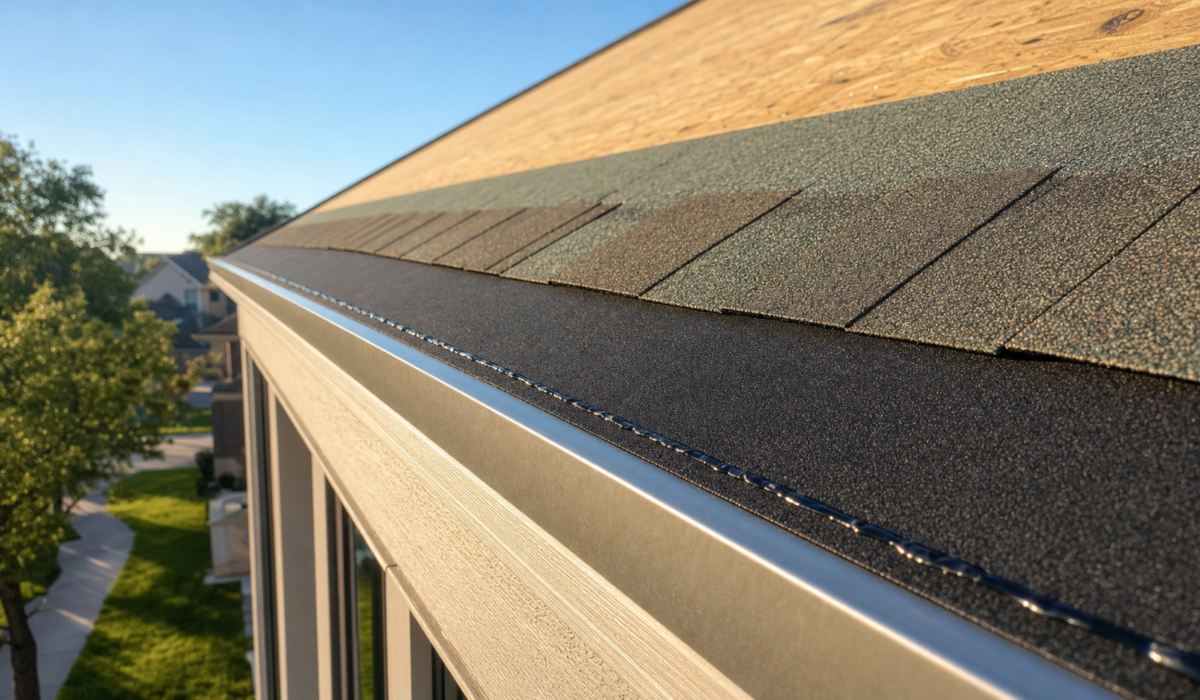
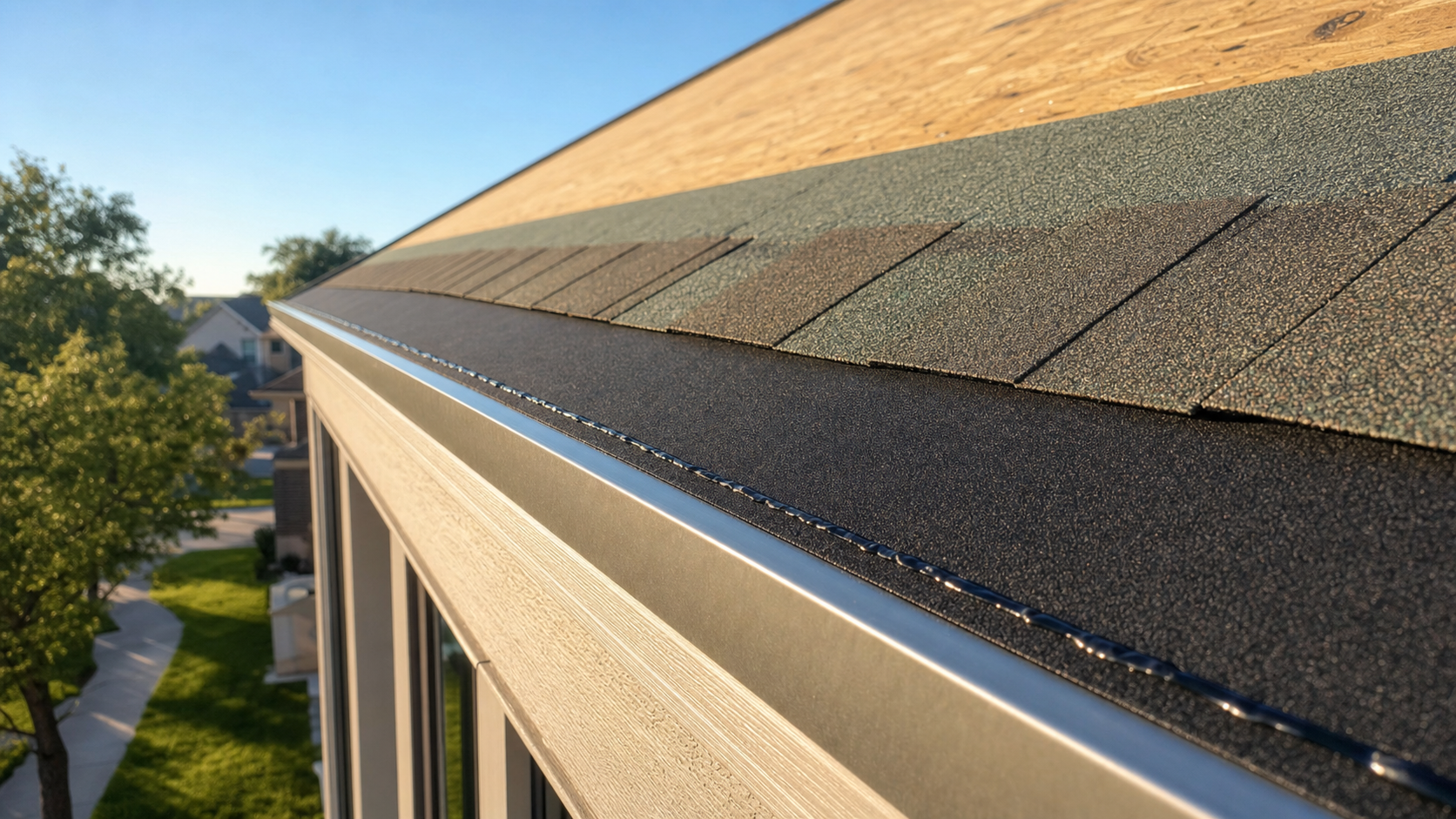
Houston starter strip shingles are the perimeter component most homeowners have never heard of, and they are also the component that decides whether the first row of field shingles stays put or peels back when a summer thunderstorm gust comes across the eave. This DC Pines Education Center primer explains what starter strip actually is, why the manufacturer-made version outperforms cut 3-tab, why it belongs on both the eave and the rake in a Houston installation, and how to spot it on a roofing estimate.
The starter course is not decorative and it is not optional. Every major shingle manufacturer publishes wind-rating labeling that assumes a compliant starter strip is installed along the perimeter of the roof, and the Asphalt Roofing Manufacturers Association residential design manual describes the same requirement in its guidance. It complements the existing Houston Class H shingle wind rating post, the underlayment comparison, and the drip edge versus gutter apron guide, all of which describe perimeter components the manufacturer requires to hit its published performance numbers.
What a Starter Strip Actually Is
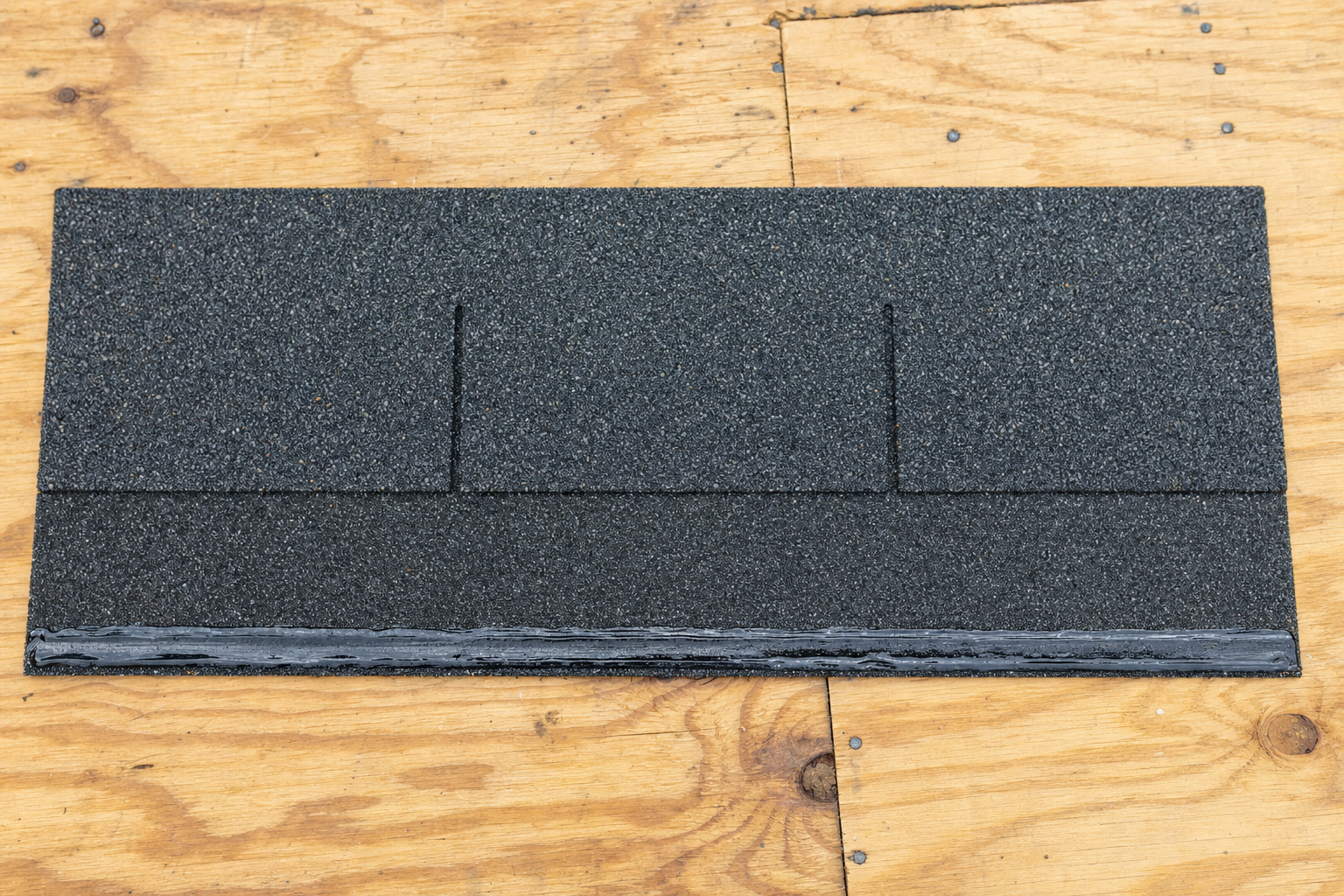
A starter strip shingle is a factory-manufactured asphalt shingle that ships with a continuous self-adhering sealant bead pre-applied along one long edge. It is installed as the first course on the roof deck, with the sealant edge oriented toward the eave or rake. When the first course of field shingles is laid over it, the sealant bead bonds the underside of the first field shingle to the top of the starter, creating a continuous glued seam along the roof perimeter. Wind pressure that reaches under the leading edge of the field shingles hits that seam and stops.
The reason it matters is basic aerodynamics. Wind lifting up and over the roof eave creates a low-pressure zone just above the shingle surface at the perimeter. That low pressure tries to peel the first course upward, and if the shingle is not glued down along its leading edge the peel propagates inward. A properly installed starter strip fixes the leading edge in place, and the wind pressure has no purchase to start the peel.
Manufacturer Starter vs Cut 3-Tab: Why the Substitution Fails
For decades the field convention was to cut down a 3-tab shingle and use it as starter along the eave. That worked, marginally, because a 3-tab has a factory sealant strip a few inches above its leading edge, and a careful installer could orient the cut piece so the sealant strip ended up near the eave. Two things changed. First, architectural laminated shingles replaced 3-tab as the dominant Houston product, and architectural shingles do not have the same factory sealant geometry available for cutting. Second, the Asphalt Roofing Manufacturers Association residential manual and every major manufacturer's written instructions moved to requiring a purpose-made starter product for the wind-rating labeling to apply.
Purpose-made starter delivers a continuous, uninterrupted sealant bond exactly at the leading edge where it is needed, sized for a full linear foot of coverage per unit and packaged for the roof perimeter. Cut shingles produce an intermittent bond, extra labor to cut and orient, and no manufacturer coverage if the wind rating is ever tested against the label. On a Houston roof paying premium for a Class H wind-rated shingle, substituting cut 3-tab for starter is spending Class H money for a Class D installation.
Eave AND Rake: The High-Wind Detail
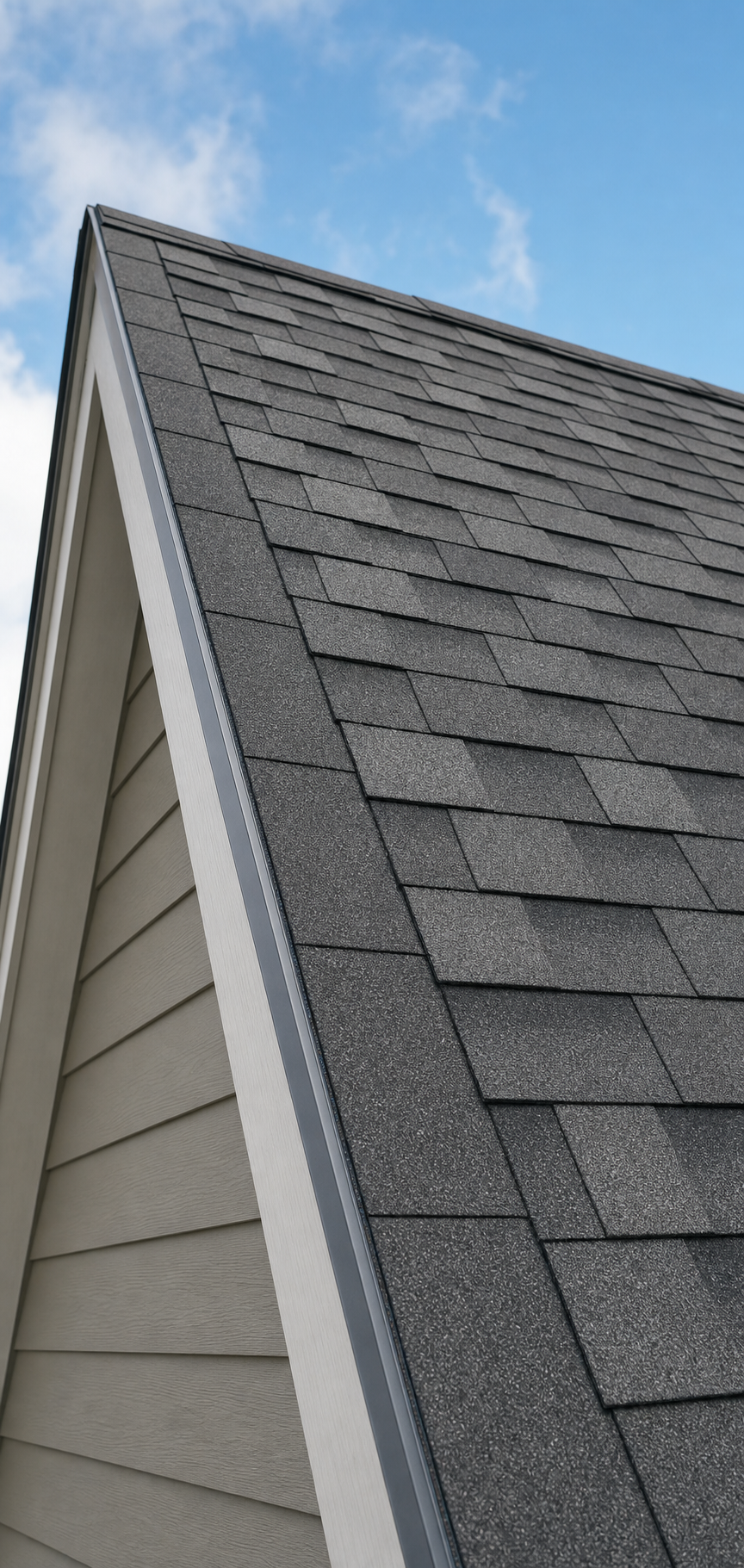
Two perimeter edges need starter on a Houston high-wind installation. The eave is the obvious one — that is the low horizontal edge of each roof slope, and it is where wind first lifts. The rake is the sloped side edge, running from eave up to ridge along the gable end, and it is the second uplift zone that most homeowners overlook. Manufacturer high-wind installation instructions call for starter along the rake as well as the eave, with the sealant bead oriented toward the rake edge so it bonds the side of the first field shingle down.
Reading the Estimate: What to Look For
A complete Houston roofing estimate lists starter strip the same way it lists the other perimeter components. There is a line for the underlayment with brand and coverage, a line for ice-and-water shield if applicable, a line for drip edge with metal gauge and linear feet, a line for ridge cap product and linear feet, and a line for starter strip with product name and linear feet for both eave and rake. If starter is not on the estimate as a line item, it is either being cut from field shingles on the deck or being skipped entirely, and both outcomes end up outside the manufacturer's published wind rating.
Homeowners comparing two Houston roof proposals side by side can use starter strip as a quick honesty check. A proposal that lists starter product, quantity, and coverage for eave and rake is a proposal built to the manufacturer specification. A proposal that omits starter, bundles it into a vague accessories allowance, or writes "starter as needed" is a proposal that has left the wind-rating detail up to whoever happens to be on the roof that morning.
The Bottom Line
Houston starter strip shingles are a small line item with a large consequence: they set the wind uplift performance of the entire roof at the perimeter, where uplift always starts. The manufacturer-made product delivers a continuous sealant bond that a cut 3-tab cannot match, and the installation belongs on both the eave and the rake for a roof that has to hold together under Gulf Coast summer wind. Homeowners who ask to see the starter product name, manufacturer, and linear-foot quantity on the estimate are asking the right question, and a Houston roofer proposing a Class H or Class F shingle should have those numbers ready for both perimeter edges before the estimate is signed.
Ask to see starter strip on the estimate before signing.
DC Pines Roofing lists starter strip as a separate line item on every Houston roofing quote, with product name, manufacturer, and linear-foot quantity for both eave and rake. Homeowners can request a line-item roof estimate that shows every perimeter component the manufacturer requires for the published wind rating.