

The memorial houston canopy is one of the defining physical features of the neighborhood. Live oaks planted seventy or eighty years ago now arch over every street from Memorial Drive through the Villages, and pines fill in the gaps along the older estate lots. That canopy is a genuine asset — it cools the streets, softens the light, and defines the character of some of the most desirable addresses in the Houston metro. It also changes how a home under it should be built, maintained, and re-roofed.
The DC Pines Education Center gets more questions about Memorial-area exterior planning than any other corridor inside the Loop. Homeowners who move from open-lot subdivisions in Katy or Cypress into a shaded Memorial estate lot often carry over maintenance habits that no longer fit — cleaning gutters once a year, treating algae as a resale-year problem, defaulting to standard shingles. This guide walks through what actually changes when a home lives under dense oak and pine canopy, and how to plan a Memorial-lot exterior around those realities.

What Dense Canopy Actually Does to a Roof
The visible effects of Memorial canopy are the ones every homeowner already knows about — leaves in gutters, dark streaks on the shingles, occasional limb strikes. The less visible effects matter more for planning. Constant shade slows the drying cycle after Houston thunderstorms, which keeps shingle mats damp longer and accelerates algae growth. Dropped leaves and pollen catkins pack into roof valleys and around chimney flashings, trapping moisture against the shingles from above. Overhanging limbs abrade the shingle surface every time the wind blows, sanding down the granule layer that protects the asphalt underneath.
According to the U.S. Department of Energy’s guidance on roof performance, roof surface temperature and moisture cycling are two of the strongest predictors of shingle durability. Canopy shifts both variables in opposite directions on a Memorial home — lower peak temperature, slower drying — and the net effect is a roof that ages differently, not necessarily faster, but on a different maintenance rhythm than an open-lot home.
Gutters Are the First Component to Feel It
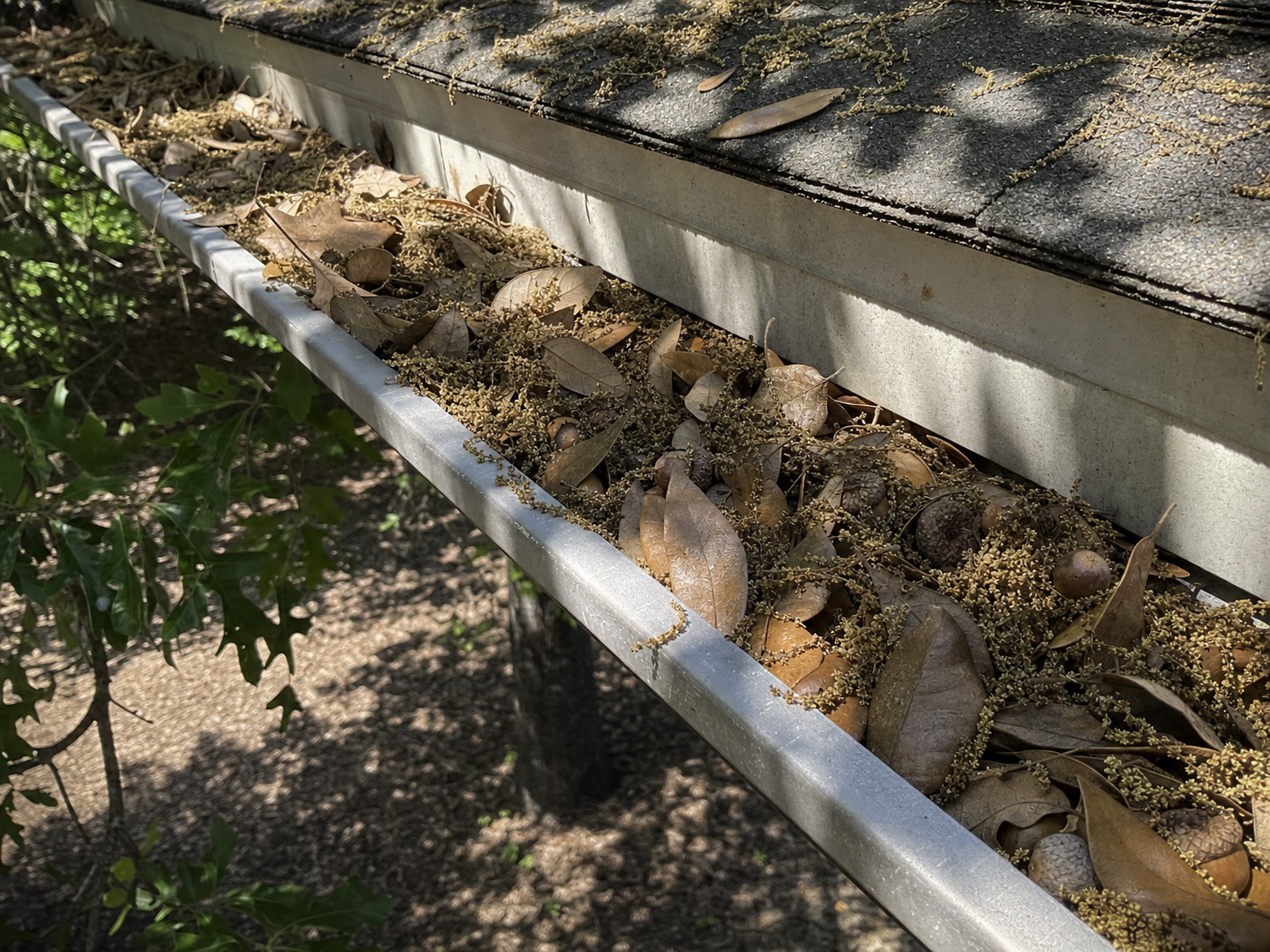
An open-lot home in Fulshear or Bridgeland can often go a full year between gutter cleanings without noticeable performance loss. A Memorial home cannot. Live oaks drop leaves gradually across late winter and early spring, drop catkin pollen strings heavily in April and May, and drop again in November and December. Pines contribute needles year-round. The debris load in a Memorial gutter can pack in enough to fully block downspouts within eight to ten weeks of the last cleaning if the run is long or the roof geometry funnels debris toward a corner.
What the debris load changes
- Cleaning frequency: two visits a year minimum, three on heavy pine lots
- Downspout sizing: 3×4 rectangular downspouts strongly preferred over 2×3 for their higher clog-tolerance
- Hidden hanger spacing: 24 inches on center or tighter to handle the added weight of packed debris
- Aluminum thickness: .032 is typically worth the upgrade over .027 to resist the deformation from ladder contact during frequent cleanings
- Gutter guard consideration: micro-mesh systems earn their cost faster on canopy lots than on open lots
Algae Growth Is a Canopy Symptom, Not a Roof Defect
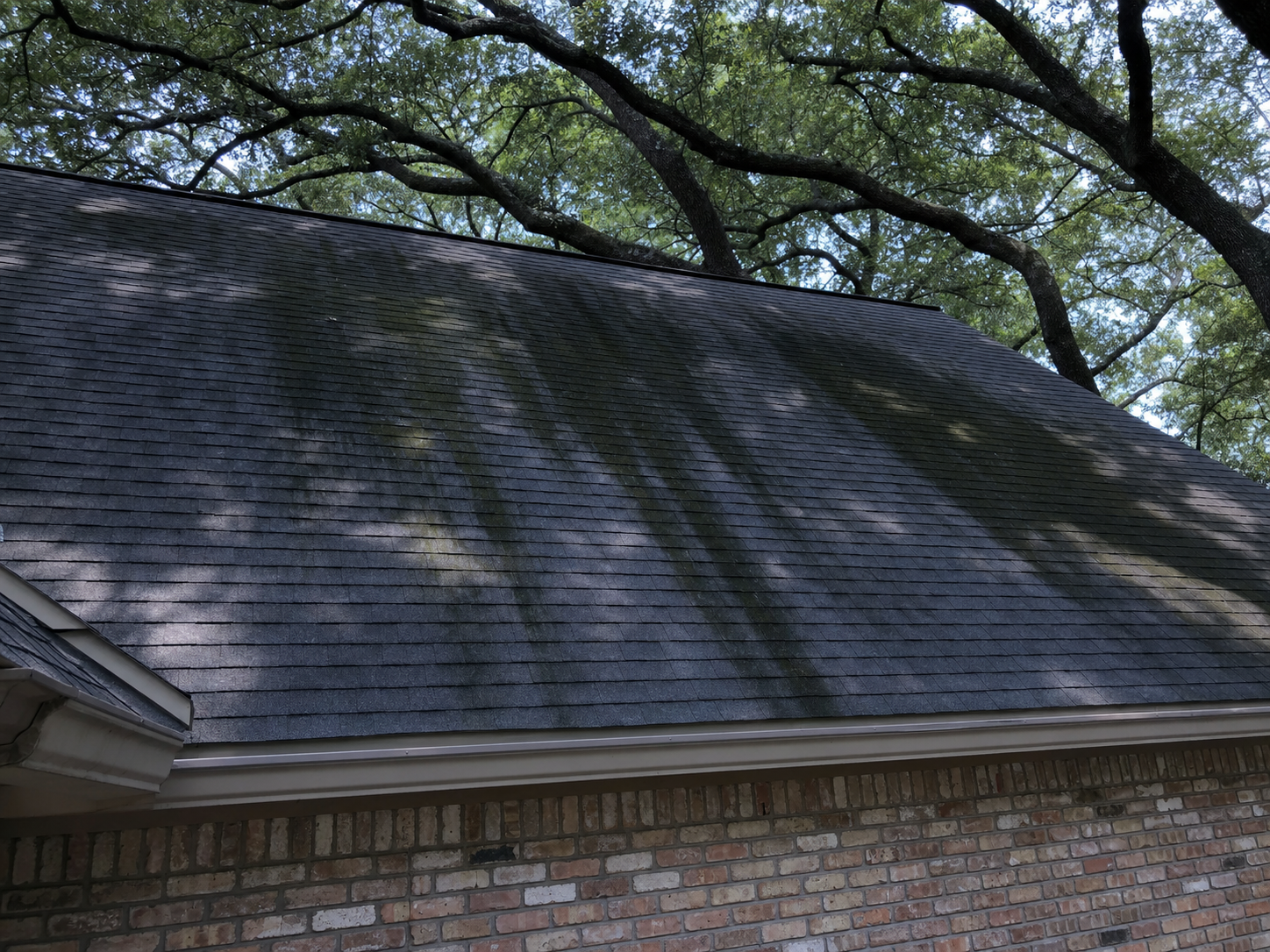
The black streaks that appear on Houston roofs are gloeocapsa magma, a photosynthetic algae that feeds on the limestone filler in modern shingles. It thrives in constant shade and humidity — two conditions the Memorial canopy provides in abundance. Every homeowner touring an older Memorial home has seen the pattern: heavy streaking on the north-facing slopes, minimal streaking on the south-facing slopes that get direct afternoon sun.
Algae-resistant shingles use copper granules embedded in the surface layer to suppress this growth. Major shingle manufacturers warrant that suppression for ten years on the standard AR product line. On a heavily shaded Memorial roof, the difference between a standard shingle and an AR-rated shingle at year five is dramatic — the AR roof looks close to new; the standard roof shows heavy black streaks that make the entire home look older than it is.
What the Education Center recommends for canopy lots
- Specify algae-resistant (AR) shingles as the default on any Memorial replacement, not the upgrade
- Prefer darker color blends only if the homeowner is committed to the AR upgrade; light colors mask streaking less
- Ask whether the manufacturer’s AR warranty is 10-year or 15-year on the specific shingle line quoted
- Plan for a soft-wash roof cleaning at year 8-10 regardless of shingle type; the AR treatment delays but does not eliminate streaking
Complex Rooflines Multiply the Debris Problem
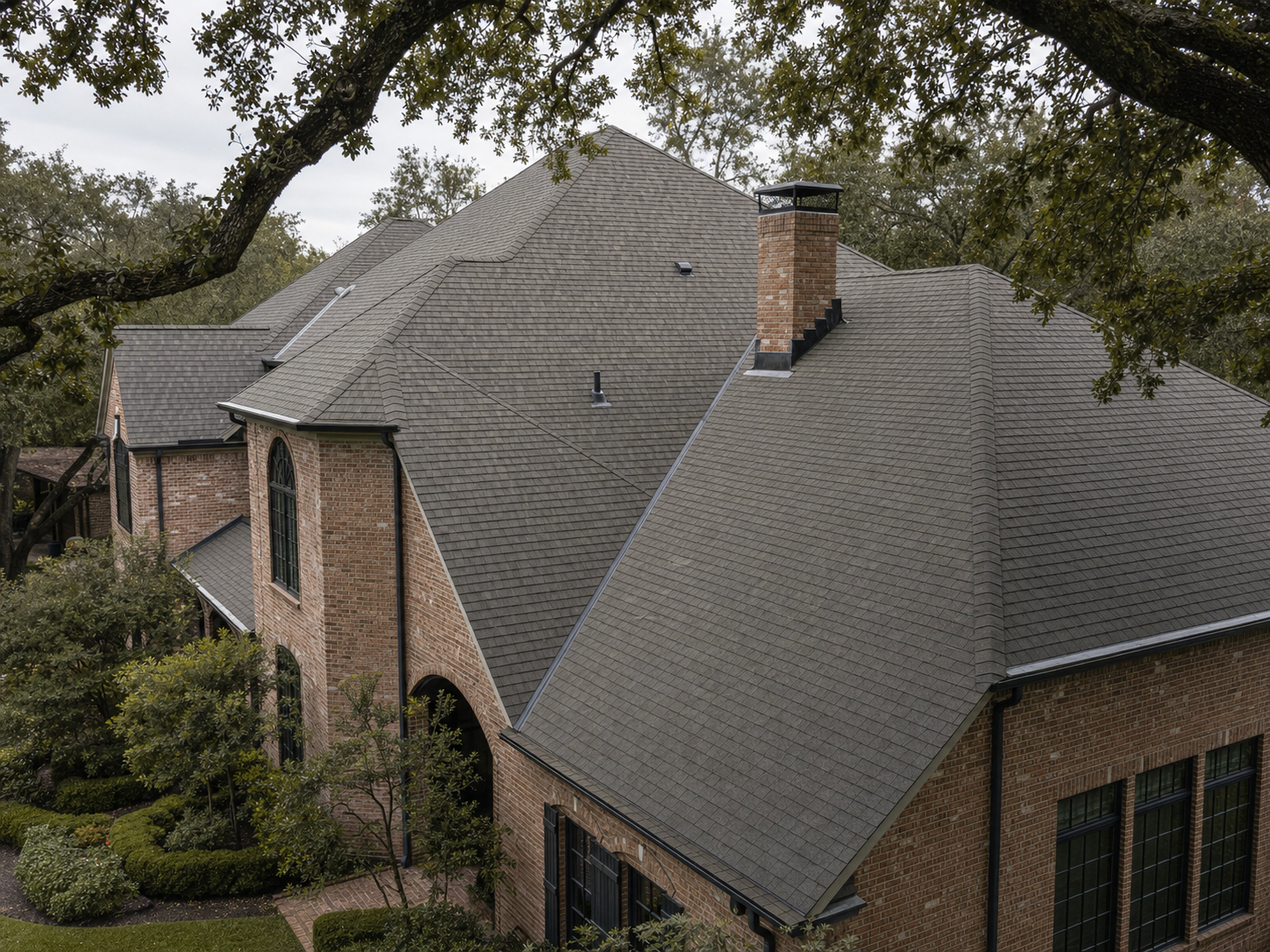
Memorial estate homes often carry complex hip-and-valley rooflines with multiple planes intersecting at chimneys, dormers, and porch attachments. Each valley collects debris from every plane that drains into it, so a home with six valleys sees six times the concentration points a simple gable roof does. Debris trapped in a valley holds water against the shingles and underlayment — where premature failures start.
Valley construction and flashing detail
Open metal valleys shed debris substantially better than closed-cut or woven valleys because leaves and needles slide across the smooth metal rather than catching in shingle laps. Pair that with new step flashing on every replacement (never reused) and kick-out flashing at every roof-to-wall termination, and the two most common water-infiltration paths on a canopy home are addressed.
Attic ventilation sized to the actual attic
Canopy homes stay cooler on peak days but dry more slowly after storms. Balanced ridge vent plus continuous soffit intake, sized to the ratio required by IRC R806 attic ventilation code, is what keeps the roof deck and insulation dry between rain events. Moisture management matters more than peak-temperature management on a canopy lot.
Drainage and Grade Change Over the Decades
Mature live oaks have surface root systems that lift concrete over decades. Driveways, walkways, and the grade around the foundation can sit several inches different from where they were when the home was built. A downspout that once emptied to a lower grade may now empty to a higher grade, and water backs up against the foundation instead of running to the street. Any gutter replacement on a Memorial lot should include a fresh grading check at every downspout termination — splash blocks, downspout extensions, or underground lines to curb pop-ups are all viable. The Education Center’s downspout extensions and underground drain guide covers the trade-offs.
The Bottom Line
The memorial houston canopy is worth every trade-off it creates — mature shade, cooler streets, higher property values, and a character that no new-build subdivision can replicate. But a home under that canopy needs a maintenance rhythm and material spec calibrated to the shade and debris load it actually sees, not to the national default for a suburban single-family home. Twice-a-year gutter cleaning, algae-resistant shingles specified as the baseline, complex-roof-appropriate flashing detail, and a fresh grading check at every downspout termination are the four moves that keep a Memorial home performing without turning the exterior into a full-time project.
For readers planning ahead on a canopy lot, the Education Center’s Kingwood tree canopy planning guide covers the same set of decisions from a pine-dominant perspective, the algae-resistant shingle guide goes deeper on gloeocapsa magma and the copper granule chemistry, and the Houston gutter maintenance guide lays out the seasonal cleaning schedule any canopy home should follow.
Planning a roof or exterior project on a Memorial-corridor home?
DC Pines Roofing scopes canopy-lot projects around the shade, debris load, and complex roof geometry that make Memorial homes different from open-lot subdivisions.