
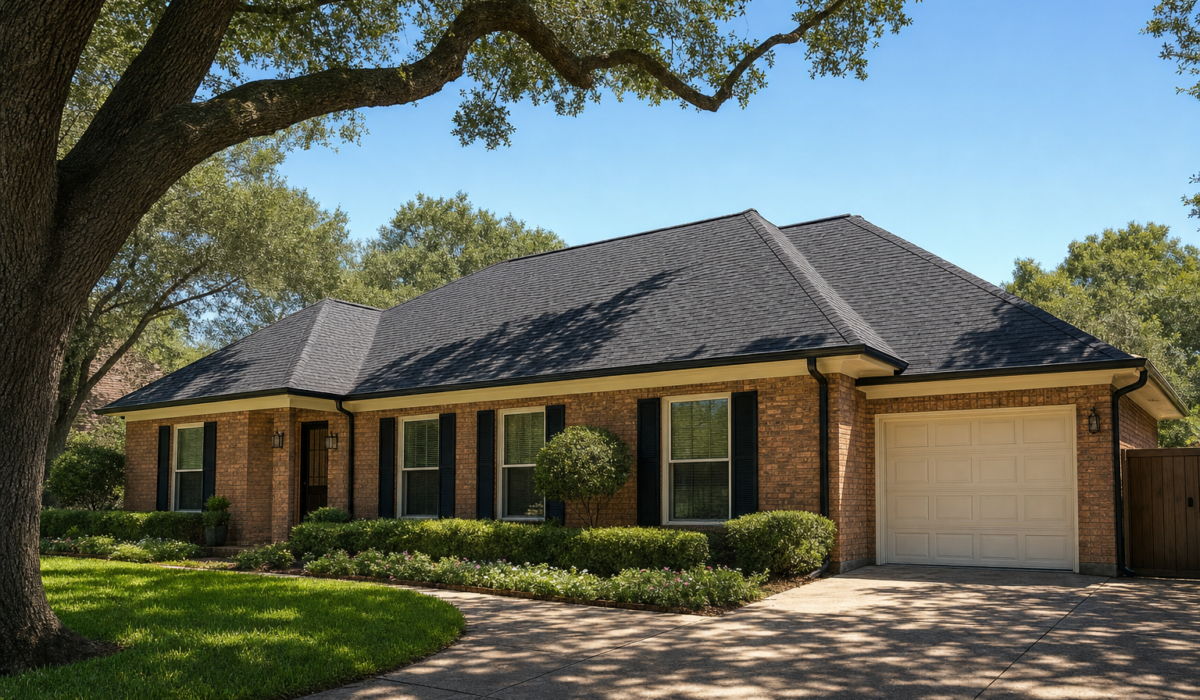
Homeowners who read specification sheets often assume every asphalt shingle roof is installed the same way. That assumption quietly costs Houston homeowners real durability. Nail count per shingle, nail gauge and length, where the fasteners land on the shingle, and how deep they penetrate the deck decide whether a roof performs to its rated wind speed. Two roofs built with the same shingle can behave very differently once Gulf Coast summer heat and coastal wind loads start working on them.
The DC Pines Education Center put together this guide to make one detail plain: houston shingle nailing is not a style choice. In greater Houston, the fastening pattern is dictated by design wind speed, roof geometry, and the manufacturer’s high-wind installation instructions. This article walks through the 4-nail versus 6-nail question, what Texas building code actually says, and the execution details that separate a roof that lasts twenty years from one that starts leaking well before then.
Why Nail Count Is Not Cosmetic
An asphalt shingle depends on two attachment systems working together: the mechanical fasteners driven through the shingle into the deck, and the manufacturer-applied sealant strip that bonds each shingle to the one below. Nails carry the initial load, and the sealant tab keeps wind from testing those nails in the first place. When either system is under-specified, the roof still looks right on install day. Wind uplift, thermal cycling, and time surface the mistake later.
The industry consensus is straightforward. Four nails per shingle is the minimum for standard inland applications rated for roughly 90 to 110 mph design wind speeds. Six nails per shingle is required in high-wind zones and delivers rated performance to 130+ mph. Coastal Texas and any project in a Texas Windstorm Insurance Association (TWIA) county default to six.
What Texas Building Code Actually Requires
The relevant code language for greater Houston comes from Chapter 9 of the International Residential Code as adopted by the City of Houston, plus the Texas Revisions to the IRC published by the Texas Department of Insurance. The City of Houston building code design criteria lists a basic (3-second gust) wind speed of 110 mph under IRC and an ultimate design wind speed of 130 mph for Risk Category I structures. Those numbers select which shingle class and which fastening pattern a roof must meet.
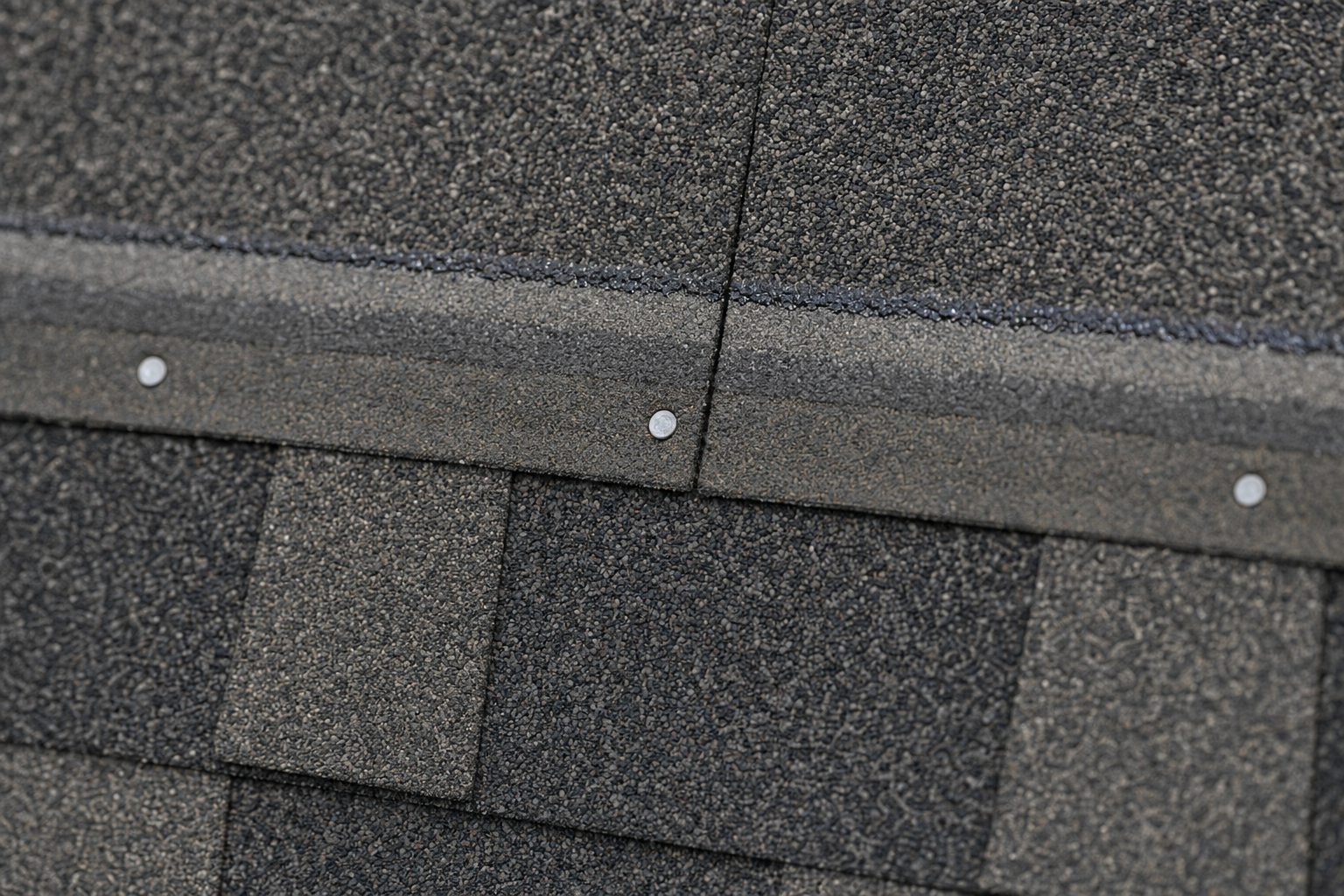
The Texas Revisions to the IRC from TDI spell out the exception homeowners should know about: asphalt strip shingles must be installed with at least six fasteners per shingle when the basic wind speed is 110 mph or greater AND the eave height is 20 feet or greater above grade, or whenever the basic wind speed reaches 120 mph or greater regardless of eave. Two-story homes in Memorial, Bellaire, Cypress, and Katy routinely meet the 20-foot threshold. Many of them are, by code, six-nail roofs.
Fastener specifications that matter as much as count
Code is equally specific about what qualifies as a “nail.” Fasteners must be galvanized steel, stainless, aluminum, or copper roofing nails at a minimum 12-gauge (0.105 inch) shank, with a 3/8-inch-diameter head meeting ASTM F1667. Length has to penetrate through the roofing materials and at least 3/4 inch into the roof sheathing — or fully through decking thinner than 3/4 inch. Staples are not permitted for asphalt shingles under current Texas revisions.
Where the Nails Land on the Shingle
Count and specification only work if the nails land in the correct zone. Every asphalt shingle has a printed nailing zone — a shaded band or “nail here” line running horizontally just below the self-sealing tar strip. Nails above that zone miss the shingle below and expose the deck. Nails below it can pierce the exposure area of the shingle underneath and telegraph water into the assembly.
In a six-nail high-wind pattern, two nails go roughly one inch in from each end of the shingle, with four more evenly spaced between them, all within the manufacturer’s nailing zone. On steep-slope applications (typically greater than 21:12), most manufacturers require six nails regardless of wind zone because gravity is peeling the shingle down harder. Overdriven nails — where a pneumatic gun crushes the mat — reduce holding power and can tear the shingle loose long before the rated wind speed. Quality-focused Houston crews fine-tune pneumatic pressure between courses.
Nail Pops: A Houston-Specific Long-Term Problem
Nail pops are the slow-burn version of the fastening issue. A nail set correctly on install day can back out over time as the wood underneath expands and contracts with heat and humidity. Houston’s June-through-September stretch runs shingle surface temperatures well over 150°F on dark roofs, then cools each night. Over years, that thermal cycling walks under-driven nails upward. Eventually the head lifts the shingle above it, breaks the seal, and creates a pinhole leak path.
The right fix is not a dab of sealant over the exposed head. Proper repair means removing the loose shingle, evaluating the decking underneath, and re-fastening with a correctly placed new nail — often slightly offset so it grabs sound wood. Decking condition matters just as much: a nail driven into an old knot, a panel joint, or delaminated OSB will not hold long-term, no matter how many are used. The Education Center’s piece on how Houston heat ages asphalt shingle roofs covers the related aging pathways for the shingle mat itself.
What Homeowners Can Verify Without Climbing on the Roof
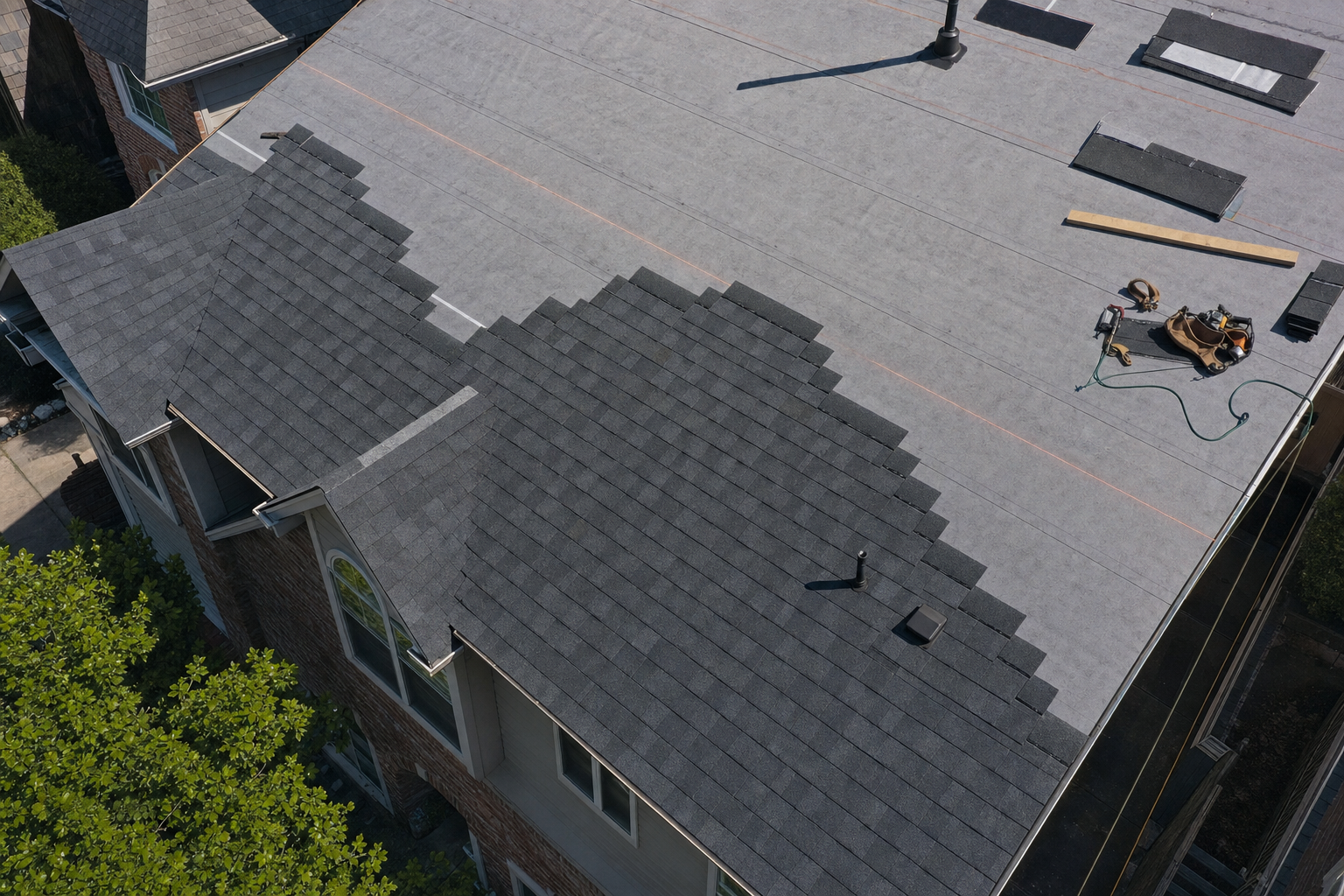
Reputable Houston roofing contractors document nailing patterns in the project file. Homeowners planning a replacement should ask three questions before signing a contract:
- Is this project being installed with a 6-nail high-wind pattern? On a two-story home, or on any home in a coastal wind exposure, the answer should be yes and it should match the shingle manufacturer’s high-wind spec.
- What nail size, gauge, and material are being used? The correct answer includes “12-gauge minimum” and “hot-dipped galvanized” or “stainless steel” — plus a length adequate for the specific deck thickness on the home.
- Will the crew photo-document the underlayment and fastening pattern before the shingles cover them? Reputable installers already do this because it protects both the homeowner and the warranty.
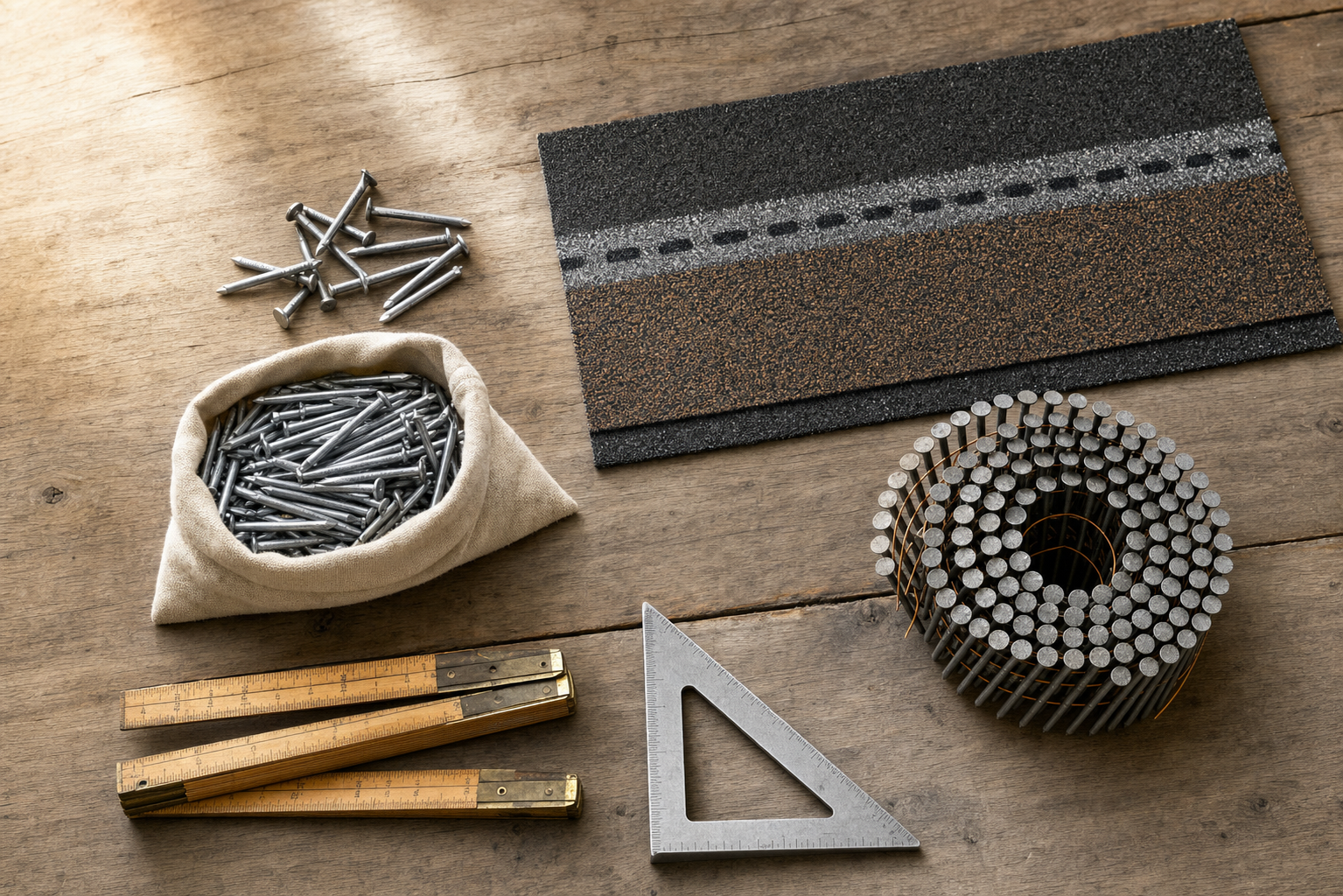
Owens Corning, GAF, CertainTeed, and Malarkey all publish high-wind installation instructions that spell out nail count, placement, and required accessories. Following those instructions is what activates the enhanced portions of the manufacturer wind warranty. Cutting corners on fastening is one of the fastest ways to void that warranty without the homeowner ever being told. The Education Center’s guide to Houston roof underlayment pairs directly with this article since both layers are fastened together.
The Bottom Line
For an asphalt shingle roof in greater Houston, the fastening pattern is not a preference. Code, manufacturer instructions, and long-term Gulf Coast weather all point in the same direction: six nails per shingle for most two-story homes and any project in a higher wind exposure, 12-gauge minimum galvanized or stainless fasteners in the manufacturer’s nailing zone, penetrating at least 3/4 inch into sound decking. Everything else the roof does — shed rain, hold under wind, keep the attic dry, last two decades — sits on top of that decision. Getting nailing right is one of the quietest ways to buy an entire additional cycle of roof life.
Not sure whether the last roof was installed with 4 nails or 6?
DC Pines installs every Houston-area asphalt shingle roof to the manufacturer’s high-wind spec and documents the fastening pattern in every project file.