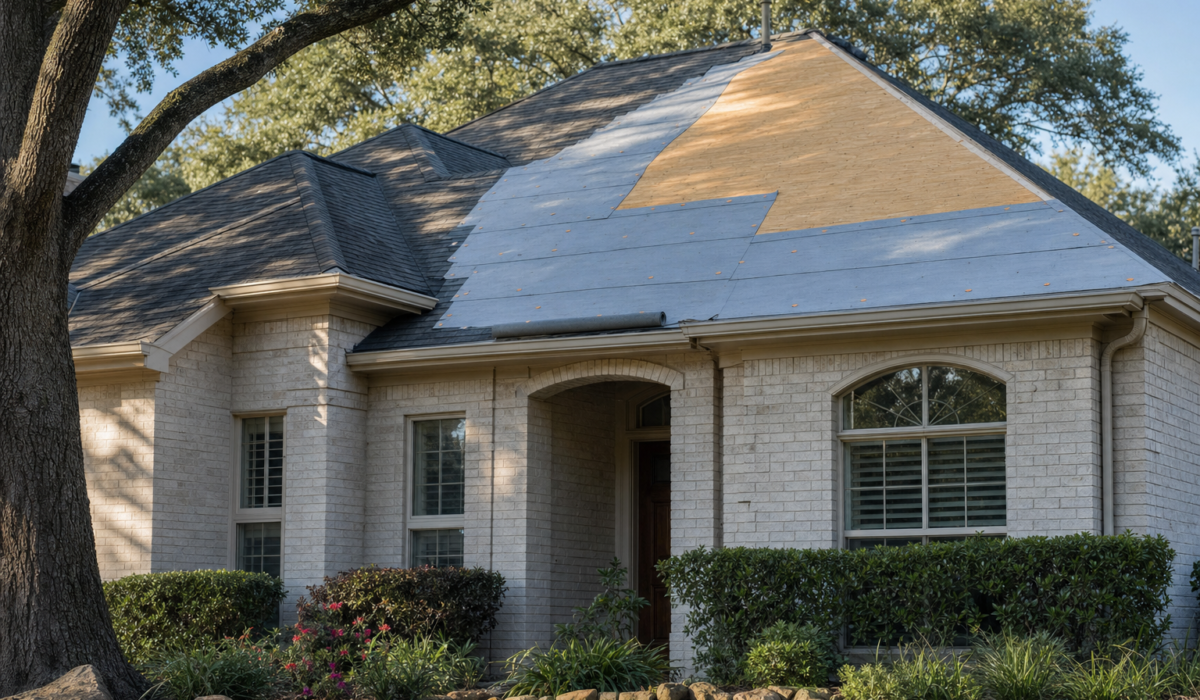
Homeowners across Houston tend to think about a roof as a layer of shingles. The DC Pines Education Center has walked hundreds of tear-offs across Katy, The Woodlands, Sugar Land, Cypress, Bellaire, and Memorial, and the pattern is consistent: the shingles get the attention, but the roof underlayment for Houston homes is where the quiet difference between a healthy roof and a compromised one actually shows up. When roof underlayment for Houston homes is specified correctly and installed cleanly, it is invisible for decades. When it is cut cheap, it shortens the service life of everything above it.
This guide from the Education Center covers what roof underlayment actually is, why the Houston climate makes synthetic underlayment and peel-and-stick membranes the practical choice, and where the vulnerable points on a Houston roof deserve upgraded materials. It is written the same way DC Pines Roofing walks a homeowner through a replacement estimate — grounded in materials, not marketing.
What roof underlayment actually does
Roof underlayment is the secondary weather barrier laid across the entire plywood roof deck before shingles are installed. It is the layer that keeps the home dry during the install itself — when the shingles are not yet down — and the layer that catches wind-driven rain if a shingle later lifts, cracks, or is torn free. Every asphalt roof in Houston has underlayment. The question is which kind and how carefully it was applied.
The Education Center thinks of underlayment as a system with three roles: temporary weatherproofing during construction, permanent secondary drainage under the shingles, and a base surface that lets the shingles perform as designed. Get any one of those wrong and the visible shingles cannot compensate.
Why synthetic underlayment beats felt in Houston
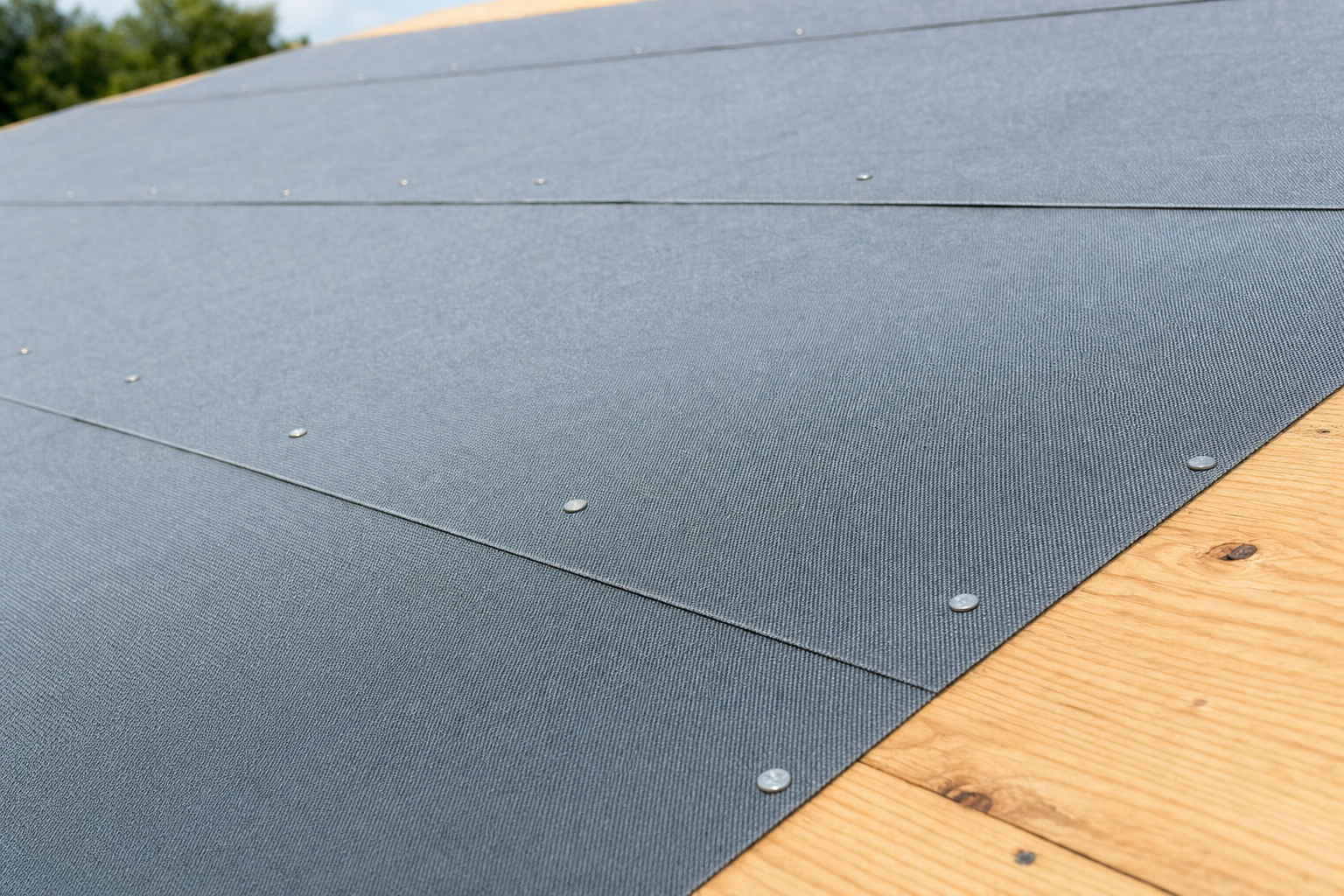
For decades the standard was 15-pound or 30-pound felt — asphalt-saturated paper laid down in overlapping courses. It still works and still has a place in small repairs. On a Houston full replacement, though, synthetic underlayment is the DC Pines Education Center’s default recommendation, and for concrete physical reasons rather than sales copy.
Synthetic underlayments are woven polymer sheets. They are lighter to carry up a ladder, which reduces fatigue-driven install mistakes late in a hot Houston afternoon. They are dramatically more tear-resistant when a crew is walking them during install. They tolerate UV exposure better if the shingles cannot be installed the same day. And critically for Texas summers, they stay dimensionally stable under heat instead of wrinkling like felt on a 95-degree roof deck. That stability is what keeps the surface flat and lets the shingles above sit correctly.
Fastener detail matters more than the roll itself
A quality synthetic underlayment fastened with staples or roofing nails without cap heads is a lower-tier install regardless of the product name printed on the roll. Houston-appropriate installation uses plastic-capped nails at manufacturer-specified intervals, so each fastener is sealed against wind uplift and water intrusion. The Education Center considers cap-nailing non-negotiable on any full replacement.
Where ice-and-water shield goes on a Houston roof
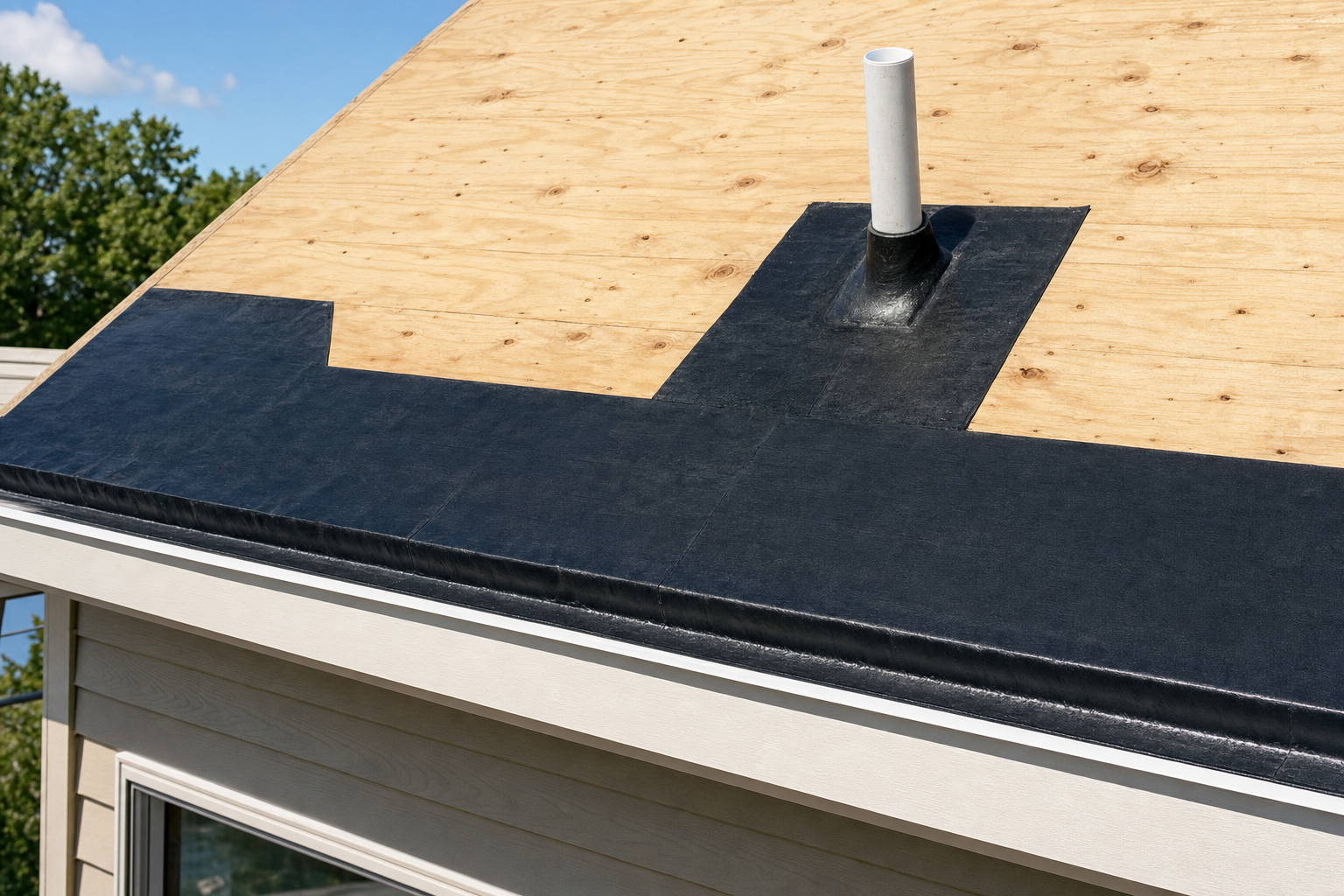
The name is misleading in a Houston context. “Ice-and-water shield” is a self-adhered rubberized membrane that peels off a release liner and sticks directly to the decking, forming a waterproof layer that self-seals around nail penetrations. Houston does not deal with ice dams, but every Houston roof has the same vulnerable points that make this membrane valuable: the eaves, the valleys, and every penetration through the roof plane.
At the eaves, wind-driven rain can push water uphill under the first course of shingles during a heavy Houston downpour. In the valleys, the sheer volume of water concentrated by two roof planes overwhelms shingle joints on tough weather days. At penetrations — plumbing vents, bathroom vents, kitchen vents, chimney flashings — the shingle field cannot form a perfect seal on its own. Peel-and-stick membrane at each of those locations turns them from potential leak sources into the strongest waterproof zones on the roof.
Full-coverage vs. targeted membranes
Some higher-tier Houston roofing packages install self-adhered membrane across the entire roof plane instead of only at critical zones. That upgrade is worth discussing on very low-slope areas, homes with complex rooflines, or when the homeowner plans to keep the home for the long term. On a typical Houston replacement, targeted membrane at eaves, valleys, and penetrations plus premium synthetic in the field is the balanced spec that the Education Center defaults to.
How underlayment quality shows up years later
Homeowners rarely see their underlayment after the last shingle is nailed. That does not mean it is not doing work. When a Houston roof reaches year eight or ten and starts showing the wear the Education Center describes in its guide to how Houston heat ages asphalt shingles, the underlayment is what keeps the home dry through the last few years before replacement. When a shingle finally lifts in a strong wind, the underlayment is what buys the homeowner time to schedule repair on their terms.
The Education Center has watched roofs where poor underlayment shortened the useful life of a premium shingle by years, and roofs where quality underlayment extended a mid-tier shingle well past its rated life. It is quiet infrastructure. It matters more than the marketing tier of the top layer.
What to ask on a Houston roof replacement estimate
When comparing bids on a Houston roof replacement, a homeowner does not need to memorize product names. Three questions are enough. Which brand and grade of synthetic underlayment goes in the field? Where does peel-and-stick membrane get installed — eaves, valleys, all penetrations? What fastener pattern is used to hold it all down? Any contractor who cannot answer those three questions in plain language is not treating the underlayment as the critical layer it actually is.
Homeowners still weighing shingle brands can also read the Education Center’s earlier discussion of how Houston’s exterior stresses stack on the whole envelope, which frames why every layer of the roof system needs to be specified for this climate, not for a generic national spec.
The Bottom Line
Roof underlayment for Houston homes is the layer most homeowners never think about and the layer that most reliably decides how a roof performs across its full service life. Synthetic in the field, peel-and-stick membrane at every vulnerable point, cap-nailed fastening, and clean sequencing on install day are the details that separate a Houston roof built to spec from one that looks fine at the driveway and disappoints five years in.
The shingles are what a homeowner sees. The underlayment is what a homeowner benefits from. Both matter — the Education Center’s honest read is that if a bid economizes anywhere on the assembly, it should not be here.
Considering a Houston roof replacement or repair?
DC Pines Roofing installs premium synthetic underlayment and peel-and-stick membranes as standard practice on Houston replacements, matched to manufacturer system warranties.