
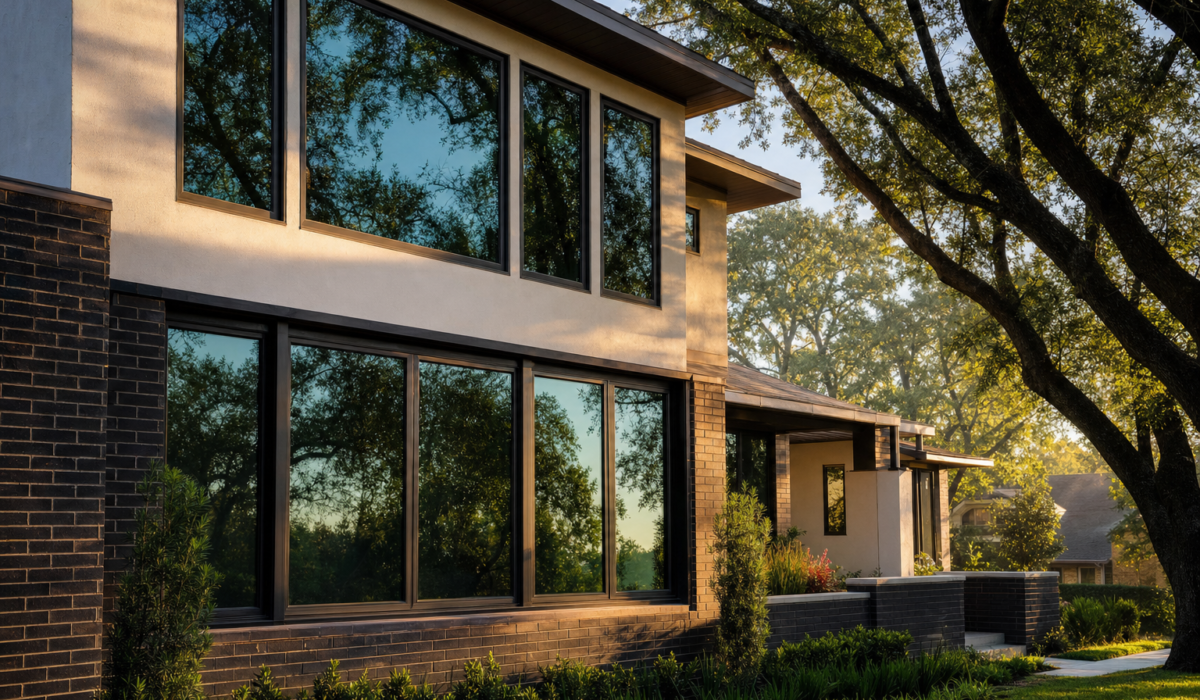
Homeowners across Houston notice the same pattern every summer: the room with the big west-facing window bakes by 4 p.m., the HVAC runs constantly to fight it, and the energy bill climbs into July and August. The DC Pines Education Center has walked hundreds of Houston homes across Katy, Sugar Land, The Woodlands, Bellaire, and Memorial, and the single most common upgrade opportunity is not adding insulation or upsizing the AC — it is replacing tired clear-glass windows with a properly-specified set of Low-E windows for Houston’s actual climate.
This guide from the Education Center explains what Low-E windows for Houston homes actually do, why the coating specification matters more than the frame color, and how to tell whether a window replacement will move the needle on comfort and energy bills. It is written the way DC Pines Roofing walks a Houston homeowner through a window estimate: focused on the physics, not on marketing terms.
Why Houston sun is harder on windows than most climates
The Texas Gulf Coast delivers a specific combination that punishes windows: long stretches of intense direct sun, high ambient temperature for six months of the year, and enough humidity to make radiant heat feel worse indoors. Every square foot of unshaded, clear-glass window on the south or west side of a Houston home is essentially a radiant heater aimed at the living room floor in July.
The Education Center measures this in a specific number: Solar Heat Gain Coefficient, or SHGC. It expresses the fraction of incoming solar radiation that a window admits into the home. Plain single-pane glass has an SHGC around 0.80. A properly-specified southern-climate Low-E window can drive that number below 0.25. That is not a marketing rounding — it is a real, physical reduction in how much heat gets through the glass on a hot afternoon.
What Low-E windows for Houston homes actually are
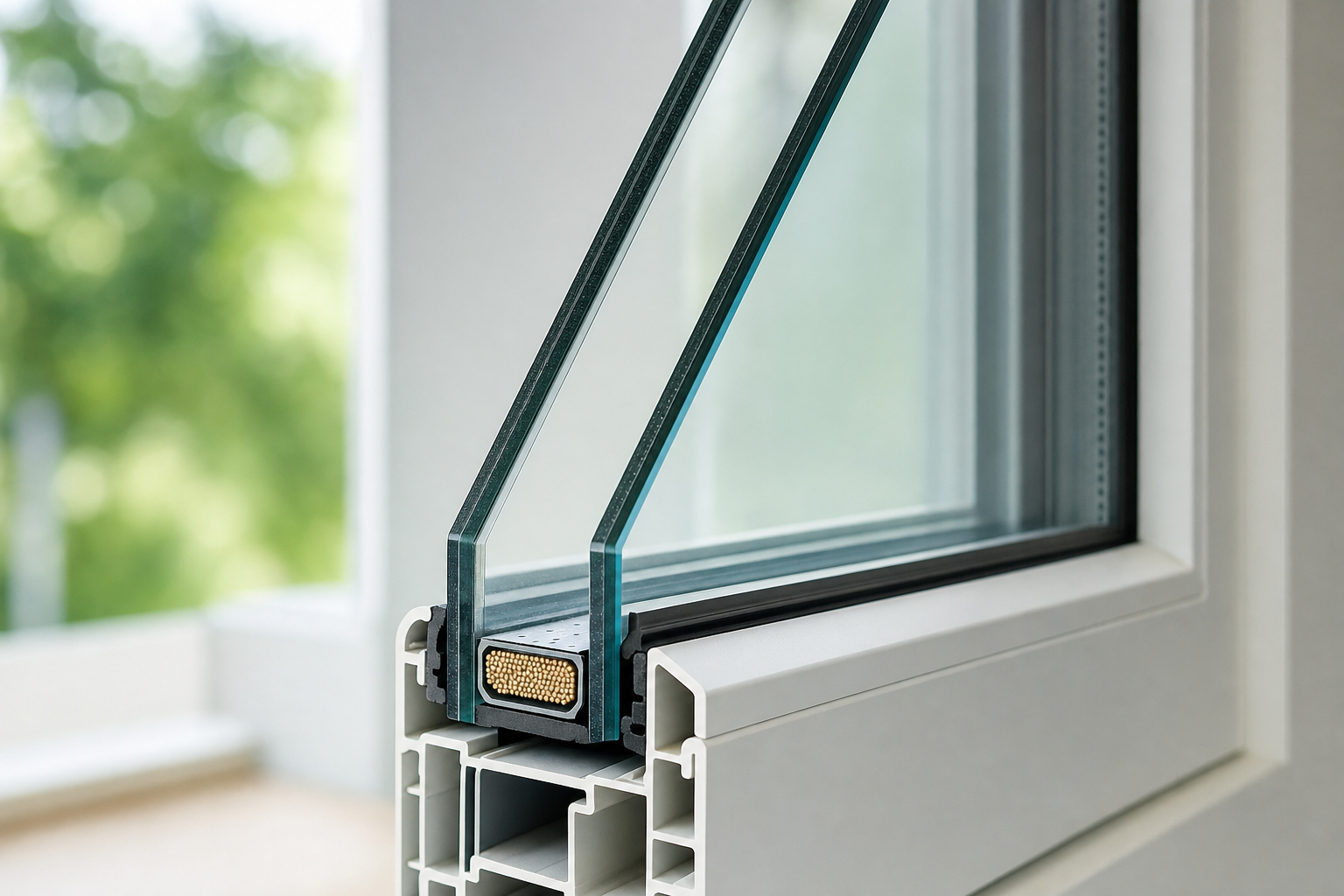
Low-E, short for low-emissivity, is a microscopically thin metallic oxide coating fused to the glass surface during manufacturing. In a modern insulated glass unit, that coating sits on the interior surface of one of the two panes, protected inside the sealed argon-filled cavity. The coating is invisible to the eye. What it does is reflect the infrared portion of sunlight — the part that carries heat — back outside, while still letting the visible portion through.
Not all Low-E is the same. There are northern-climate packages designed to keep solar heat inside for winter warmth, and southern-climate packages designed to keep solar heat out through long cooling seasons. The Education Center’s guidance for Houston is unambiguous: buy the southern-climate package. A window optimized for Chicago is the wrong window for a home in Cypress, no matter how impressive the salesperson’s brochure looks.
SHGC and U-factor: the two numbers that matter
Every ENERGY STAR-rated window carries an NFRC label with two headline numbers. SHGC governs solar heat gain — lower is better for Houston. U-factor governs conductive heat transfer through the whole window assembly — again, lower is better. For a Houston home, the Education Center recommends targeting SHGC at 0.25 or below and U-factor at 0.30 or below. Windows that meet both numbers are widely available and generally sit inside the ENERGY STAR Southern zone specification.
Where Low-E windows change the feel of a Houston home

Homeowners often expect Low-E replacement to show up on the energy bill first. In practice, the change most families notice first is comfort. The west-facing living room stops feeling like a furnace after lunch. The kitchen counter next to the big south window stops burning to the touch by 3 p.m. The bedroom over the garage becomes usable during summer afternoons instead of being written off until sundown. The energy savings are real, but they arrive quietly on the monthly statement while the comfort improvement is immediate.
Comfort improvements also reduce load on the HVAC system. When a home’s cooling load drops during peak sun hours, the AC cycles less frequently and runs shorter, which pairs well with the ventilation and radiant-barrier upgrades covered in the Education Center’s Houston attic ventilation and radiant barrier guide. Windows, attic, and roof color are the three levers that most heavily determine whether a Houston home fights summer or coasts through it.
Common mistakes when replacing Houston windows
The Education Center sees the same three mistakes repeated across Houston window projects. First: picking a window on frame appearance alone and letting the salesperson choose the glass package. The glass carries the physics; the frame carries the aesthetic. Second: mixing northern-climate and southern-climate Low-E in the same home because the installer stocked what was on the truck. Third: skipping the installation details — the flashing, the caulk, the sill pan — and expecting a premium glass package to make up for a sloppy rough-opening seal.
A properly-specified Low-E window installed poorly performs worse than a mid-tier window installed carefully. The Education Center considers the install and the flashing detail as much a part of the product as the glass itself.
Is window film a shortcut?
Aftermarket solar film is a legitimate interim step for homeowners not yet ready for a full replacement, and it can reduce solar heat gain and glare on existing clear-glass windows meaningfully. What film cannot do is repair a fogged insulated glass unit, replace a failed seal, or salvage a rotting wood frame. Homeowners with windows already at the end of their service life get more long-term value from a Low-E replacement than from layering film over failing hardware. For those still on the fence about the whole system, the Education Center’s guide to Houston window warning signs covers the specific failure indicators to watch for.
The Bottom Line
Low-E windows for Houston homes are not a decorative upgrade or a marketing category. In a cooling-dominated climate with six months of aggressive solar heat gain, the right southern-climate Low-E package is the single most direct lever a homeowner has to reduce afternoon heat load, protect interior finishes from UV, and cut the HVAC’s summer workload. Frame color and grid style are the fun part; SHGC, U-factor, and clean installation are the parts that decide whether the upgrade actually delivers.
For a Houston homeowner deciding between adding more insulation, upsizing the AC, or replacing windows, the Education Center’s practical read is straightforward: address the windows first when they are older or single-pane. Everything else works better once the biggest source of daytime heat gain has been addressed at the glass.
Ready to see what Low-E replacement windows can do for a Houston home?
DC Pines Roofing installs properly-specified Southern-climate Low-E replacement windows across greater Houston, matched to the SHGC and U-factor targets that make sense for the Texas Gulf Coast.