
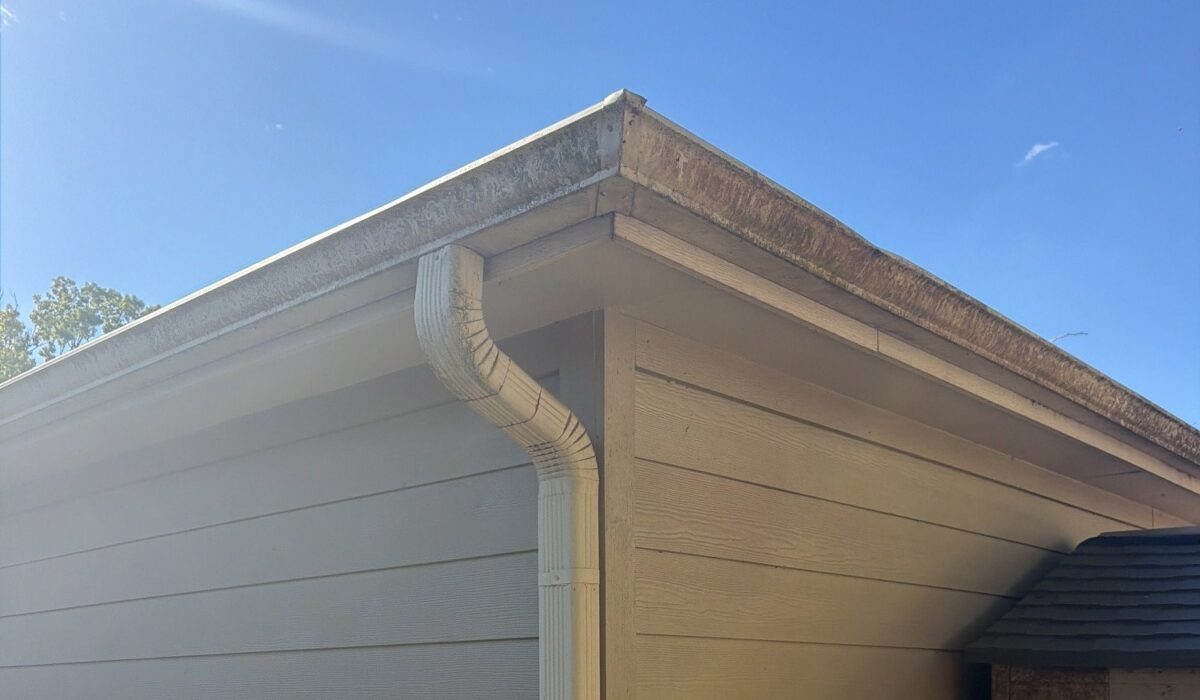
A gutter leaking at the corners is one of the most common complaints Houston homeowners have about their gutters, and it often starts with a seamless system that looks fine from the driveway. Seamless gutters remove the joints along a straight run, but every system still has corners, end caps, and downspout outlets. Those junctions carry the most water and take the most movement, so they’re where leaks show up first.
The DC Pines Education Center wrote this guide to explain why gutter corners and joints fail in Houston, how to spot the early signs, and what a repair that lasts looks like.
Where Gutters Actually Leak
On a seamless aluminum system there are three main weak points:
- Corners (miters). Inside and outside corners join two runs at a right angle. At a valley, the corner also takes the concentrated flow from two roof planes meeting.
- End caps. The closed ends of each run are sealed and fastened. If water stands at a dead-flat end, it sits against that seal after every rain.
- Downspout outlets. The outlet is cut into the gutter bottom and sealed. A poorly crimped or undersealed outlet drips at the drop instead of draining into it.
Sectional gutters, sold in fixed-length pieces at big-box stores, add another weak point: a sealed joint every few feet along the run. That’s the main reason seamless systems outlast sectional ones in Houston.
Why Houston Is Hard on Gutter Joints
Heat makes aluminum move
Aluminum expands and contracts with temperature. A University of Chicago reference table of metal expansion coefficients lists alloy 3003 aluminum at 12.9 millionths of an inch per inch, per degree Fahrenheit. The National Weather Service’s Houston IAH climate normals put the average January low at 43.7°F and the average August high at 94.9°F. Across that 51-degree swing, a 40-foot aluminum run changes length by about 5/16 of an inch. Metal in direct sun gets much hotter than the air, so real movement is larger. All of that movement ends at the corners and end caps, where the seal has to flex instead of crack.
Debris dams form at corners
Pine needles and oak leaves wash along a gutter and pile up where the water changes direction. A debris dam at an inside corner backs water up against the joint and over the front lip. The Education Center’s guide to gutter guards for live oak and pine debris covers how to keep corners clear.
Standing water finds the seal
A gutter hung dead flat, or one that sags between hangers, holds water in low spots. When a low spot lands at an end cap or corner, the seal sits underwater for days after every rain. Even a good sealant breaks down faster under constant water.
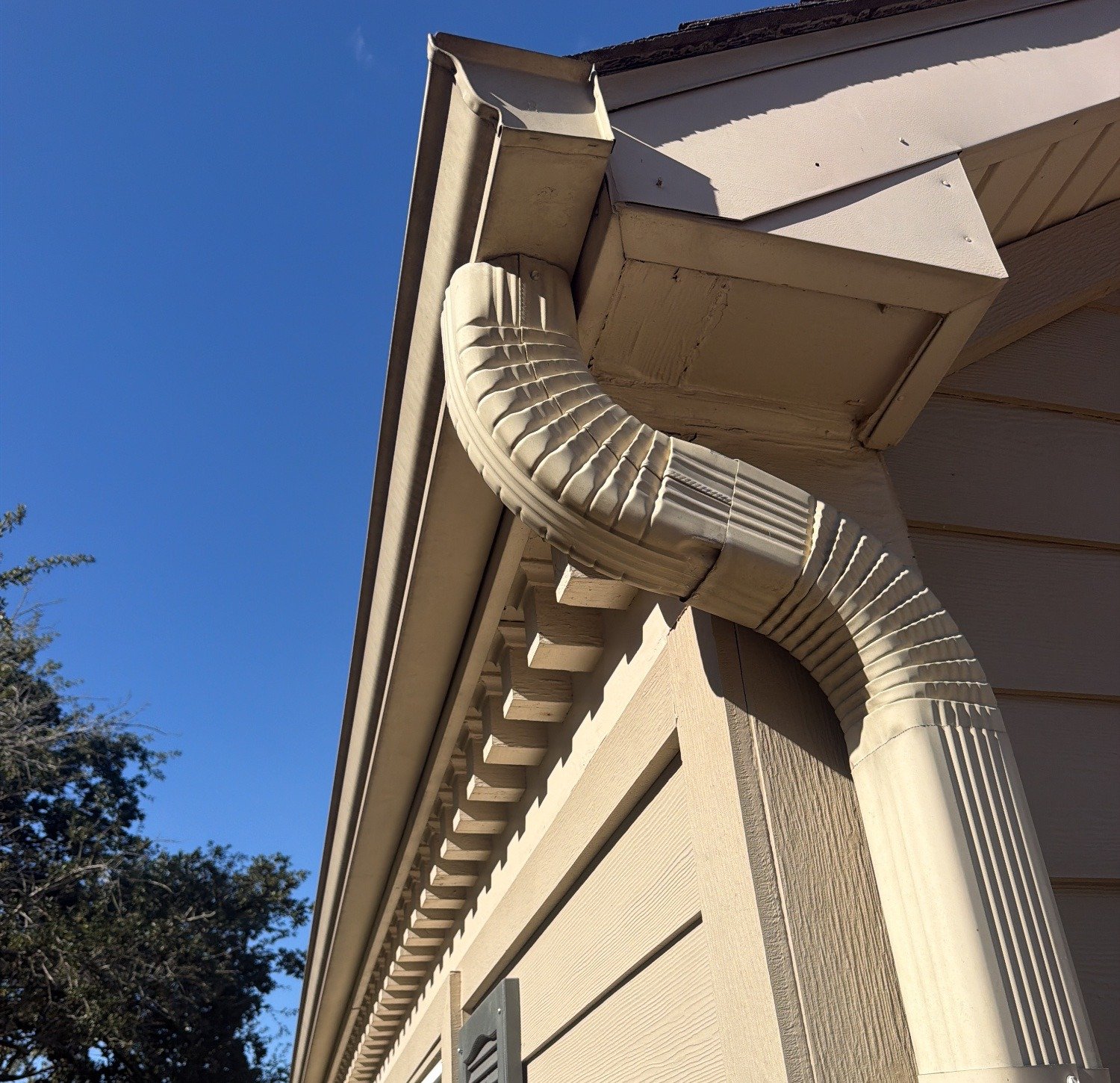
Signs of a Leaking Gutter Corner or Joint
- Drips or a steady stream at a corner during rain, especially when the rest of the gutter is draining normally.
- Dark streaks on the fascia below a joint. Water running behind or under the gutter leaves a stain line on the trim board.
- Streaking on the gutter face. Dirty stripes down the front of the gutter often mean water has been spilling over the lip, usually because a corner or outlet downstream is clogged.
- Peeling paint, soft wood, or wet soil directly below one corner of the house.
Fascia damage behind a leaking corner is the expensive part. The Education Center’s guide to gutter apron, drip edge, and fascia protection explains how water reaches the wood.
Why Caulk Over the Leak Doesn’t Last
The common quick fix is a bead of general-purpose caulk over the dripping joint. It usually fails within a season or two, for three reasons. The old sealant and debris underneath prevent a real bond. Many caulks harden in Houston heat and can’t flex as the aluminum moves. And if the cause is a debris dam, a low spot, or a loose rivet, sealing over the symptom does nothing about it.
How a Lasting Repair Is Done
- Clean and dry the joint. Remove debris, scrape out the old sealant, and clean the aluminum so the new sealant bonds to bare metal.
- Re-fasten the joint. Replace loose or corroded rivets or screws so the corner is mechanically tight before any sealant goes on.
- Seal with a flexible sealant made for gutters. On new installs and corner repairs, DC Pines Roofing uses Geocel 2320 tri-polymer sealant at every corner and outlet, because it stays flexible in Houston heat instead of cracking.
- Fix the cause. Re-hang sagging sections, correct a flat run so water moves toward the downspout, and clear or guard the corner that keeps collecting debris.
DC Pines fabricates its seamless 6-inch aluminum gutters on the driveway to the exact length of each roofline, which removes mid-run joints entirely. Its hidden hangers are spaced 24 to 30 inches apart depending on the run, which keeps the gutter from sagging into low spots. Details are on the DC Pines gutters page.
Frequently Asked Questions
Why is my seamless gutter leaking at the corner?
Seamless gutters still have joints at corners, end caps, and outlets. The sealant at those joints ages in Houston heat, the aluminum moves with temperature, and debris dams at corners push water against the seal.
Can a leaking gutter corner be repaired, or does the gutter need to be replaced?
Most leaking corners can be repaired by cleaning out the old sealant, re-fastening the joint, and resealing with a flexible gutter sealant. Replacement makes sense when the gutter is sectional, badly sagging, or damaged along much of its length.
How long should gutter sealant last in Houston?
It depends on the product and how the joint was prepared. General-purpose caulk over a dirty joint often fails within a season or two. A flexible sealant on clean, bare aluminum lasts much longer.
Can a leaking gutter corner damage the house?
Yes. Water running behind a leaking corner can rot the fascia board, stain siding or brick, and saturate soil near the foundation at that corner.
Do gutter guards stop corner leaks?
Guards reduce the debris dams that push water over corners, but they don’t fix a failed seal. A leaking joint still needs to be cleaned and resealed.
The Bottom Line
Gutter corners, end caps, and outlets do the hardest work in the system, and Houston’s heat, rain, and tree debris all concentrate there. A drip at a corner is usually an early warning, not a reason to replace the whole gutter. Clean the joint, re-fasten it, reseal it with a flexible sealant, and fix the low spot or debris dam that caused the problem.
Written by the DC Pines Education Center for Jeff Ternois, Army veteran and owner of DC Pines Roofing.
Gutter dripping at the corners?
DC Pines Roofing installs seamless 6-inch aluminum gutters fabricated on site, with hidden hangers and flexible sealant at every corner and outlet.

Jeffrey Ternois
Jeff Ternois is the owner and founder of DC Pines Roofing, a veteran-owned roofing, gutter, and window company in Houston. A former U.S. Army Infantry Captain, he led an infantry platoon in Afghanistan and was awarded the Bronze Star Medal and the Combat Infantryman Badge. After the Army he earned an MBA focused on real estate and learned homebuilding from the studs out before founding DC Pines. DC Pines Education Center guides are published under his direction.