


Houston summer window condensation surprises homeowners every year. The AC is running, the outdoor humidity is punishing, and one morning a bank of windows shows droplets, streaks, or full-on sheeting water. Most homeowners’ first instinct is to blame the window. That instinct is usually wrong, and it costs money — because where the moisture forms matters far more than the fact that it formed at all.
The DC Pines Education Center treats window condensation as a three-part diagnostic. Moisture on the inside of the glass, moisture on the outside of the glass, and fog trapped between the panes each tell a different story about indoor humidity, ventilation, and window performance. This guide walks Houston homeowners through what each pattern means and what to do about it before the fall temperature swings make it worse.
Interior condensation: a humidity signal, not a glass defect
Interior condensation — water on the room side of the window — is the most common Houston summer window condensation pattern, and almost always the least about the window itself. Warm, humid indoor air hits a cooler glass surface, cannot hold its moisture, and drops the excess as liquid water on the pane. Cold-air-conditioned interior temperatures plus high summer dew points make this easy to trigger in the coolest rooms of the house first.
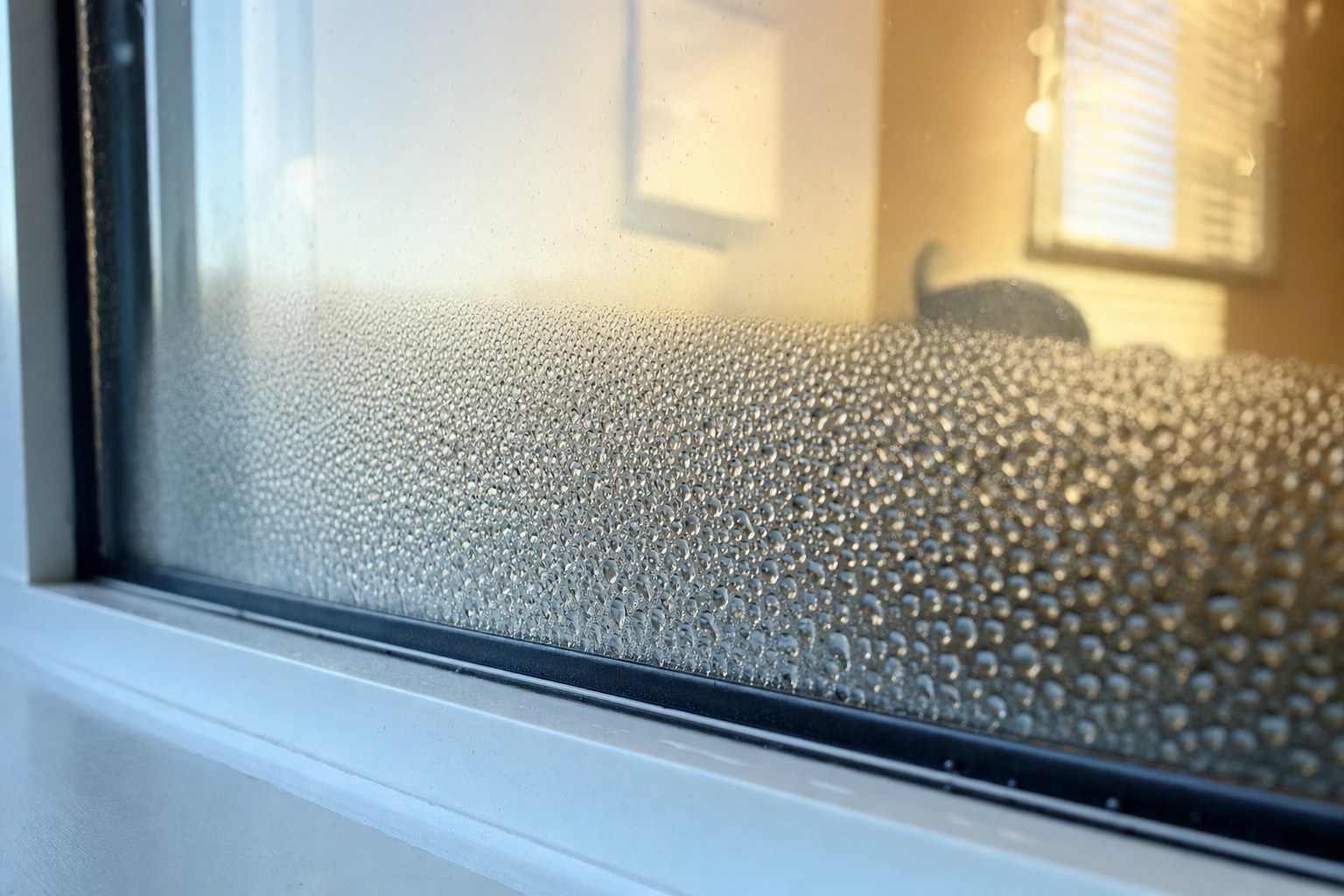
The EPA recommends indoor relative humidity between 30 and 50 percent to prevent mold and control moisture. Many Houston homes drift above that range in summer, especially when bath fans vent into the attic instead of outside, when the AC is oversized and short-cycles without dehumidifying, or when the return-air path is starved. Homeowners can rule out the window by taking humidity readings in the room with a $10 hygrometer before assuming the glass is the problem.
Where the moisture comes from
Indoor moisture is cumulative: showers, cooking, laundry, aquariums, houseplants, gas ranges without hoods, unvented dryers, and the water vapor exhaled by every occupant. When those sources have nowhere to go — a bath fan dumping into the soffit, a recirculating range hood, or a plugged HVAC condensate line — the moisture stays in the air and finds the coldest surface it can. In most Houston homes, that is a window.
Exterior condensation: the sign of a high-performing window
Exterior condensation on the outside of the glass in the early morning looks alarming and is actually good news. It means the interior pane is not letting heat leak out to warm the exterior pane, so the outside surface drops below the dew point of the humid Houston morning air. Same physics as a cold drink sweating on a summer patio. In this scenario, the window is doing exactly what a low-E, argon-filled IGU is supposed to do. It usually burns off within an hour of sunrise. Homeowners can reduce it further by trimming landscaping to increase morning airflow across the glass.
Fog between the panes: a failed insulated glass unit
The one condensation pattern that always points to the window itself is fog trapped between the two panes of an insulated glass unit. Homeowners can identify this pattern by pressing a fingernail to the fog — if the fingernail meets clear glass and the fog remains, the moisture is inside the sealed cavity between the panes, not on either exposed surface. That is a failed IGU seal.
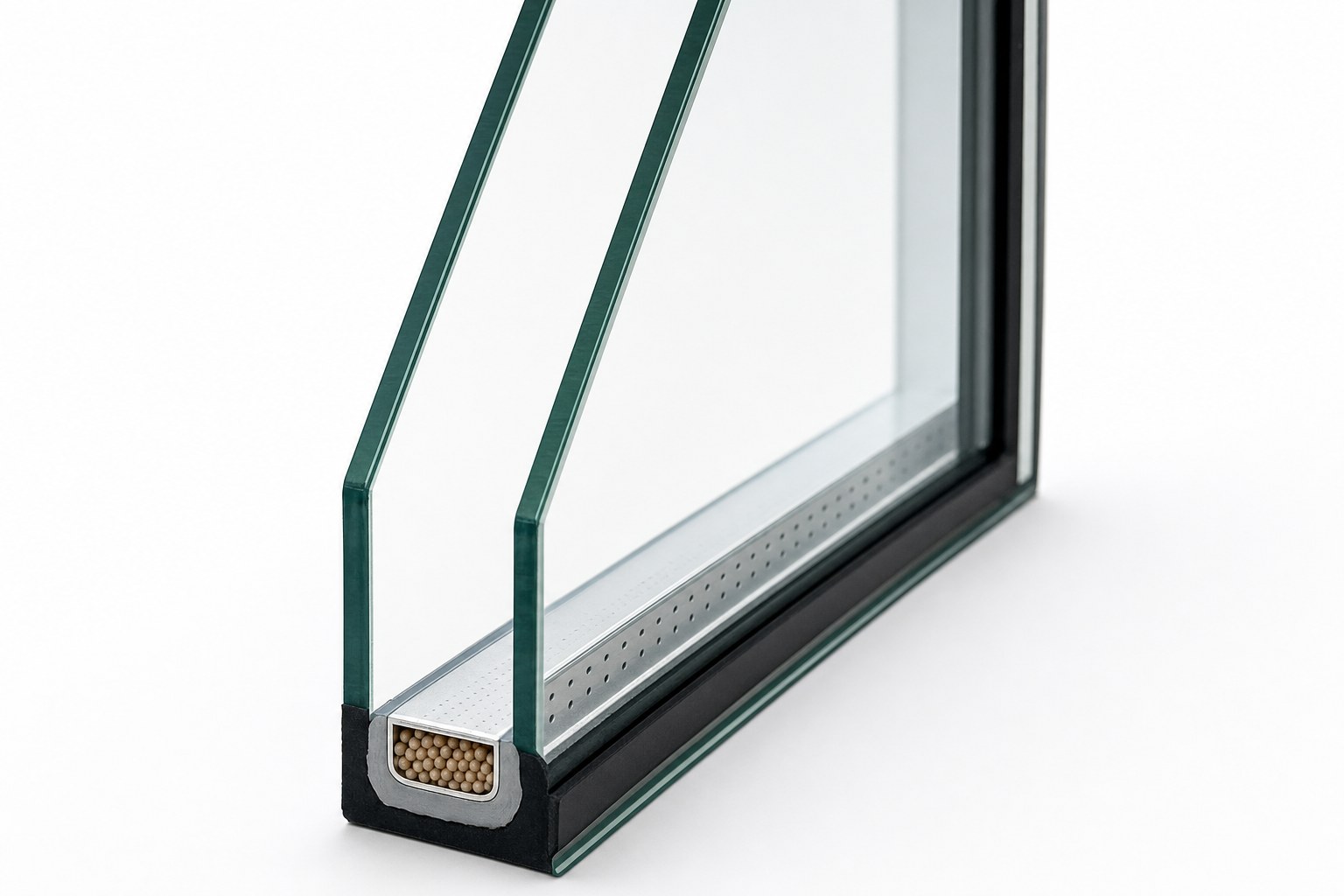
Inside a healthy IGU, a metal spacer bar filled with dessicant beads sits between the panes to absorb any trace moisture that migrates through the seal. The perimeter has a primary sealant that stops gas from escaping and a secondary sealant that provides structural adhesion. When either seal fails — from age, thermal cycling, poor original workmanship, or framing that moves under the window — outside air with its Houston humidity works its way in, saturates the dessicant, and starts condensing on the interior surfaces of the panes.
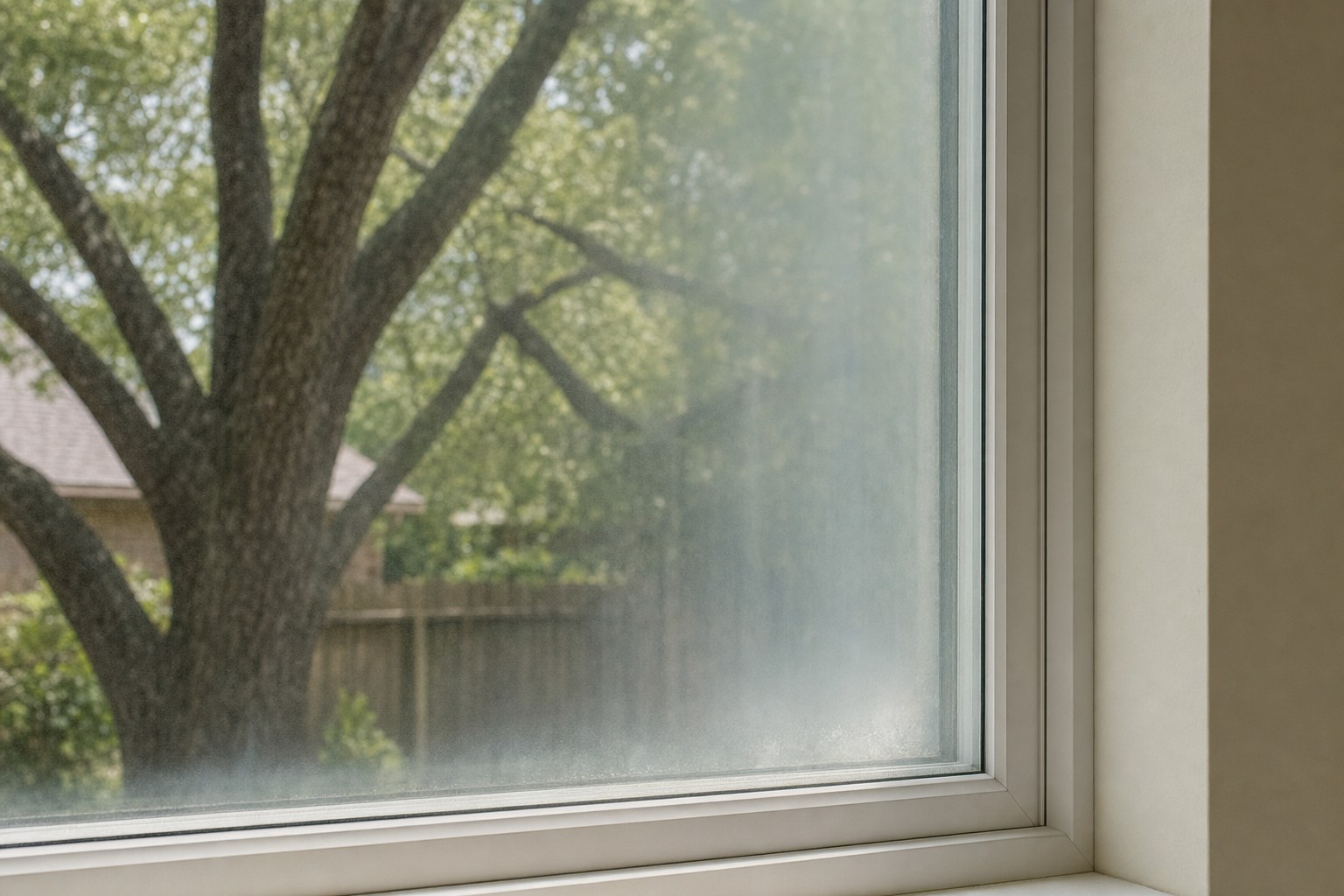
Once the seal fails, the argon or krypton gas fill escapes and the window loses most of its insulating value. For a deeper look at how seal failure progresses and what warranty coverage typically applies, the Education Center’s guide to Houston double-pane window seal failure walks through the mechanics and the repair-versus-replace decision.
Single-pane windows in a Houston climate
Older Houston homes still standing on original single-pane windows show interior condensation more aggressively than any other configuration. A single pane of glass has almost no insulating value, so its interior surface tracks close to outdoor conditions. Run the AC to 72 degrees in a room with a single-pane window when it is 88 degrees and 75 percent humidity outside, and the interior pane is cool enough to condense moisture out of the room air within minutes.
Upgrading to a modern double-pane low-E insulated glass unit shifts the interior pane temperature much closer to room temperature, which is why the same room with the same indoor humidity stops fogging up when the windows are replaced. The U.S. Department of Energy energy-efficient windows guide explains the physics of low-E coatings, warm-edge spacers, and gas fills in more detail. Homeowners shopping for replacement windows should also review the Education Center’s guide to reading a window sticker’s SHGC and U-Factor before comparing quotes.
When condensation signals a bigger problem
Persistent interior condensation is worth taking seriously because the same conditions that fog a window also grow mold behind the drapes, warp the trim under the sill, and rot the drywall paper behind the casing. If moisture keeps returning after longer bath fan runs, cleared returns, a checked HVAC condensate line, and indoor humidity confirmed above 55 percent, the next step is a professional assessment of the envelope and window package together. For the broader warning-sign list, see the Education Center’s guide to Houston window energy efficiency warning signs.
The Bottom Line
Houston summer window condensation is a diagnostic tool, not automatically a failure. Interior condensation points to indoor humidity and ventilation. Exterior condensation usually confirms the window is performing well. Fog trapped between the panes is the one pattern that names the window itself. Homeowners who match the pattern to the cause spend money on the right problem and stop watching the same windows sweat every August.
Are your Houston windows sweating, fogging, or losing efficiency?
DC Pines Roofing installs high-performance replacement windows built for Houston humidity, with low-E glass, warm-edge spacers, and manufacturer-backed IGU warranties.