
Houston gutter myths are among the most expensive misconceptions in residential home maintenance because the failure mode is quiet. A gutter that is undersized, poorly sloped, missing a downspout, or trusted as maintenance-free does not usually leak in an obvious way. It overflows at the front lip during heavy rain, saturates the fascia and the ground next to the foundation, and shows up months later as rotted trim, stained brick, or a puddle that never quite dries. Every one of those outcomes traces back to a myth a homeowner accepted at the start of a project.
The DC Pines Education Center put this post together to name the specific Houston gutter myths that cost homeowners money, and to describe what the correct answer actually looks like in a Houston-appropriate system. This is a homeowner-education explainer, not a product pitch. It is written for the homeowner comparing two or three gutter quotes and trying to tell which one is honest.
Myth 1: “Gutter Guards Eliminate All Cleaning”
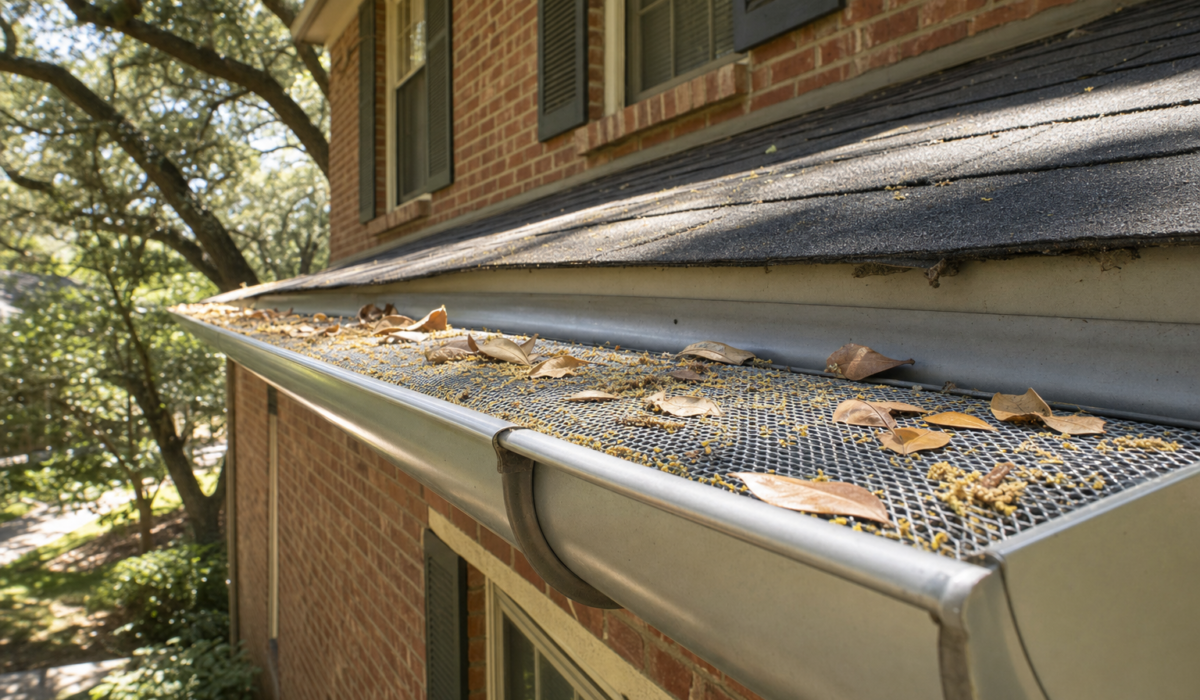
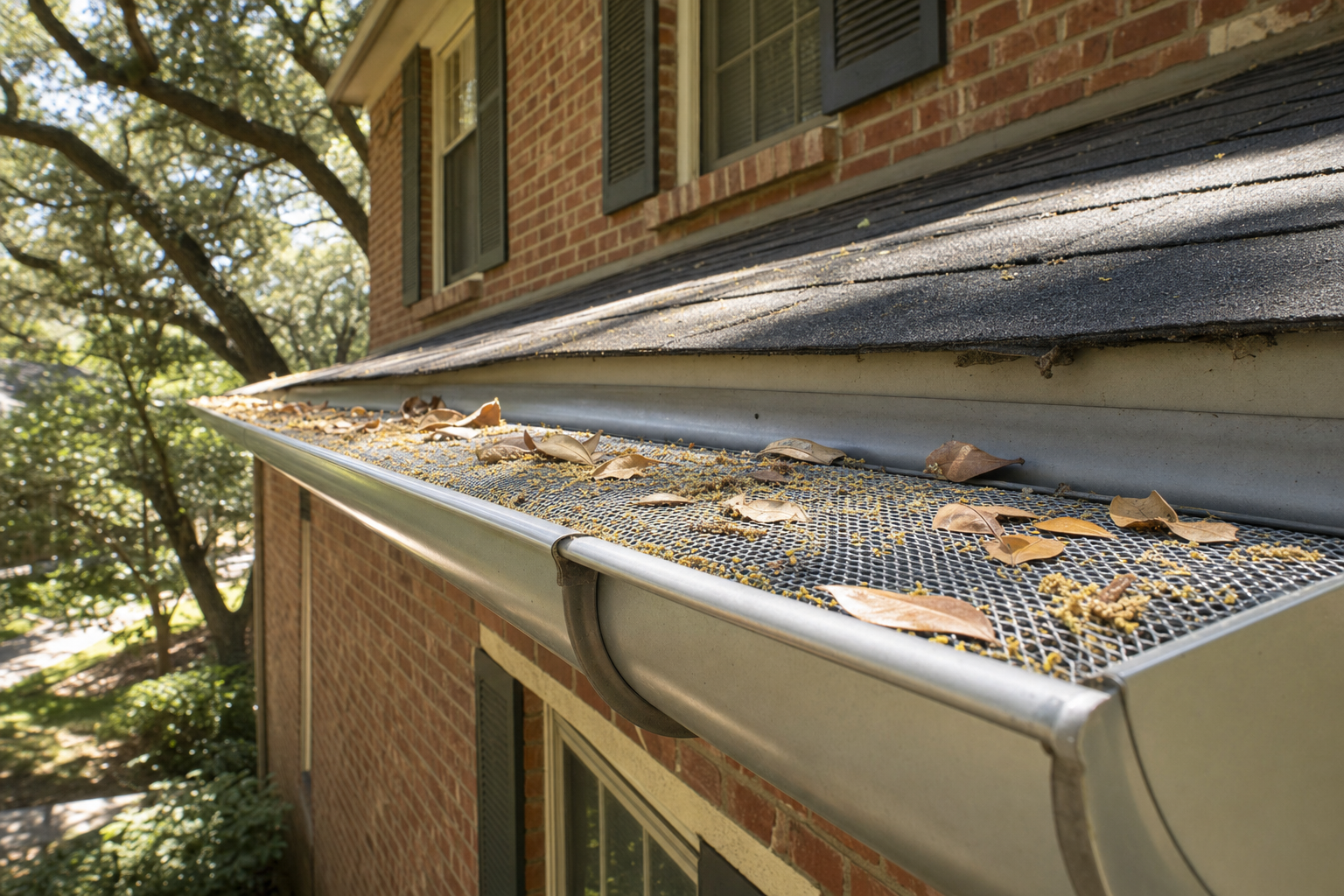
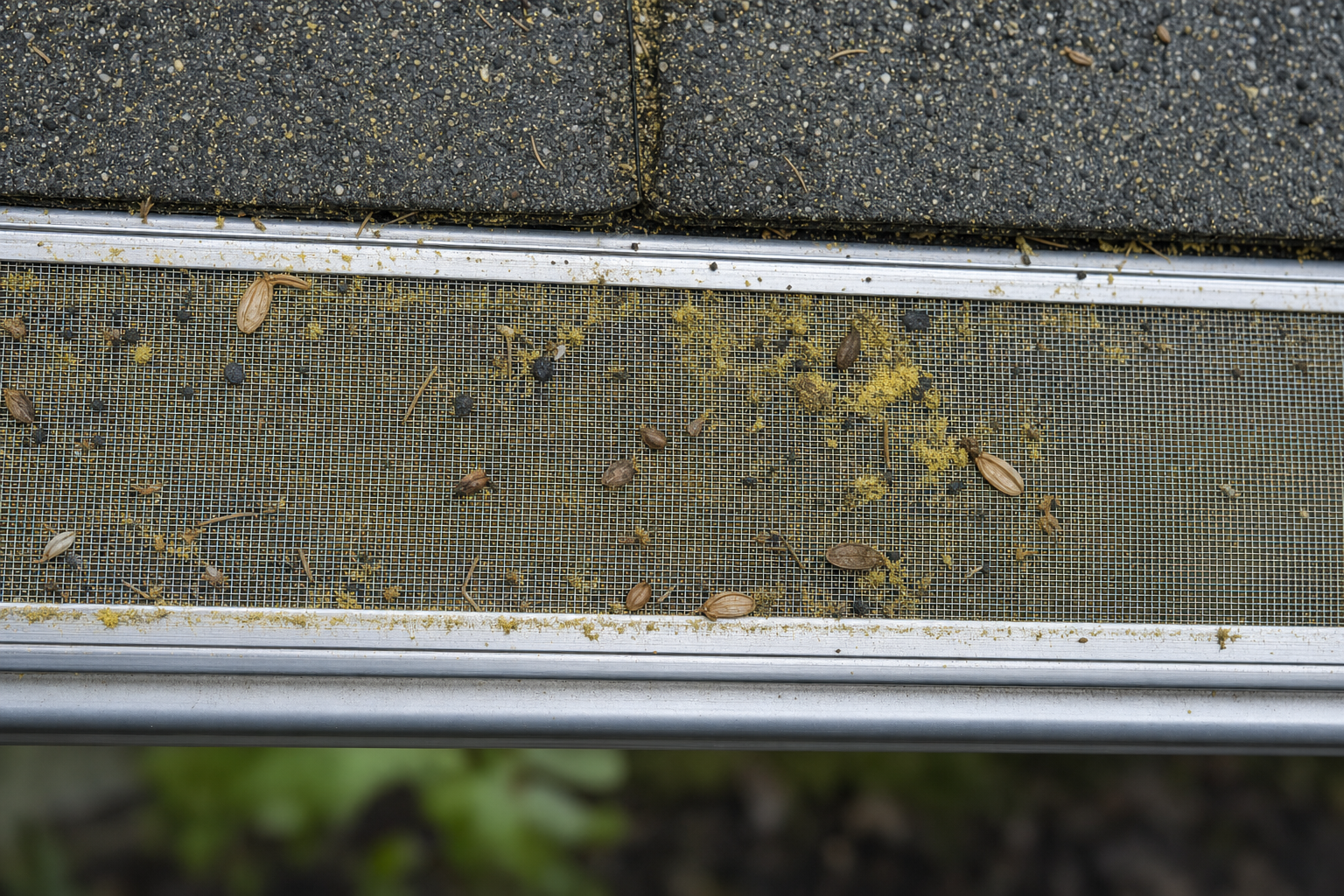
The largest gutter myth in Houston is the idea that installing gutter guards eliminates the need for cleaning. It does not. Independent consumer reporting is consistent on this point. Even premium micro-mesh systems reduce cleaning frequency dramatically, but they still require periodic attention. Debris that is too fine to enter the gutter, such as tree pollen and shingle granules, collects on top of the mesh and can eventually create a water-repellent film that causes rain to sheet over the front of the gutter without ever entering it.
The correct expectation for a guarded gutter in Houston is a shift from twice-a-year full cleanouts to periodic top-surface inspection and rinse. Under a dense live oak or pine canopy, that inspection is still meaningful work. It is far less frequent and far less unpleasant than pulling wet leaves out of an unguarded gutter, but calling any guard system maintenance-free is inaccurate.
Myth 2: “Seamless Means Maintenance-Free”
Seamless aluminum gutters are formed on-site from a continuous coil, which removes the periodic sectional joints that were the historical leak points on older gutter systems. That is a real durability advantage, and it is why seamless is now the default for residential installation. What seamless does not mean is maintenance-free.
Every seamless gutter still has an inside miter at each corner, an outlet cut at every downspout, and an end cap sealed at each termination. Each of those is a joint that uses sealant, and sealant does have a service life. Every seamless gutter still collects debris where a run passes under a tree canopy, and every seamless gutter still relies on hangers screwed into the fascia that need periodic inspection. Seamless describes the horizontal run of aluminum, not the entire system.
Myth 3: “5-Inch Gutters Are Enough for Any Houston Home”
Five-inch K-style aluminum gutter with a 2×3 downspout has been the default residential specification in the Houston market for decades, and on many single-story homes with modest roof planes it is genuinely the right answer. It stops being the right answer as the roof area draining into a single gutter run increases, as roof pitch increases and concentrates water into fewer valleys, and as long uninterrupted runs are forced to drain into a single downspout.
On larger two-story Houston homes, homes with complex roof geometry, and homes where valley water lands hard into an eave gutter, 6-inch K-style aluminum gutter with 3×4 rectangular downspouts is usually the correct specification. The larger trough holds more water during peak rainfall, and the larger downspout evacuates it fast enough that the trough never fills to the front lip. A gutter contractor who quotes 5-inch on every home without doing the math is quoting from a habit, not a specification.

Myth 4: “More Downspouts Always Solve Overflow”
Downspouts remove water from the gutter and put it somewhere on the ground. Adding a downspout in the middle of a run can help if the existing run has too few downspouts for its length or if a single downspout is being overwhelmed. It does not help if the new downspout dumps water in a spot that has no drainage plan. Water added directly beside a foundation, at the top of a saturated flower bed, or onto a walkway is not solving overflow. It is trading one visible problem for a hidden one.
The full downspout question is a sizing, spacing, and tail-location question, not just a count. Every downspout needs a tail extension, splash block, buried drain, or pop-up emitter that carries water far enough away from the foundation that it drains away from the house rather than back toward it. A homeowner reviewing gutter quotes should ask specifically where each downspout terminates.
Myth 5: “Ice Dams Are a Houston Gutter Problem”
Ice dam messaging still shows up in Houston gutter marketing, particularly from national brands that use the same copy across every U.S. metro. Ice dams are a cold-climate roof problem tied to snow melt and refreeze at the eave. Houston does not have the sustained subfreezing conditions or snow load that produce them, so gutter product features designed to prevent ice damming solve a problem this market almost never has.
The real Houston gutter conversation is about rainfall intensity, canopy debris, and foundation drainage. Complementary reading on how debris moves through a system lives in the Education Center’s Houston gutter maintenance guide, and the case for correct hanger hardware sits in the hidden hangers vs spike and ferrule deep dive.
The Bottom Line
Houston gutter myths cost homeowners money because they turn quiet, ongoing failures into repair bills that look sudden. Gutter guards reduce cleaning without eliminating it. Seamless improves durability without making the system self-maintaining. Five-inch is not always the right size, more downspouts is not always the right fix, and ice dams are not a Houston problem. Every one of those corrections is a small change in the specification conversation with a gutter contractor, and each one moves a homeowner one step closer to a system that quietly handles Houston rain instead of quietly failing under it.
Get a gutter system sized for a Houston roof, not a marketing claim.
DC Pines Roofing specifies aluminum gutter profile, downspout size, hanger spacing, and outlet placement for the actual roof draining into every run. Homeowners can request a full gutter inspection and quote that names each component instead of hiding behind maintenance-free marketing language.