

By the last week of August, a Houston home has been through nearly four months of relentless heat, humidity, and UV exposure. That is the moment when the small issues that started in June begin to become visible from the driveway. A structured late summer home exterior checklist is one of the most useful tools a Houston homeowner can run before the first cool front arrives.
The DC Pines Education Center put together this walk-around guide so homeowners in neighborhoods from The Woodlands and Spring down through Bellaire, Memorial, Sugar Land, Katy, and Pearland can spot the six items most worth checking right now — before fall debris, cooler rains, and holiday scheduling make repairs harder.

1. Walk the Roof From the Sidewalk First
The best late-summer roof inspection starts at the curb, not on a ladder. Standing back 30 to 40 feet gives a homeowner a wide view of color uniformity across the roof slopes, straightness of ridge and hip lines, and the general condition of visible flashing.
Signs worth noting on a Houston roof in late August include darker or lighter patches on individual slopes, especially the south and west faces that took the most sun, small dips or valleys in what should be straight lines, and any shingles that appear slightly lifted at the corners. Each of these findings is normal in isolation but useful as a written baseline going into fall.
For homeowners who want the technical background on why Houston sun ages asphalt shingles the way it does, the Education Center’s deep-dive on how Houston heat actually ages an asphalt shingle roof at year 10 pairs well with this walk-around.
2. Check What the Downspouts Are Delivering
The base of every downspout tells the story of what is happening on the roof above it. In late August, a small pile of asphalt granules at the discharge point is one of the clearest signs of ongoing wear. Some granule loss is normal across the life of a roof, but a concentrated pile after summer is a good reason to note the location, take a photo, and revisit the same spot after fall storms have passed.
Downspout discharge itself also matters. Splash blocks, buried drain extensions, or simple flexible tubing should be moving water at least five to six feet from the foundation. In Houston’s expansive clay soil, water pooling against the slab is a much bigger problem than most homeowners expect.
3. Look Inside the Gutters Before Fall Debris Doubles Down
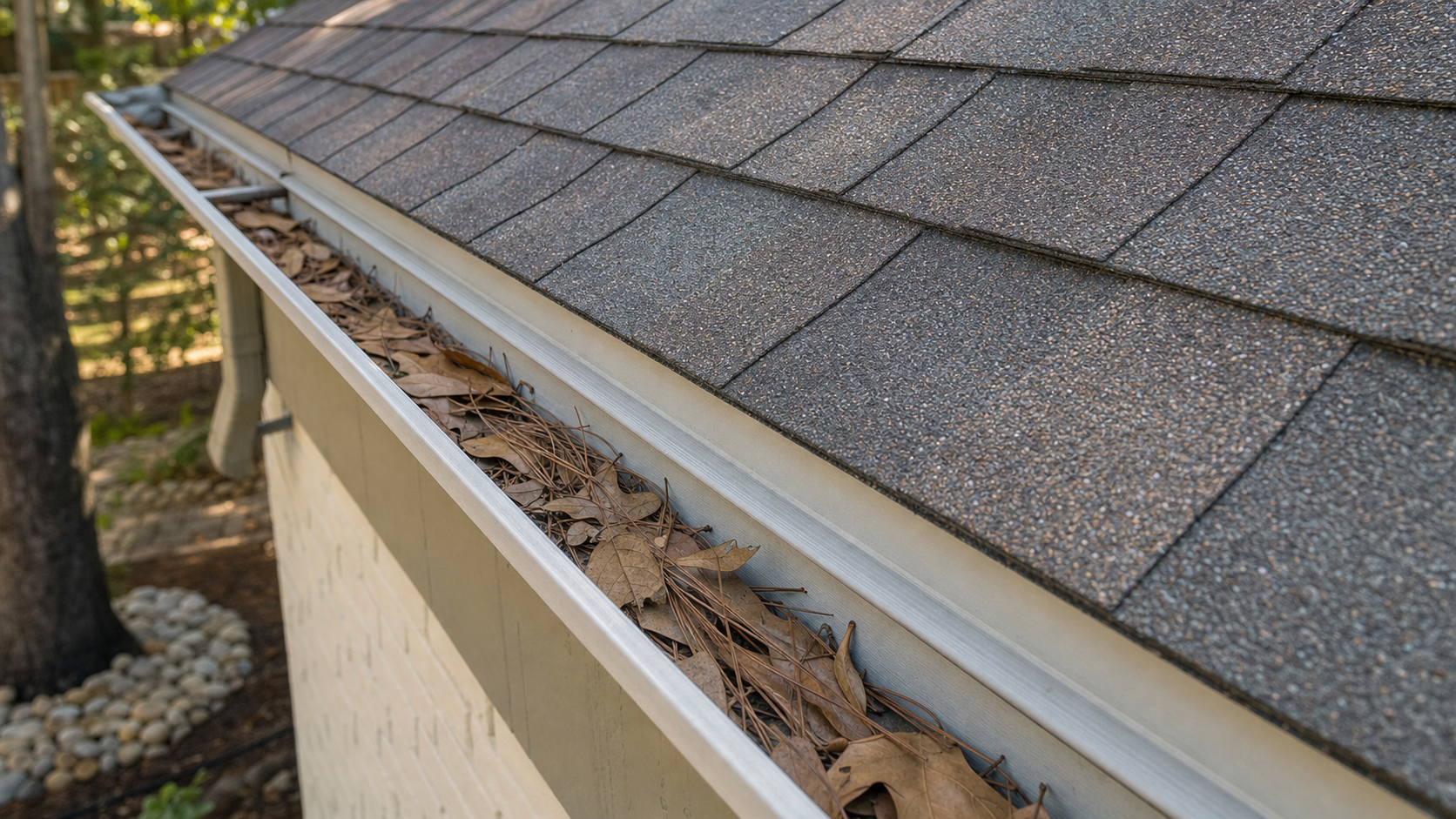
Houston gutters do not empty out in summer. Live oaks shed year-round in small waves, and pines drop needles heavily during the hot months. By late August most homes already have a partial layer of last spring’s debris compacted along the bottom of every run, and that is before autumn leaf drop begins in earnest.
Checking gutter interiors before fall means catching clogs while they are still small. A partially clogged gutter still moves water, so it hides its own problem — right up until the first heavy rain overflows behind the fascia and stains the soffit. Homeowners who want a broader read on this can review the Education Center’s homeowner’s guide to Houston gutter maintenance.
4. Inspect Exterior Caulk, Trim, and Siding Seams
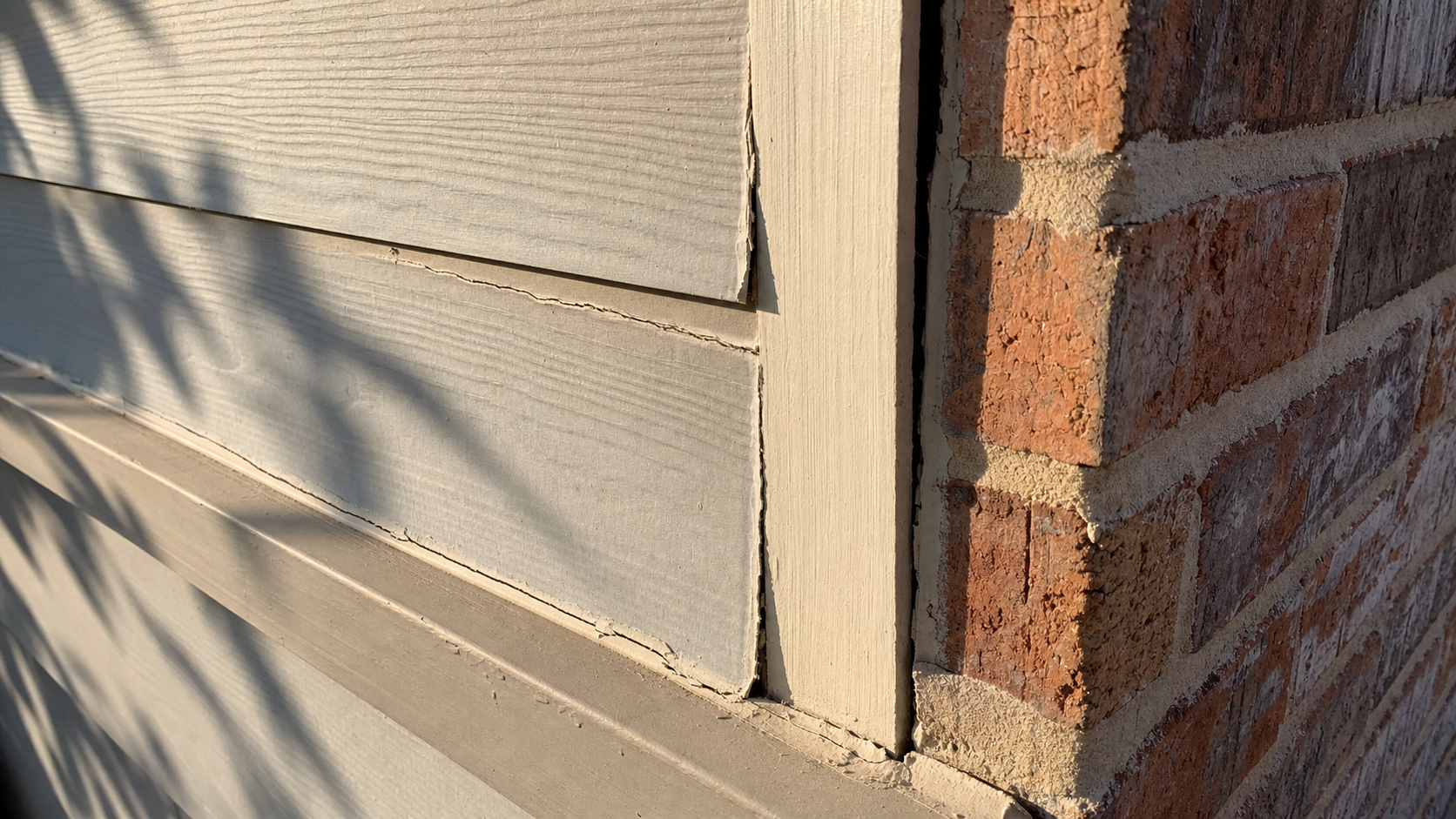
Caulk is the quietest part of a Houston home’s exterior, and it is also the first material to tell the truth about how the summer went. Around window frames, at corners where hardie siding meets brick, along fascia joints, and at exterior door casings, the caulk should still be flexible and continuous.
Late-summer inspection often turns up hairline cracks, small pull-back at the edges, and dry-looking sun-baked lines that have lost their bond. These are minor issues on their own, but they are the small openings that let water past the exterior finish and into the wall assembly. Recaulking a handful of spots in September is far cheaper than repairing water damage six months later.
5. Read the Attic and Soffit From Outside
Attic ventilation is impossible to fully evaluate from the ground, but there are a few outside clues that tell a homeowner whether the attic is likely working hard. Soffit vents should be free of paint over-spray and undamaged. Ridge vents, if present, should sit straight and uncrushed along the peak. Any brown or rust-tinted staining on the soffit near the eave usually means water sat somewhere it should not have.
In Houston’s Jun-through-September window, attic temperatures routinely reach 140 degrees when ventilation is undersized, which drives up cooling costs across the whole house. The Education Center covered the physics in detail in its guide to Houston attic ventilation and radiant barrier energy efficiency.
6. Note the Neighborhood-Specific Risks
Houston is not one climate. The Woodlands and Spring push more pine needles into gutters than most inner-loop neighborhoods. Bellaire and Memorial live under dense live oak canopies that shade roofs beautifully in summer but leave them cool and slow to dry after a rain. Katy, Cypress, and parts of Sugar Land sit on expansive clay soils that lift and settle with moisture cycles, making downspout discharge distance more important than the average homeowner realizes.
A useful late-summer walk factors these local realities into the checklist. A home in Memorial with heavy tree cover has different gutter, ventilation, and siding priorities than a newer construction in Cypress on open lots. Writing down the specific pressures on a specific home is what turns a generic checklist into a plan.
The Bottom Line
Late August is the quietest window in the Houston home-services calendar and the loudest window for showing what the summer did. A structured 30-minute exterior walk — curb view of the roof, downspout inspection, gutter interior check, exterior caulk pass, attic and soffit read, and neighborhood-specific notes — gives a Houston homeowner a documented starting point for fall. The homes that go into cooler weather with a written plan are the ones that avoid the emergency phone calls in November.
Turn the late-summer walk into a written plan for fall.
DC Pines Roofing helps Houston homeowners inspect roofs, gutters, and windows across the entire exterior with a documented, photo-backed report — not a sales pitch.