

Most gutter conversations in Houston start with color and finish with cost. The DC Pines Education Center has watched enough gutter systems fail during a heavy Gulf Coast afternoon to know that a Houston gutter sizing guide is worth publishing before either of those conversations happens. Gutters are hydraulics before they are trim. Houston rain arrives in short, intense bursts, and a system spec’d for a mild-climate national average gives up right when the homeowner most needs it.
This Houston gutter sizing guide walks through when 5-inch K-style gutters are enough, when 6-inch gutters are the smarter default, how downspout size and count actually control performance, and where seamless aluminum belongs in the conversation. It is written the same way the DC Pines Roofing team walks a homeowner through a gutter estimate — the numbers first, the color second.
Why Houston rainfall breaks generic gutter rules
National gutter sizing guides tend to assume moderate rainfall spread over a long duration. The Gulf Coast does the opposite. Houston delivers rainfall in short, high-intensity bursts where inches of water can move across the roof in tens of minutes. That is when an underspec’d gutter fails — not on a gentle spring shower, but on the ten-minute event that hits every summer.
The Education Center thinks about a Houston gutter system in three dimensions: the cross-sectional capacity of the gutter itself, the drainage capacity of each downspout, and the number of downspouts serving each run. Get any one of those wrong and the other two cannot rescue the system. The oldest homes in the Houston metro were built when 5-inch K-style gutters with 2-by-3 downspouts were the industry default. That specification is no longer generous.
5-inch vs 6-inch gutters: when the upgrade earns its cost
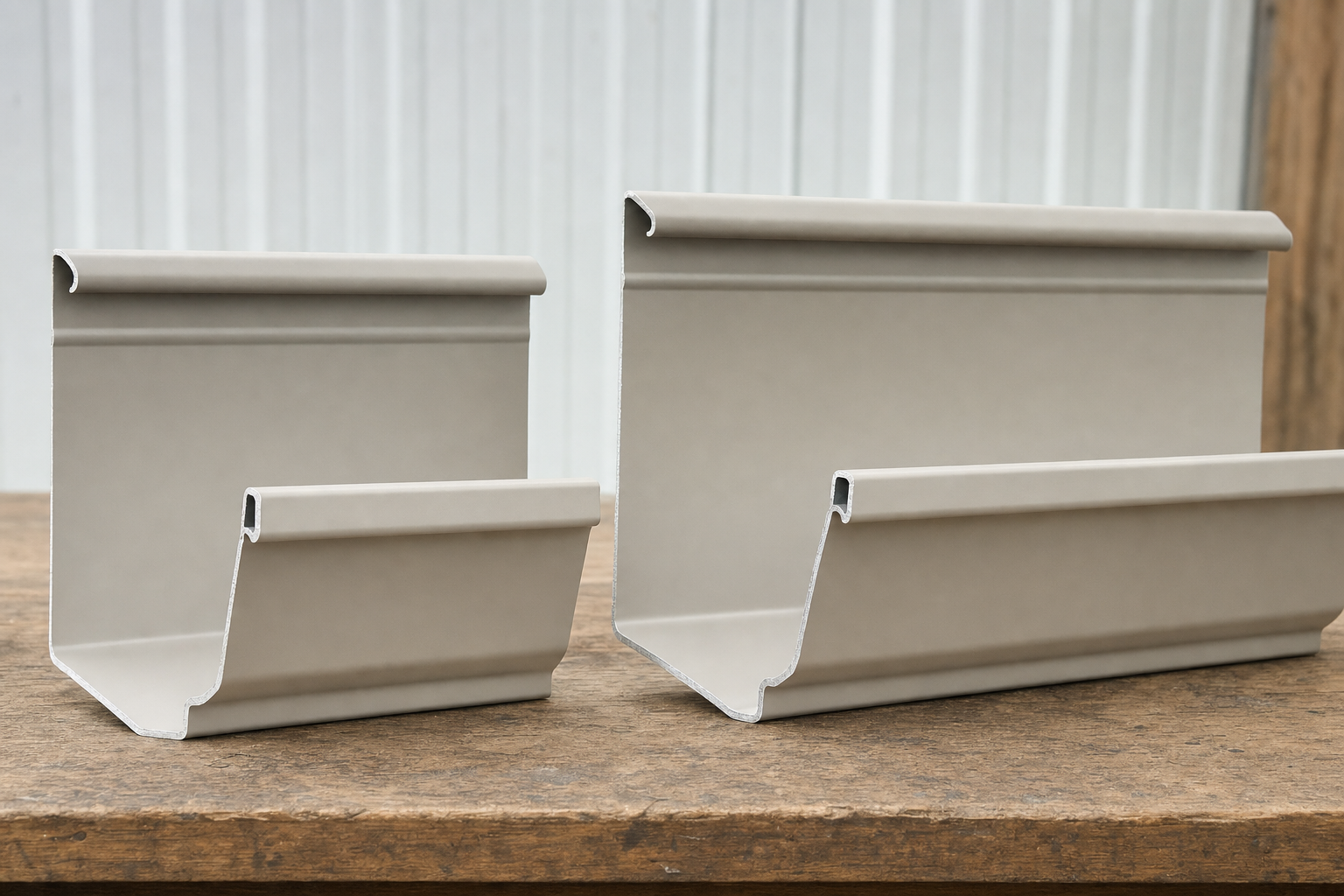
A 5-inch K-style gutter has roughly 20 to 22 square inches of cross-sectional area. A 6-inch K-style gutter jumps to roughly 30 to 32 square inches, about a 40 percent capacity increase for a modest per-foot price bump. On a small ranch with short roof runs and gentle pitches, a 5-inch system installed correctly is often plenty. On the majority of Houston homes the Education Center walks — two-story homes, homes with steep pitches, homes with long single runs — the extra capacity of a 6-inch profile earns its cost the first time a Gulf Coast burst rolls through.
The key drivers pushing a Houston home toward 6-inch gutters are total roof area draining to a single run, roof pitch (steeper pitches deliver water faster), and the length of the run itself. When any one of those pushes toward the edge, the 5-inch profile is where overshoot at the eave starts happening on peak events. Overshoot is what ends up staining fascia and eroding the flowerbeds directly below the gutter line.
Where 5-inch still makes sense
A 5-inch K-style gutter has a real place on smaller Houston homes with short runs, generous outlet counts, and modest roof pitches. The Education Center’s caution is against defaulting to 5-inch to save money without checking whether the roof plane actually supports it. That decision should be driven by the roof, not the estimate.
Downspouts do more work than the gutter above them
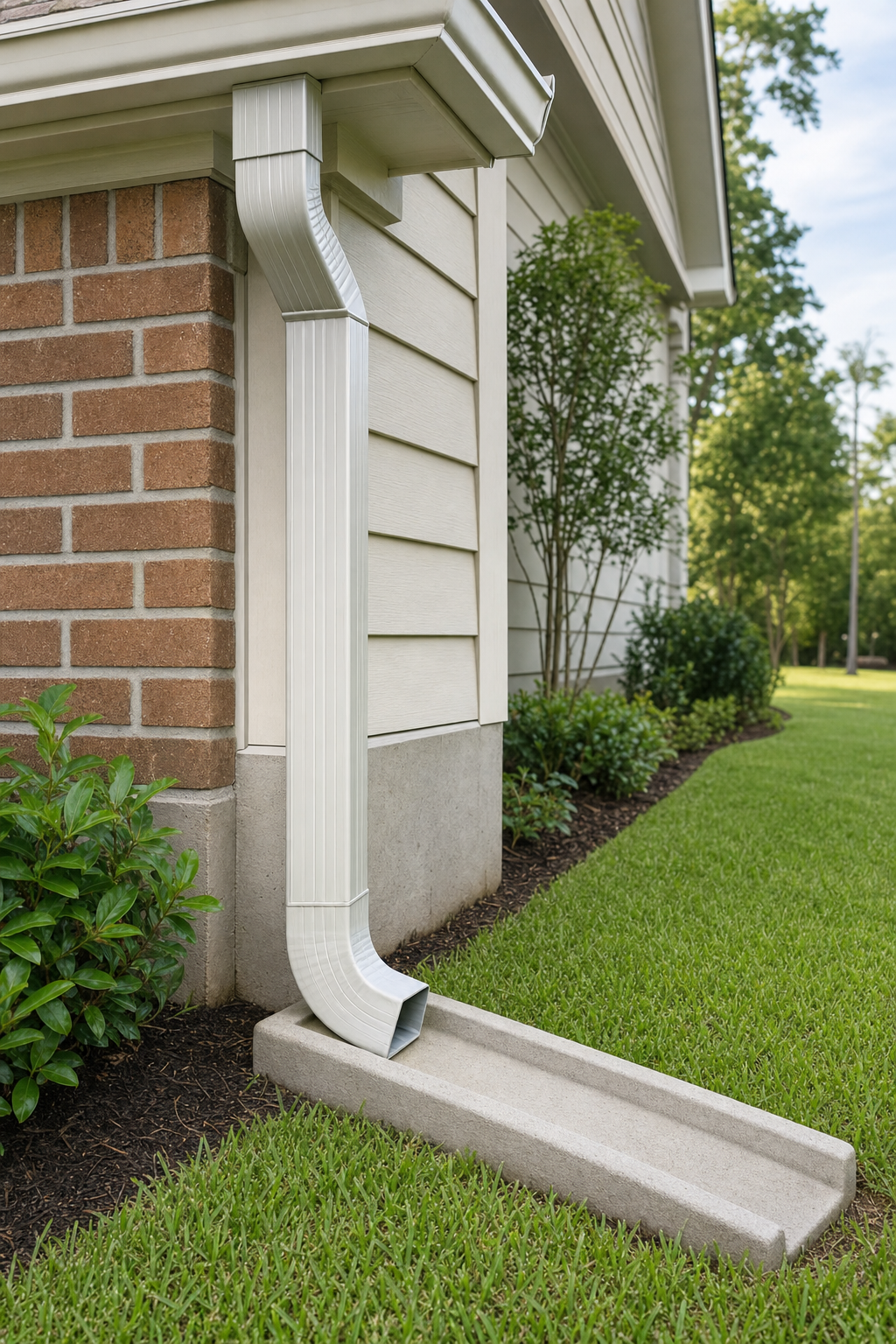
If gutter size is the reservoir, downspout size is the drain. Even a perfectly sized 6-inch gutter overflows if the downspouts cannot move water off the roof fast enough. This is the most common failure mode the DC Pines Education Center sees on otherwise well-installed Houston gutter systems: adequate gutters, inadequate outlets.
A 2-inch by 3-inch downspout — still common on older homes — has about 6 square inches of drainage area. A 3-inch by 4-inch downspout has about 12 square inches, roughly double. The Education Center’s default on Houston homes is the 3-by-4 profile, both for peak flow and for the fact that Houston tree debris — live oak catkins, pine needles, magnolia leaves — clogs a narrow outlet far faster than a wider one. Debris exposure is covered in more depth in the Education Center’s guide to gutter guards for live oak and pine debris, and downspout sizing is one of the two levers that determines whether that debris ever becomes a problem.
How many downspouts a Houston roof actually needs
The Education Center works from a practical rule of thumb: one downspout for every 30 to 40 feet of gutter run on a typical Houston roof, with additional outlets on steep pitches or large single-plane roofs. Every long run should have at least two outlets so no drop of water is asked to travel the whole length in one direction. Outlet count is where a lot of Houston homes were originally underspecified — the fix is usually adding a downspout, not replacing the gutter above it.
Why seamless aluminum is the Houston default
Seamless aluminum K-style gutters, formed on site to the exact length of each run, are the DC Pines Education Center’s default gutter recommendation for Houston homes. Fewer joints means fewer leak points across a system that will sit through decades of Gulf Coast humidity. Aluminum handles that humidity without the corrosion problems older galvanized steel systems developed in the same climate.
The finish matters too. A baked-on paint finish on aluminum holds color against Houston sun far better than an older painted-in-place system. That said, aluminum sizing rules do not change the hydraulics — a seamless aluminum 5-inch gutter with 2-by-3 downspouts is still capacity-limited on a big Houston roof, regardless of finish quality.
Discharge routing: where water ends up after the downspout
A Houston gutter system that dumps water directly against the foundation is only half a system. The other half is what happens once water leaves the downspout. Splash blocks, downspout extensions, and buried drainage lines all belong in the conversation. The Education Center’s broader piece on how Houston clay soil moves against a home foundation covers why bad discharge routing quietly stresses the whole exterior envelope, not just the flowerbed.
At minimum, every downspout in Houston deserves either a splash block extending water two to three feet away from the foundation or a buried drainage line carrying it further. Sending water straight down onto bare soil next to a slab is how gutter problems become foundation problems.
The Bottom Line
A Houston gutter system is a hydraulics problem before it is a materials or color problem. On most Houston homes the DC Pines Education Center walks, 6-inch seamless aluminum gutters with 3-by-4 downspouts and adequate outlet count are the balanced default. On smaller homes a 5-inch system installed with the right outlet count and downspout size still works fine.
The failure mode is not usually a single wrong component — it is a system that was spec’d for average conditions instead of Gulf Coast conditions. When a Houston homeowner is comparing bids, the right questions are about gutter profile, downspout dimensions, outlet count per run, and how the discharge is routed away from the foundation. The color decision can wait.
Ready to upgrade a Houston gutter system?
DC Pines Roofing installs seamless aluminum gutters spec’d for Gulf Coast rainfall — right profile, right downspouts, right outlet count, discharge routed away from the foundation.