Your attic is a solar oven. Radiant barrier is the lid.
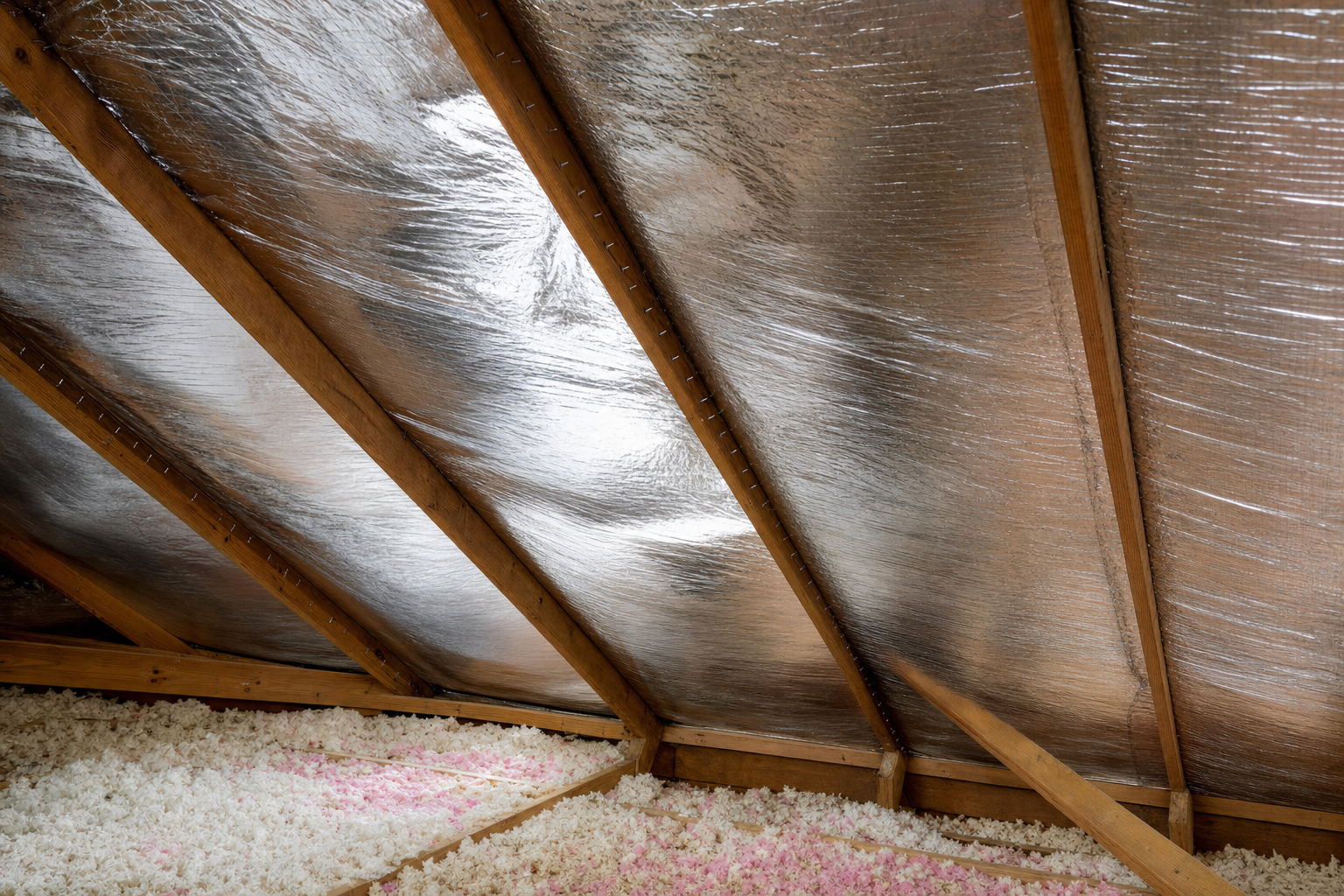
Perforated double-sided aluminum foil, stapled to the underside of your rafters. Reflects up to 97% of the radiant heat trying to push through your roof deck — without trapping the moisture Houston humidity throws at it.
Insulation slows heat. Radiant barrier stops it before it starts.
Most heat entering your attic in a Houston summer doesn’t come through conduction — it comes through radiation. Your roof deck heats up to 160°F+ under direct sun and radiates that heat straight down onto your insulation and ductwork. Adding more insulation just gives that heat something thicker to push through. A radiant barrier reflects it back before it ever hits the insulation.
160°+ roof deck
Dark asphalt shingles absorb solar energy and radiate it downward. The bare wood underside of your roof deck sits at 150–170°F for most of a Houston summer afternoon.
Cooked ductwork
Your AC ducts run through that superheated attic. Every foot of duct in a 140° attic is losing cooling capacity to the air around it before it ever reaches your rooms.
Ceiling drywall radiates in
Even with R-38 insulation, a 140° attic transmits enough heat downward that your ceilings sit warm to the touch. That’s what your AC is fighting all afternoon.
AC that never catches up
Insulation alone can’t handle Houston’s radiant load. Systems get sized for a house, not a house sitting under a solar collector. Radiant barrier is the missing piece.
Radiant heat is the load your insulation was never designed for.
Houston sits in DOE Climate Zone 2 — cooling-dominated, humid, and hot. On a still July afternoon, the underside of an uninsulated asphalt-shingle roof deck routinely measures 150–170°F. That surface radiates heat downward onto everything below it: your insulation, your ducts, your framing, your ceiling.
A properly-installed radiant barrier reflects up to 97% of that radiant heat back toward the roof — before your insulation ever has to deal with it. The result is an attic that runs 15 to 30°F cooler, ductwork that stops fighting the environment, and cooling bills the DOE estimates 10–15% lower in hot climates.

Perforated double-sided foil, stapled to the rafters. Nothing else.
There are three ways to add radiant barrier to a home — foil sheeting stapled to rafters, spray-on radiant paint, and reflective roof decking installed during a re-roof. We install the option that actually works after the roof is already on: perforated foil, hung between rafters.
Perforated foil-faced radiant barrier
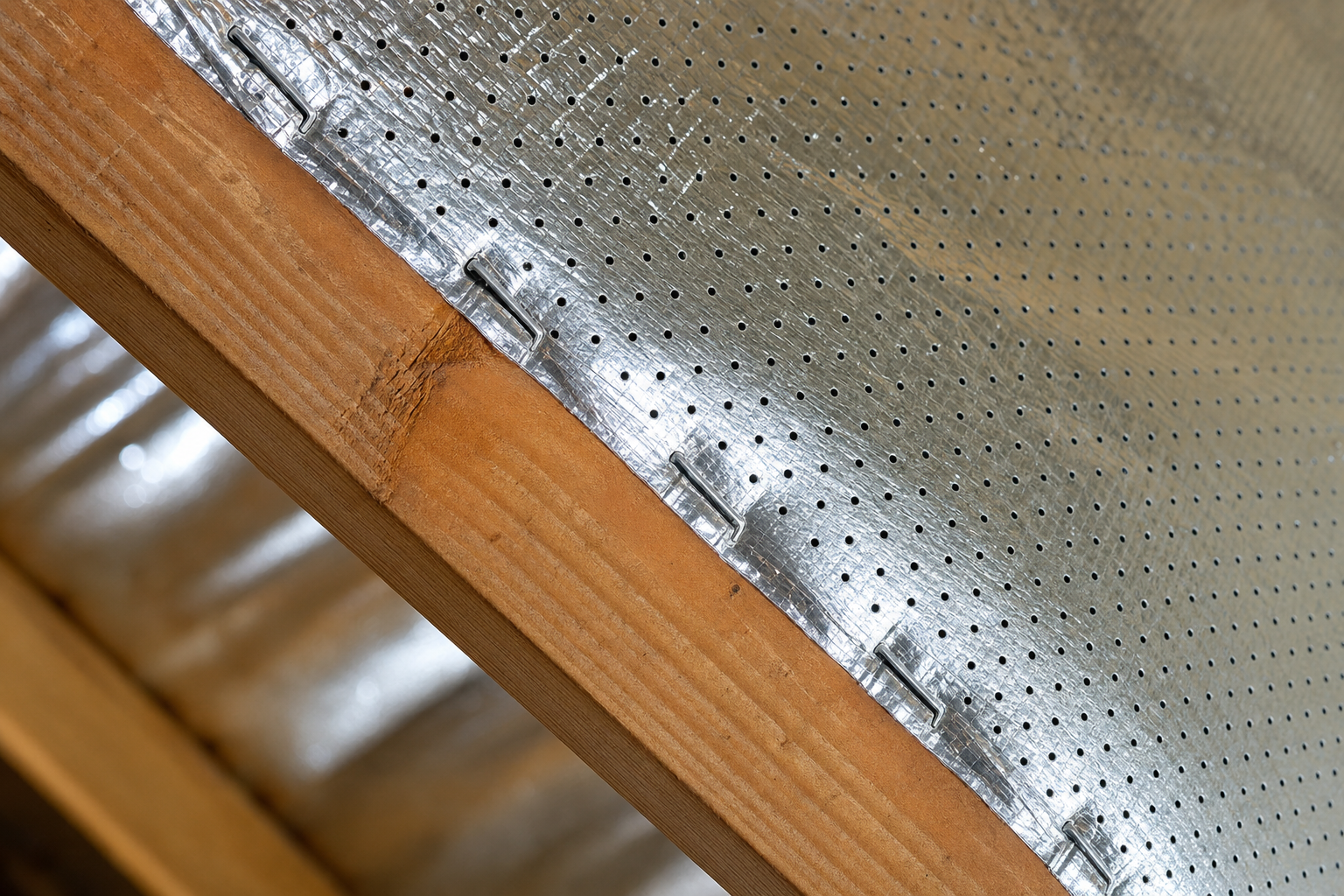
Reflective aluminum on both sides, reinforced with a woven scrim, and micro-perforated for moisture breathability. We staple it to the underside of your roof rafters with an air gap — the physics that make radiant barrier work. Perforation lets water vapor pass through so nothing gets trapped in your attic.
- ReflectivityUp to 97% radiant heat
- Emissivity0.03 (industry lowest)
- PerforationVapor-permeable (breathable)
- FacingDouble-sided reflective aluminum
- FasteningStainless staples, 4–6″ centers
- Time on site1 day, most single-family homes
Spray-on & radiant decking
Spray-on radiant paint applies a low-emissivity coating directly to the roof deck. It works — but degrades and loses reflectivity over time, and can’t be re-applied without removing insulation. Radiant sheathing (like TechShield or LP TechShield) is only installable during a new roof deck replacement.
- Spray-on coatingDegrades over 5–10 years
- Radiant deckingOnly during full re-roof
- BothCannot be topped up later
- Stapled foilPermanent, verifiable, adds no roof weight
- Best comboFoil + R-49 blown-in insulation
How radiant barrier stacks against everything else in your attic.
Emissivity measures how much heat a surface radiates. Lower is better. Aluminum foil sits at 0.03 — meaning it emits only 3% of the radiant heat it receives, and reflects the other 97%. Nothing else in your attic even comes close.
Surface reflectivity — real materials, real numbers.
These are published emissivity values from ASTM C1371 lab testing. The lower the emissivity, the more heat a surface reflects rather than radiates onward. It’s the physics that make radiant barrier work — and why insulation alone can’t do the job in a Houston attic.
- Bare wood deck0.90 emit
- Fiberglass insulation0.75 emit
- Aluminum radiant foil0.03 emit
Three things that separate a real install from a stapled-up mess.
Radiant barrier only works if it’s perforated, if there’s an air gap behind it, and if your attic can still breathe. Most bargain installers skip at least one of those three. Here’s what a proper Houston install looks like.
Perforated foil only
Solid (non-perforated) radiant barrier traps moisture behind the foil. In humid Houston attics that means condensation on the roof decking — the fastest way to rot sheathing. We install only micro-perforated product that lets water vapor pass through.
Air gap facing down
Radiant barrier only reflects heat across an air gap. Foil stapled directly against the roof deck does almost nothing. We hang it below the rafters with a full open cavity above — that air gap is the physics.
Ventilation stays intact
Your attic still needs soffit intake and ridge exhaust. We leave a clear gap at every eave vent and ridge, and never cover a can light, bath fan, or HVAC penetration. Radiant barrier is passive — it can’t work if the attic can’t breathe.
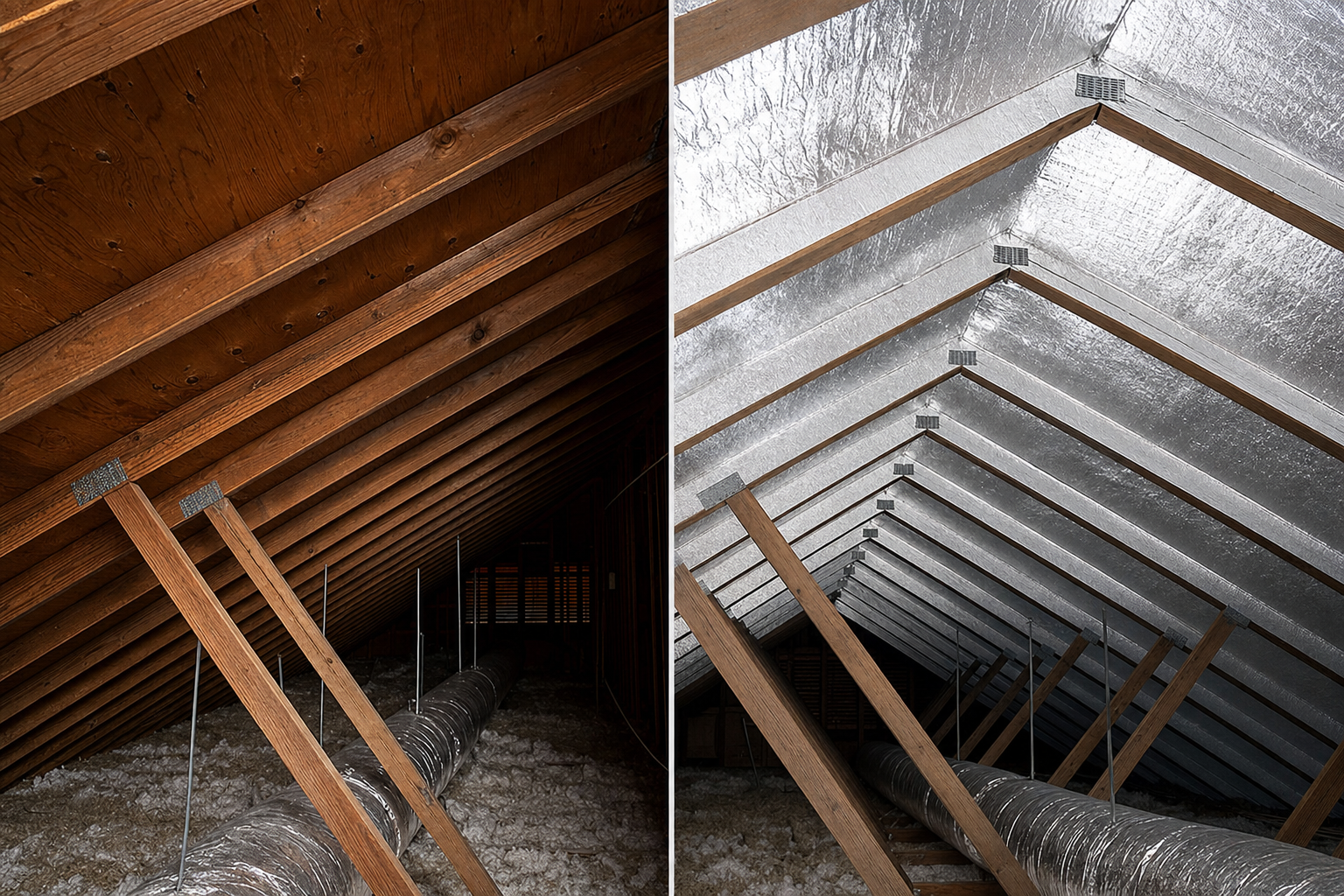
What a real install looks like — versus what most crews sell you.
| Feature | DC Pines | Bargain Attic Crews | Spray-On Radiant Paint |
|---|---|---|---|
| Product | Perforated double-sided foil w/ scrim | Cheap single-sided foil | Low-emissivity paint coating |
| Reflectivity | 97% (0.03 emissivity) | ~85% (single-sided drops fast) | ~75% when new |
| Vapor breathable | ✓ Micro-perforated | ~ Sometimes | ~ Depends on product |
| Air gap installation | ✓ Rafter-hung, air gap intact | ✗ Stapled flat to deck | N/A (surface coating) |
| Preserves ventilation | ✓ Soffit & ridge stay open | ✗ Often blocks vents | ✓ No ventilation impact |
| Adds roof weight | ✓ None (foil is negligible) | None | None |
| Longevity | Permanent, no degradation | Permanent | ~ Degrades over 5–10 yrs |
| Post-install verification | ✓ Attic temp reading + photos | ✗ Not offered | ✗ Not offered |
| Written warranty | ✓ Lifetime, transferable | 1 year workmanship | Depends on product |
| Owned by a roofer | ✓ Yes | ✗ No | ✗ No |
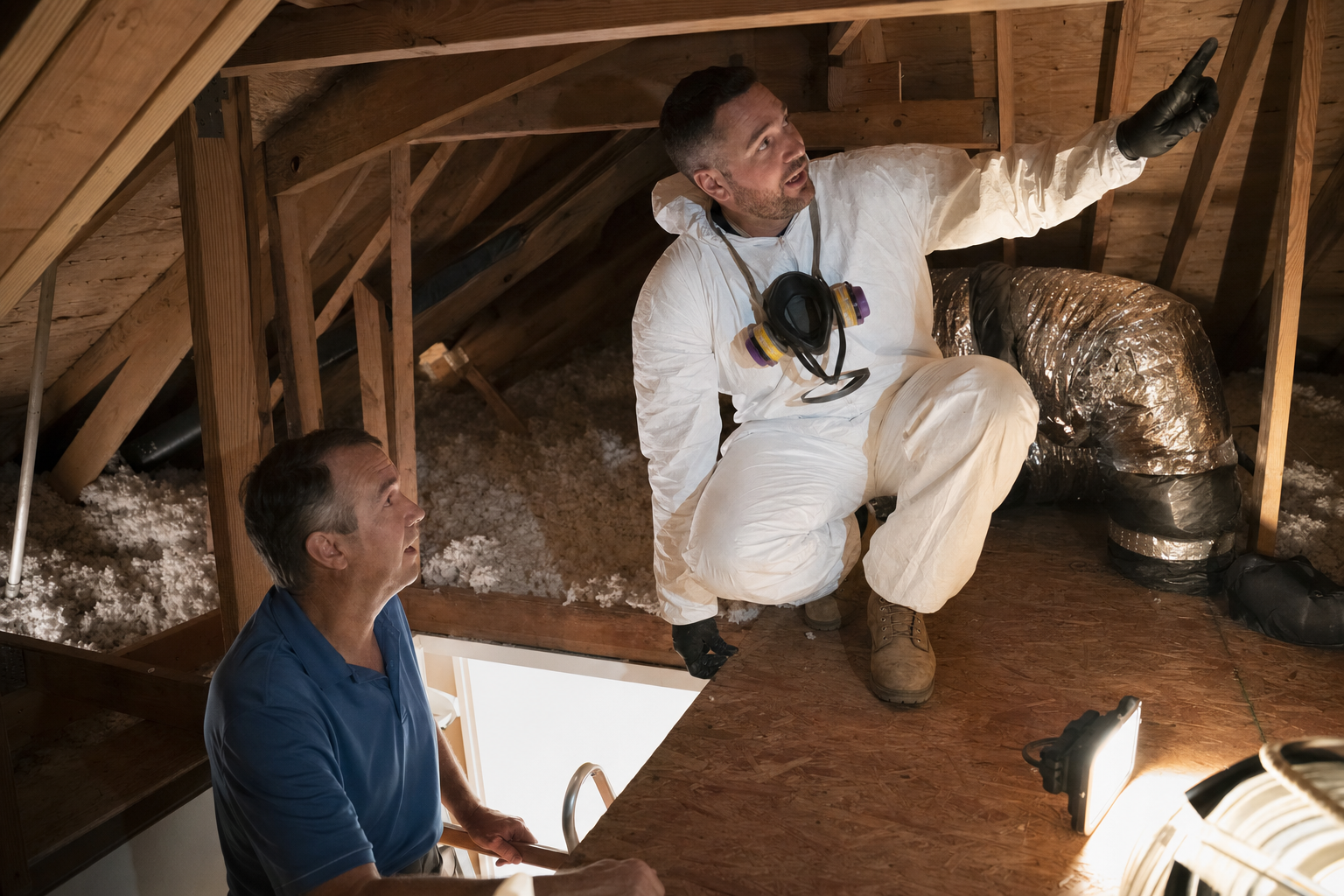
We know what happens when you seal an attic wrong.
DC Pines is a roofing company first. That means when we hang radiant barrier, we’re checking the ventilation balance, the flashing at penetrations, the moisture history, and the shingle condition — not just how fast we can staple foil.
A wrongly-installed radiant barrier can trap moisture and rot your decking in a single humid Houston summer. You don’t need a crew that installs foil. You need one that knows what an attic is actually doing.
Get My Free Attic InspectionFour steps from first call to reflective attic.
Free attic inspection
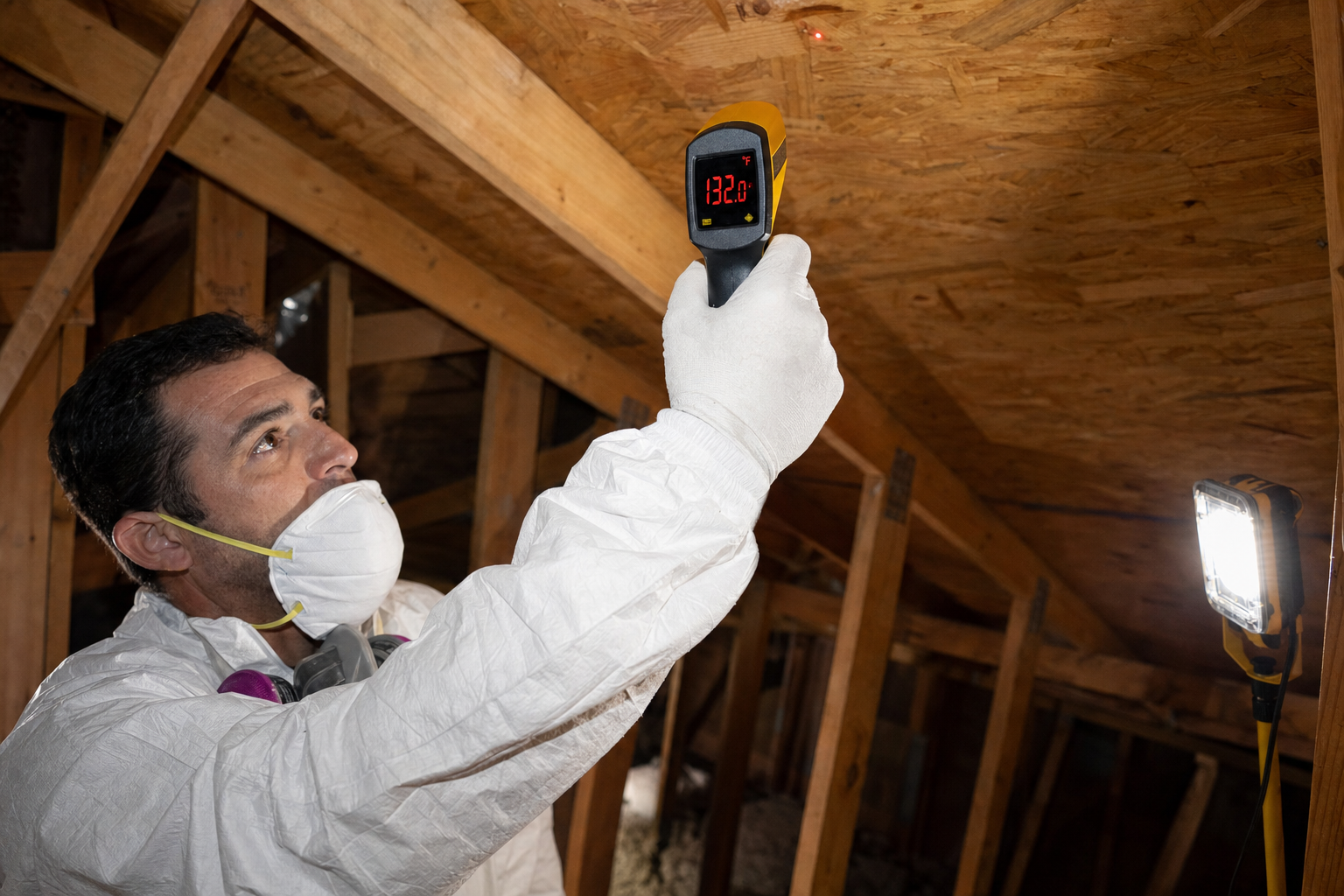
We crawl your attic, measure the roof-deck temperature with an infrared thermometer, check ventilation balance, and photograph what’s up there. You get a written report same-day or next-day.
Flat quote, single number
You get one price per square foot of attic, with the product, coverage, and warranty in writing. No hidden line items, no surprise upsells at the truck.
Prep & protect
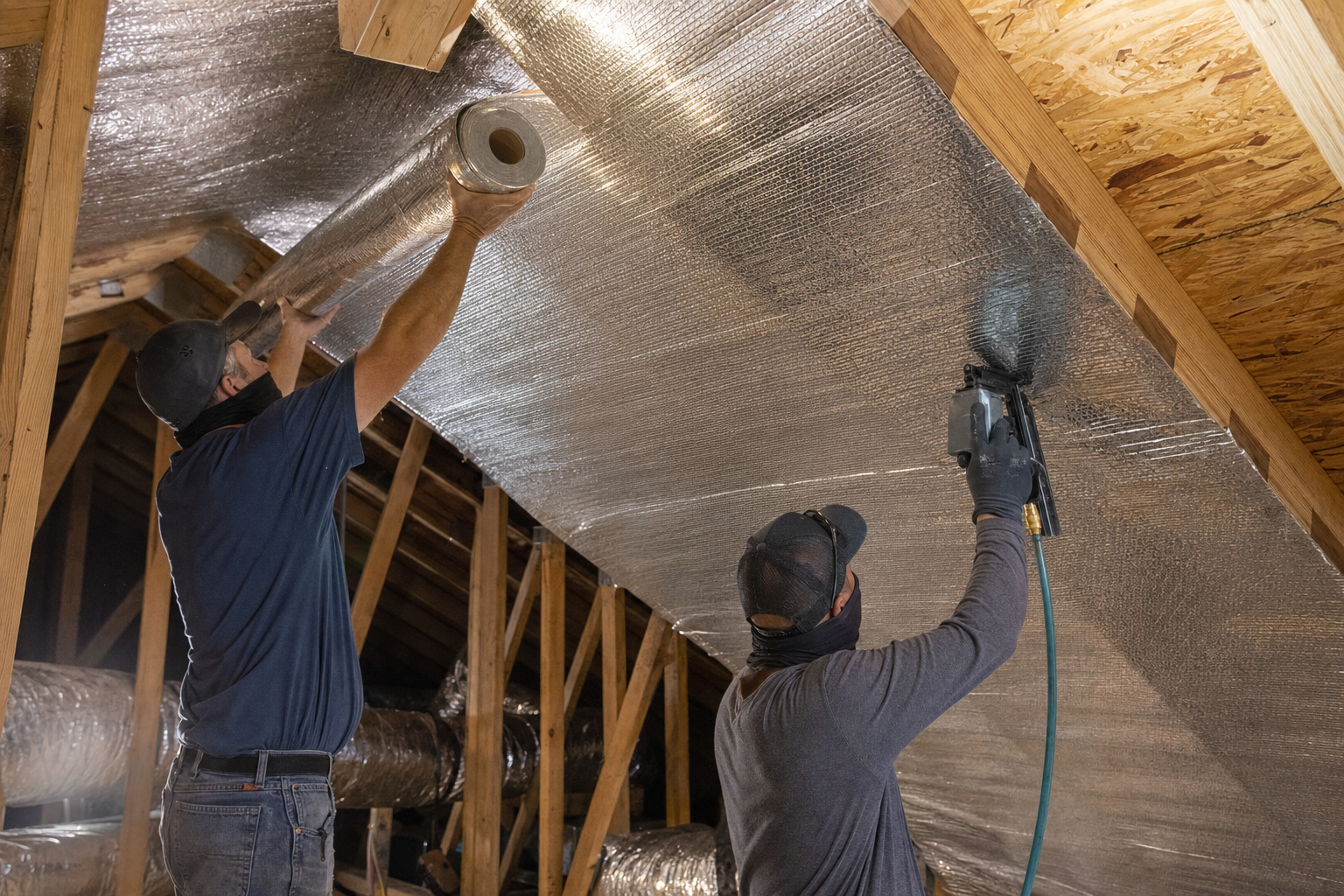
We tarp the pathway from the truck to the attic hatch, mask off can lights and HVAC penetrations, and stage rolls of perforated foil at the ridge.
Staple, verify, walk it
We staple foil to every rafter bay from ridge to soffit — keeping the air gap intact and ventilation open. We measure the deck temperature again before we leave, and you get a written before/after.
Answers to what most Houston homeowners ask.
Does radiant barrier actually work in Houston?
Do I still need attic insulation if I have radiant barrier?
Will it trap moisture in my attic?
Will it interfere with my roof warranty?
How much does it cost, and what’s the payback?
Can I install it myself?
How long does it last?
What if my roof deck is dark? Does that matter?
Ready to knock 15 to 30 degrees off your attic?
Free inspection with a before-and-after temperature reading. Same-day or next-day quotes. Flat pricing, no upsell.