
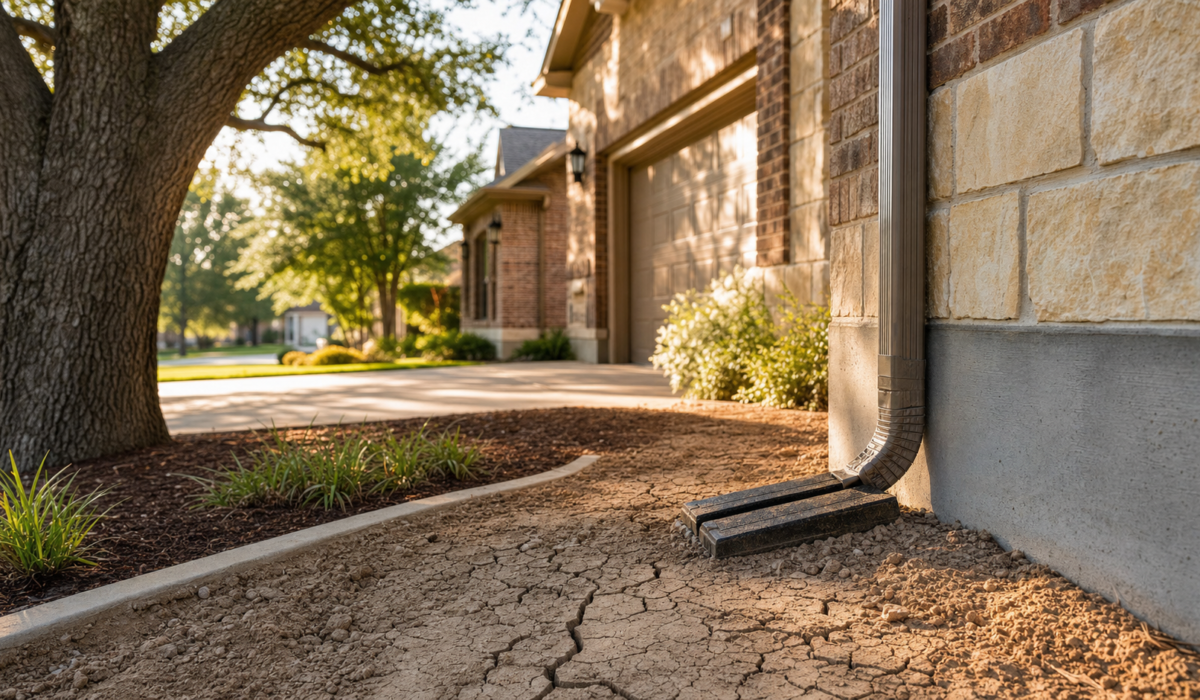
Houston homeowners tend to focus on the roof, the paint, and the landscaping when they think about home exterior care. What sits under all of it — the clay-heavy Gulf Coast soil — is quietly doing more damage to gutters, drainage, and trim than the more obvious culprits. The houston clay soil home exterior relationship is one of the least-discussed maintenance stories in Texas home ownership, and it becomes especially active during the long, dry stretches of August and September.
The DC Pines Roofing Education Center takes a closer look at how expansive clay soil behaves through a Houston summer, where the damage shows up first on a typical brick or fiber-cement home, and what routine attention keeps small issues from turning into expensive ones.
Why Houston Sits on Some of the Country’s Most Active Soil
The greater Houston metro is built on a broad band of expansive clay — soils rich in montmorillonite minerals that swell when they absorb water and shrink when they release it. Neighborhoods across Katy, Sugar Land, The Woodlands, Cypress, Pearland, and Bellaire all sit on variants of this same clay profile. Local soil-behavior classifications routinely rate the metro’s soils among the most active in the United States for seasonal movement.
Movement of a fraction of an inch under a foundation is easy to shrug off. Multiplied across an entire home footprint over the course of a summer, though, that movement translates into measurable shifts at every place the home meets the ground: driveways, walkways, splash blocks, downspout terminations, and any exterior element anchored to the wall near ground level.
Where the Damage Shows Up First
A homeowner rarely notices a foundation shifting a millimeter. What they do notice — if they look closely — is what happens at the ground-level transitions.
Splash-block separation
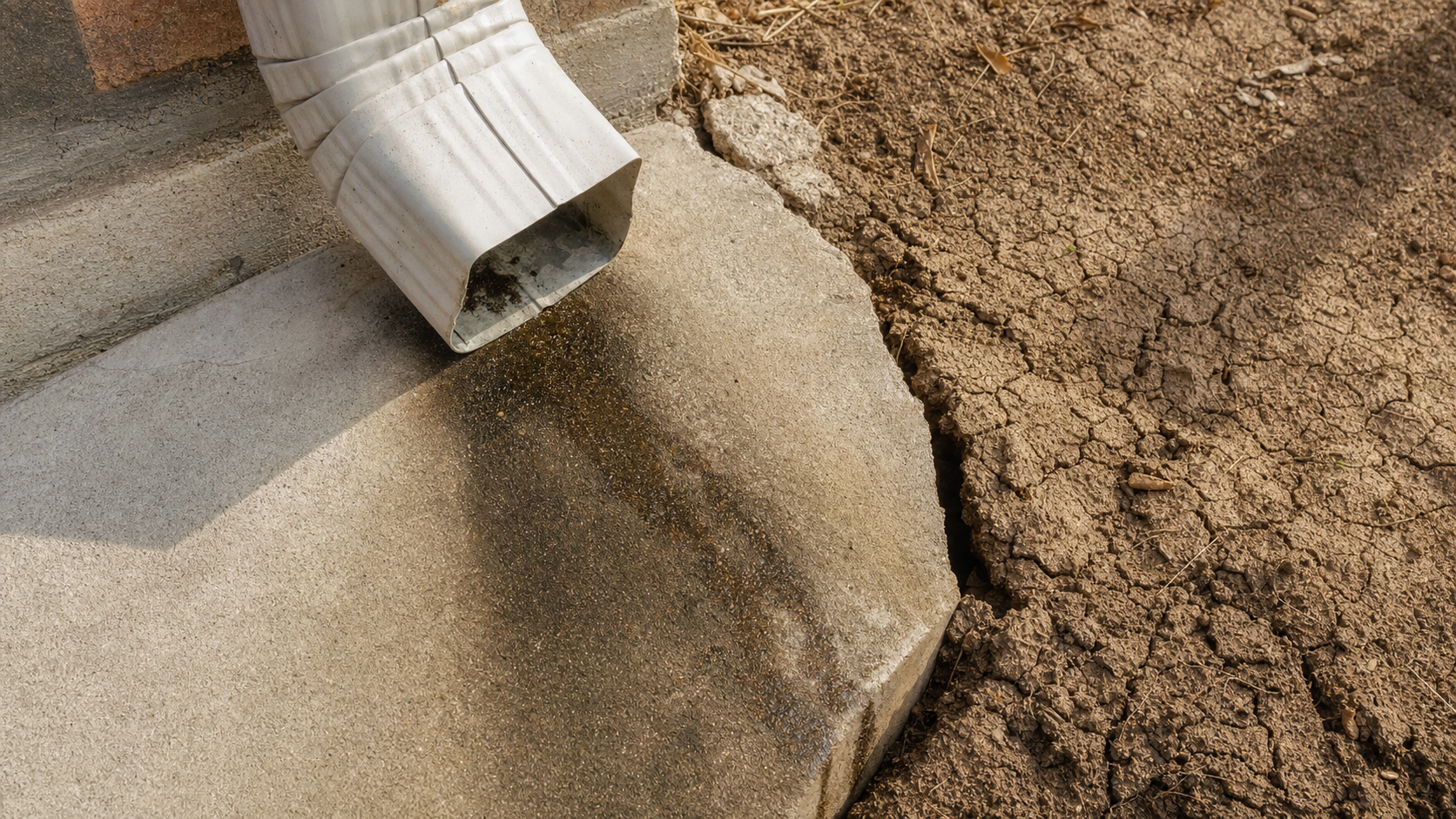
The concrete splash block at the base of a downspout is designed to sit flat on the soil so that discharged water spreads across the top and drains away from the foundation. When surrounding clay shrinks during a dry stretch, the block loses contact with the soil beneath it — the block stays put while the earth pulls back. The result is a small ledge that channels water directly against the foundation instead of away from it.
Downspout kick-out
Because the elbow at the base of a downspout is often only tacked to the wall with a single strap, movement of the splash block will slowly angle the downspout outward from the home. Over time, this “kick-out” means the downspout no longer discharges onto its splash block at all — a common sight on Houston homes that haven’t had a gutter tune-up in several years.
Caulk-line cracks at trim and brick
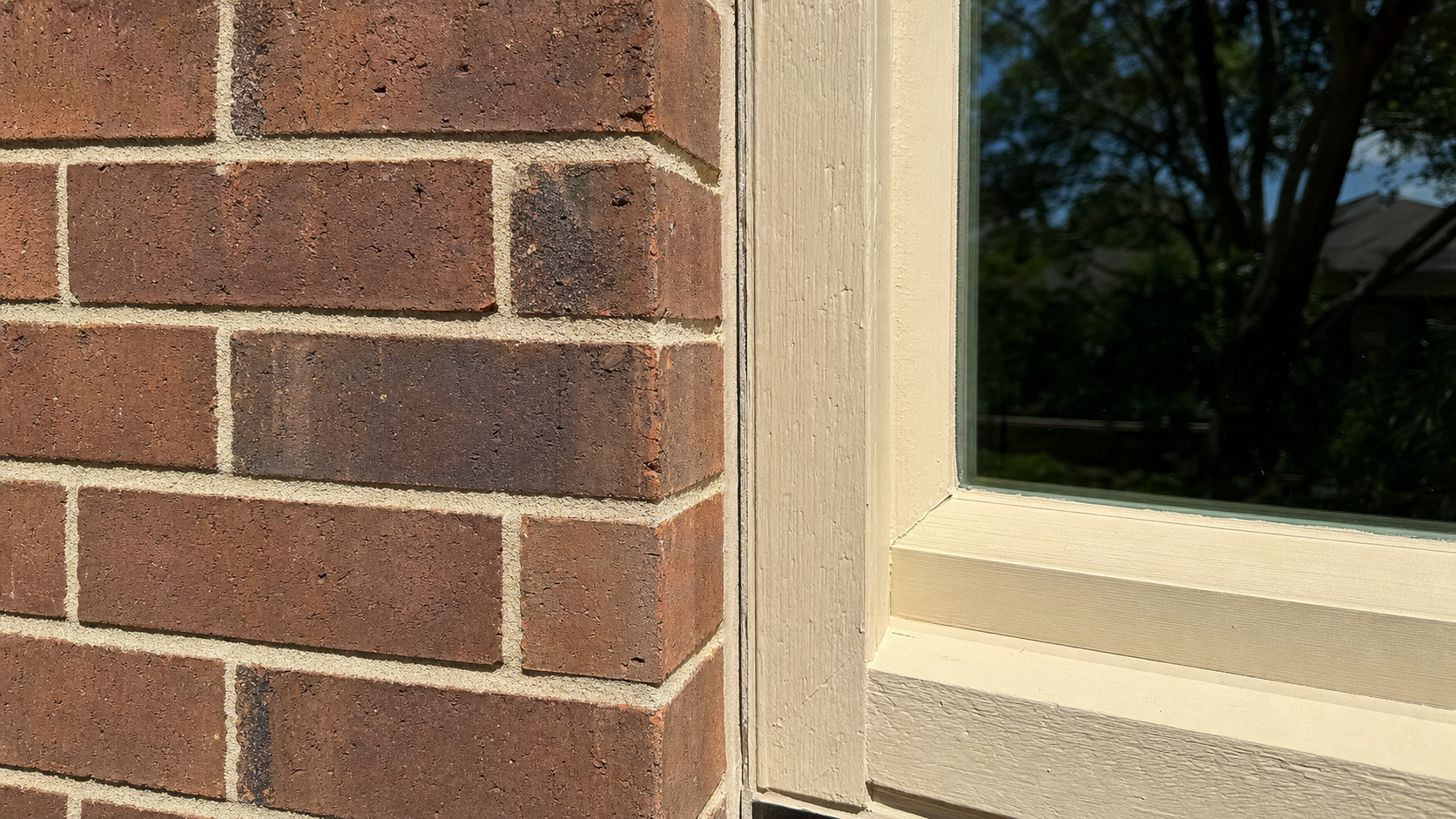
The exterior seams around windows, garage-door surrounds, and where brick meets siding are all sealed with elastomeric caulk. That caulk is engineered to stretch, but only up to a point. Repeated seasonal soil movement, combined with Houston’s temperature swings, eventually breaks the caulk bead. The result is a hairline gap that admits moisture and pests behind the trim.
The Water Cycle That Feeds the Problem
The frustrating part of clay-soil damage is that it accelerates the very drainage failures that cause more soil movement. Once a splash block loses contact with the ground, water pools at the foundation instead of flowing away. Pooled water saturates the clay directly under the foundation, which then swells while surrounding soil stays dry, creating uneven pressure. The next dry cycle exaggerates the movement further.
Well-functioning gutters and downspouts are the single most effective interruption to that cycle. A gutter system pitched correctly, with downspouts that extend at least four to six feet from the home, keeps roof runoff away from the foundation and gives the surrounding clay a chance to shift uniformly rather than in patches. For homeowners just starting to think about upgrades, the Education Center’s guide to Houston gutter maintenance covers the routine that keeps a gutter system doing its job through both wet and dry stretches.
Trim, Caulk, and Window Frames Feel It Next
The same forces that pull splash blocks off the soil also stress the seams around windows and doors. Once a caulk line separates, moisture wicks behind the trim, and if the framing is wood-based, slow rot begins. On the inside, this often shows up as a subtle draft near a window casing or a rise in cooling costs during peak Houston summer heat.
Homeowners often mistake this stage for a window failure. Sometimes it is; often it is not. For a walk-through of what actually indicates a window problem versus what points to a seal or trim issue, the Education Center’s window warning-signs guide is the right next read.
A Simple Late-Summer Walk-Around
Once a year, ideally in late August or early September when clay soil has been dry for weeks, a fifteen-minute walk around the home surfaces most issues before they compound. The checklist is short:
- Check every splash block — is it still flat against the ground?
- Look up each downspout — does it discharge cleanly onto its splash block or has it kicked outward?
- Trace the caulk lines around every ground-floor window and door — any hairline gaps forming?
- Look for cracks in the driveway or walkway that weren’t there in the spring.
- Note any spots where landscape edging or mulch has separated from the concrete or foundation.
None of these are emergencies on their own. Tracked over time, though, they tell the story of how a specific home is moving through the seasons — information a good contractor can use to make targeted, cost-effective repairs before a caulk gap becomes a rot repair.
Heat, Ventilation, and the Attic Connection
Late-summer soil movement doesn’t happen in isolation from the rest of the home’s exterior. A hot, poorly-ventilated attic can push shingle temperatures past 160°F, accelerating aging on the roof at the same time the soil beneath the home is at its most active. Homeowners curious about the attic side of this equation will find the Education Center’s guide to Houston attic ventilation useful — it covers why the ventilation upgrade is often the highest-ROI exterior improvement a Houston home can make.
The Bottom Line
Houston’s clay soil is patient. It doesn’t damage a home in one season or one storm — it works in fractions of inches, over years, at the seams and edges where the house meets the ground. The homeowners who pay attention to those seams once a year, keep their gutters and downspouts doing their job, and refresh caulk lines before they fully separate are the ones whose homes still look tight and dry at year fifteen. The rest usually find out the hard way, on a rainy October afternoon, that a small gap has been quietly widening since the previous August.
Gutters and drainage are the frontline defense against Houston clay-soil damage.
DC Pines Roofing installs seamless gutters, gutter guards, and drainage extensions engineered specifically for the way Houston homes and soils behave.